Exodus 34 - Renewal of the Covenant and the Second Tablets
Timeline: 1450 BC
|
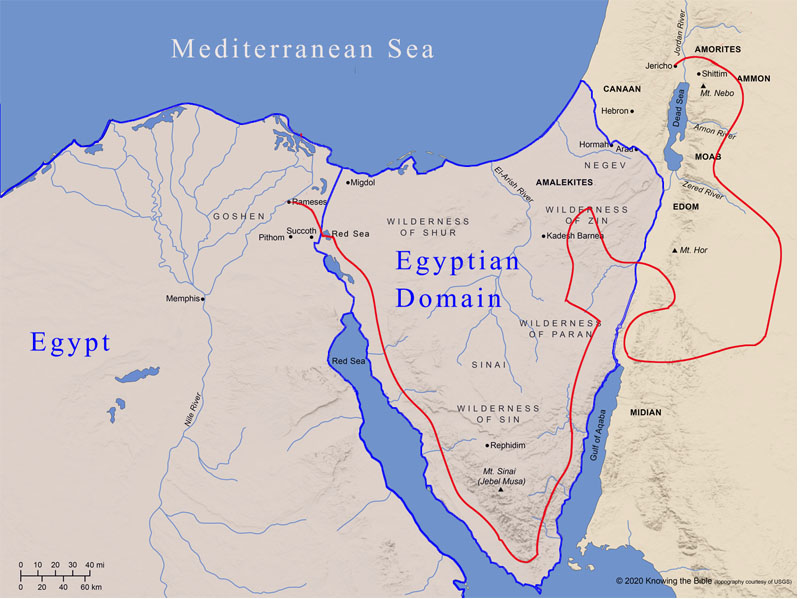
Israelite Journeys Rameses
|
Just as the Israelites sinned against the LORD during the time of Moses' original forty days of fasting on Mount Sinai, so now Moses prayed again on behalf of the people for the same amount of days in order to reverse the sinful consequences of their actions. God provided the first set of tablets, but now Moses is directed to cut a new set out of stone. These were to be a sign of the renewed covenant between the Lord and the Israelites. Exodus 34:1 And the Lord said to Moses, "Cut two tablets of stone like the first ones, and I will write on these tablets the words that were on the first tablets which you broke. So be ready in the morning, and come up in the morning to Mount Sinai, and present yourself to Me there on the top of the mountain."
The word "ark" means a "chest," a strong container made of wood and used to protect the tablets of stone from any damage or any loss, and to preserve the law. This was a temporary ark in which to keep the two tablets until the permanent one was built. Deuteronomy 9:25 "So I lay prostrate before the Lord for these forty days and forty nights, because the Lord had said he would destroy you. Exodus 34:3 And no man shall come up with you, and let no man be seen throughout all the mountain; let neither flocks nor herds feed before that mountain. This time he was to come alone. Not even Moses' faithful assistant Joshua is allowed to come along. And the beasts were kept away on the account of their keepers. Exodus 34:4 So he cut two tablets of stone like the first ones. Then Moses rose early in the morning and went up Mount Sinai, as the Lord had commanded him; and he took in his hand the two tablets of stone. It seems that Moses did not take the ark he had made up onto the mountain. Exodus 34:5 Now the Lord descended in the cloud and stood with him there, and proclaimed the name of the Lord. And the Lord passed before him and proclaimed, "The Lord, the Lord God, merciful and gracious, longsuffering, and abounding in goodness and truth, keeping mercy for thousands, forgiving iniquity and transgression and sin, by no means clearing the guilty, visiting the iniquity of the fathers upon the children and the children's children to the third and the fourth generation." The Lord proclaimed His name but there is only one thing that is held higher than the Lord's name:
God revealed to Moses the most hidden nature of God. In the Talmud, Rabbi Yehudah states that "a covenant was established regarding the 13 Attributes of God's Mercy:"
"…visiting the iniquity of the fathers upon the children and the children's children to the third and the fourth generation." Iniquity literally means 'twisting,' or 'something twisted,' and is thus the opposite of 'righteousness,' This doesn't mean that God holds the generations accountable for the father's sins, it is stating that sins of the fathers affect the children for generations. They learn to repeat our mistakes often to even greater degrees. However, when you sow faith, you can actually break the cycle.
Exodus 34:8 So Moses made haste and bowed his head toward the earth, and worshiped. Then he said, "If now I have found grace in Your sight, O Lord, let my Lord, I pray, go among us, even though we are a stiff-necked people; and pardon our iniquity and our sin, and take us as Your inheritance." As soon as God appeared, Moses immediately bowed down and worshipped Him. He agrees with God that the people are rebellious but He asks for mercy. Exodus 34:10 And He said: "Behold, I make a covenant. Before all your people I will do marvels such as have not been done in all the earth, nor in any nation; and all the people among whom you are shall see the work of the Lord. For it is an awesome thing that I will do with you. Observe what I command you this day. Behold, I am driving out from before you the Amorite and the Canaanite and the Hittite and the Perizzite and the Hivite and the Jebusite. The Israelites have already seen wonders that no one alive has seen today. From the plagues in Egypt to the parting of the Red Sea, they saw the power of God personally. What can surpass those marvels? God promised the Promised Land to the Israel nation. In order for that to happen, the inhabitants must be conquered. So God restored the broken covenant, as He promised to drive out all the idolatrous population, the seven nations, the Canaanites, Amorites, Hittites, Jebusites, Hivites, Perizzites, and Girgashites who currently occupy the land. In today's language, the word "awesome" means something excellent. However, in this passage, it refers to something inspiring an overwhelming feeling of fear. All the surrounding nations have heard of the Israelites who were redeemed to be God's people. They heard about the great deeds of terror that God did on behalf of His people. Now God shows the children of Israel even more of His great power. He commands them to listen and obey His words. Exodus 34:12 Take heed to yourself, lest you make a covenant with the inhabitants of the land where you are going, lest it be a snare in your midst. But you shall destroy their altars, break their sacred pillars, and cut down their wooden images (for you shall worship no other god, for the Lord, whose name is Jealous, is a jealous God), lest you make a covenant with the inhabitants of the land, and they play the harlot with their gods and make sacrifice to their gods, and one of them invites you and you eat of his sacrifice, and you take of his daughters for your sons, and his daughters play the harlot with their gods and make your sons play the harlot with their gods. God gave a clear and strong command to the Israelites not to worship or serve the gods of the nations that they will encounter in the Promised Land. They were to completely destroy the idols and sacred stones of the surrounding nations to make a statement of devotion to God. If they obeyed, God made them many promises. He promised to make bread and water more refreshing and nourishing, the continuance of their health, the increase of their wealth, prolonging of their lives to old age, and He promised to remove the Hivite, the Canaanite, and the Hittite, the present occupants of the land of Canaan, to make room for them. Some commentaries believe the word hornet was a metaphore. However others believe they were a sort of wasp that, when it stings a man, it throws him into the rage of a fever. If God drove all their enemies at once, the land would be desolate and uninhabitable. God drove them out slowly, and then He enabled the Hebrews to take over the land. Exodus 34:12 "You shall make no molded gods for yourselves. Do not make a molded gods of any kind that you will bow down and worship. An idol distracts a person from our living God. Think about what idols people worship today: People, money, astrology, Buddha, Crucifixes, rabbit's foot, and even the cross. Anything that we rely on for some blessing, or help, or guidance which takes the place of a wholehearted reliance on the true and living God is an idol. This does not mean we cannot make statues? God instructed Moses to make the cherubs and place them above the mercy-seat, the bronze snake put on a pole, and a lampstand of pure gold. However, do not bow to them and worship them. (See Exodus Chapter 20)Exodus 34:18 "The Feast of Unleavened Bread you shall keep. Seven days you shall eat unleavened bread, as I commanded you, in the appointed time of the month of Abib; for in the month of Abib you came out from Egypt. The Feast of Unleavened Bread began on Nisan 15, at twilight, the day after the Passover. This feast began on the Sabbath and lasted seven days until the next Sabbath. This festival memorialized that, because of having to leave Egypt in haste, the Israelites did not have enough time to let their dough be leavened. The number of days of the festival represents perfection and completeness. The Israelites who obeyed and worshiped a Merciful God were set free. This feast spoke of the purity God desired among Israel before Him, when all leaven – a symbol of sin – was put away and Israel walked in a symbolic purity. (See Exodus Chapter 12) Exodus 34:19 "All that open the womb are Mine, and every male firstborn among your livestock, whether ox or sheep. But the firstborn of a donkey you shall redeem with a lamb. And if you will not redeem him, then you shall break his neck. All the firstborn of your sons you shall redeem. The Israelites were to sacrifice every to the Lord the firstborn male of their clean domestic animals: cattle, sheep and goats. An unclean animal, such as a donkey being a beast of burden, could not be sacrificed. The word redeem means "buy back." If a family's firstborn donkey was critical to their livelihood, they could buy it back from God by offering a lamb in its place. The Israelites were required to sacrifice their firstborn males to the Lord, including their firstborn sons. God did not demand that His people offer their firstborn children as literal human sacrifices. The firstborn son was dedicated for holy service, for the sacred ministrations of the priestly office. This was in force until the Levis were selected to be the priests. However If a father wanted to exempt his son from service, he could redeem him by presenting an offering of five silver coins. (See Exodus Chapter 13) "And none shall appear before Me empty-handed.
When the Israelites left Egypt, they did not leave empty-handed. They acted on Moses' word and asked the Egyptians for articles of silver and gold, and for clothing, and the Lord gave the people such favor in the sight of the Egyptians that they granted their request. (See Exodus Chapter 12) Exodus 34:21 "Six days you shall work, but on the seventh day you shall rest; in plowing time and in harvest you shall rest. Once a week, on the seventh daythey must rest, even in ploughing time and in harvest. The rest of the sabbath was not to be violated. (See Exodus Chapter 31) Exodus 34:22 "And you shall observe the Feast of Weeks, of the firstfruits of wheat harvest, and the Feast of Ingathering at the year's end. The Feast of Weeks, aka Feast of Pentecost - one of the "harvest feasts when the Jews were commanded to "present an offering of new grain to the Lord." This time of celebration is known as Shavuot, which is the Hebrew word meaning "weeks." (See Exodus Chapter 23) The Firstfruits of Wheat Harvest - they were to bring a sheaf of the firstfruits to the priests for a wave offering. Feast of the Ingathering - when grains and fruits were gathered at the harvest's end recalling the days when the Israelites lived in tents during their years of wandering in the wilderness. (See Exodus Chapter 23) Exodus 34:24 For I will cast out the nations before you and enlarge your borders; neither will any man covet your land when you go up to appear before the Lord your God three times in the year. Although there were a total of seven feasts, all male Israelites were required to attend three of them. They were to remember their independence from slavery to Egypt by the mighty hand of God. During significant festivals and national events, God promises that no one will covet their land while they fulfill their religious duties. When God is prioritized, He provides for His people's needs and protects them from their enemies. In addition to God's added divine blessing, He would give them even more land. At first Canaan alone was occupied, but under David and Solomon the borders were greatly enlarged; and "Solomon reigned over all kingdoms from the river (Euphrates) unto the land of the Philistines, and unto the border of Egypt". (See Exodus Chapter 23) Exodus 34:25 "You shall not offer the blood of My sacrifice with leaven, nor shall the sacrifice of the Feast of the Passover be left until morning. These laws were intended to protect the Israelites from adopting idolatrous practices of neighboring nations. It was forbidden to include any kind of leaven in a blood sacrifice since leven was a picture of sin. If atonement was to be regarded as a complete work, everything must be given to God, not a portion reserved for later. (See Exodus Chapter 23) Exodus 34:26 "The first of the firstfruits of your land you shall bring to the house of the Lord your God. You shall not boil a young goat in its mother's milk." Giving God the first and the best honored Him as the Good Provider of all things. It was a command to not imitate the cruel pagan fertility rituals practiced among the Canaanites. (See Exodus Chapter 23) Exodus 34:27 Then the Lord said to Moses, "Write these words, for according to the tenor of these words I have made a covenant with you and with Israel." So he was there with the Lord forty days and forty nights; he neither ate bread nor drank water. And He wrote on the tablets the words of the covenant, the Ten Commandments. This was a completely unique and supernatural fast. A person cannot go more than nine days without water let alone for forty days and forty nights without water or food. One would dehydrate and die. Yet Moses was able to because the glory of God sustained him. (See Exodus Chapter 24) Exodus 34:29 Now it was so, when Moses came down from Mount Sinai (and the two tablets of the Testimony were in Moses' hand when he came down from the mountain), that Moses did not know that the skin of his face shone while he talked with Him. So when Aaron and all the children of Israel saw Moses, behold, the skin of his face shone, and they were afraid to come near him. Then Moses called to them, and Aaron and all the rulers of the congregation returned to him; and Moses talked with them. Afterward all the children of Israel came near, and he gave them as commandments all that the Lord had spoken with him on Mount Sinai. And when Moses had finished speaking with them, he put a veil on his face. But whenever Moses went in before the Lord to speak with Him, he would take the veil off until he came out; and he would come out and speak to the children of Israel whatever he had been commanded. And whenever the children of Israel saw the face of Moses, that the skin of Moses' face shone, then Moses would put the veil on his face again, until he went in to speak with Him. For the first time the face of Moses shines after communications with God. After such a remarkable fast we would expect that Moses looked pale and sickly. He communicated so directly with God that his face received some of this shining glory. Moses' face shined so that the children of Israel could not bear it. However, because Moses was a genuinely and deeply humble man, he was unaware of the greatness of his own spiritual radiance. Two other instances where the glory of God was shown on a face:
The Hebrew word for "shone" being used in this chapter is "qaran". It is closely connected with a word translated "horn"; and hence, the Latin version and others have rendered the verb "to be horned." Michaelangelo's statue at Rome represents Moses with horns on his forehead due to this interpretation. Aaron and the people were stricken with awe, and feared to approach him until he gave them words of encouragement. Perhaps their fear arose from a sense of guilt. After Moses had put a veil on his face he talked with them and told them all that had happened to him in the mount. When Moses went before God, he would remove the veil and when came out from the Lord he put it back on. We are not told how long this lasted, but presumably the glory began to fade when Moses was no longer regularly going into the presence of God. Unlike Moses, who wore a veil to conceal the temporary glory of the Old Covenant, we boldly proclaim the permanent glory of the New Covenant. A veil descends over the hearts of unbelieving people. Their vision is obscured, and they are hard of heart. The "veil" prevents them from seeing the true glory of God. The veil is only taken away when they turn to Christ. 1. How many tablets did God tell Moses to cut? 1. 1 2. What did he Lord say to Moses? 1.He would "visit the iniquity of the fathers upon the children and the children's children to the first and the second generation." 3. Whom did the Lord say He would drive out from the Promised Land? 1. Canaanite and the Hittite and the Termites and the Hivite and the Jebusite 4. What did Moses do when he got to the top of the mountain? 1. He looked up to heaven, and worshiped. 5. What did God tell Moses to do when he got into the Promised Land? 1. Cut down their wooden images. 6. What Feast did God tell them to keep in this passage? 1. The Feast of Tabernacles. 7. What was God talking about when He said, "All that open the womb are Mine"? 1. Every male firstborn from the Levites. 8. Six day they should work but what did they do on the seventh day? 1. They should plow. 9. How many times in the year shall all their men appear before the Lord God of Israel? 1. 1 10. What happened to Moses' face when he came down from the mountain? 1. His hair was on fire. Matt, Cassie, Joe |