Numbers 20 - Water from the Rock/Edom Refuses Passage/Death of Aaron
Timeline: 1407 BC
(Numbers 20:1-29)
|
Israelite Journeys Rameses
|
The first sermon in Deuteronomy recounts the forty years of wilderness wanderings which led to the time just before the Israelites entered the Promised Land.
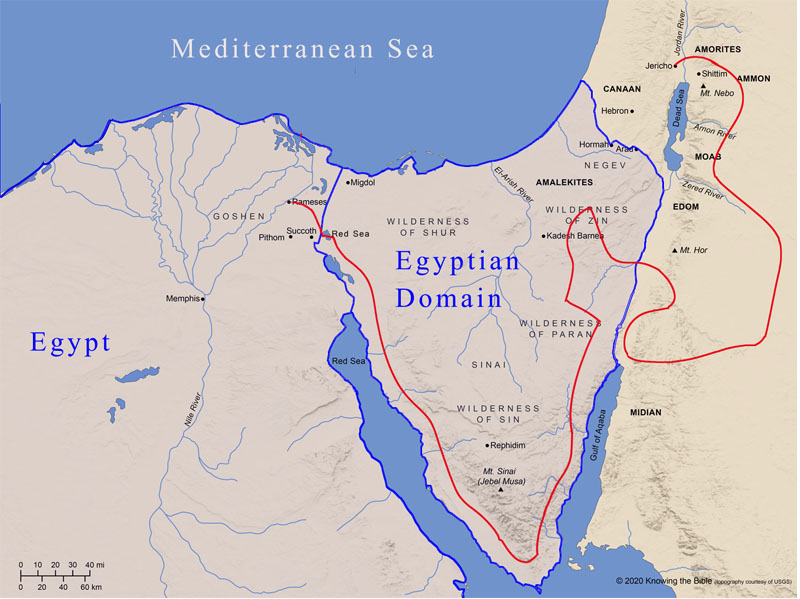
After the events of Chapter 19, the narrative jumps forward nearly four decades. During those 38 years, there was much movement – but no progress. This spans the wandering period where the entire first generation of rebellious Israelites (who refused to enter Canaan in Numbers 13-14) died off in the wilderness. The Israelites circled the hill country of Seir and then God commanded them to turn north toward the Promised Land. They returned to Kadesh in the Dessert of Zin situated on the southern border of the Promised Land of Canaan. Moses was 120, Aaron 123 and Miriam 127 years old. Water from the Rock Numbers 20:11 In the first month, the whole congregation of Israel entered the Wilderness of Zin and stayed in Kadesh. There Miriam died and was buried. the "first month" refers to the month of Nisan (originally called Abib) in the religious calendar. This corresponds to the early spring, usually falling in March or April on our modern calendar. According to the Targum of Jonathan, it was the beginning of the fortieth year. Miriam was Moses' older sister who watched over her infant brother in his papyrus basket on the Nile and arranged for their mother to nurse the baby when the Pharaoh's daughter retrieved him from the water to raise him as her own. After crossing the Red Sea she became known as a prophetess and a leader of the women of Israel. After Moses sang his song of deliverance, Miriam took up a timbrel (tambourine) and led all the women in a celebratory dance praising God for saving them from their enemies. Miriam's song is frequently recited during services that emphasize female leadership today. The sudden transition between Miriam's death and a sudden water shortage inspired the sages of the Talmud and Midrash (ancient Jewish commentaries and folklore) to fill in the narrative gaps. Although not explicitly in the Bible, the legend tells of a miraculous well of fresh water named "Miriam's Well" that followed the Israelites through the desert to sustain them. The story states that this started when Moses struck the rock at Horeb (Exodus 17:5-6), the water became a gift to the people through the merits of Miriam's goodness. A traveling rock in the shape of a sieve and the size of a beehive provided water for the Israelites continuously through their journeys through the desert. Water came out in a trickle from a narrow-necked jug and shot high up in the air like a geyser. This rock would roll up mountains and down into valleys in tandem with the Jews. When the people arrived in a new location, it rested close by on an elevated spot opposite the entrance to the Tent of Meeting. Miriam would speak and sing specific words and tunes. The leader of each Tribe took his staff to the well with a staff/stick draw a line in the dirt with the staff back to his tribe's location and chant these words to the well, "Spring up, O well, sing ye unto it; nobles of the people digged it by the direction of the lawgiver with their staves." The well would issue water through that delineating line thus supplying water for each of the Tribes. So long as she lived, the well was a fountain of living water that sustained the people. This source of strength and sustenance, however, dried up upon her death. The Israelites immediately complained to Moses and Aaron about their thirst, appearing to skip mourning Miriam entirely. The drying of the well, then, was God's way of reminding them of what they had lost. Perhaps because the people themselves failed to mourn due to an under-appreciation of the role women played in their redemption and survival. Upon the entrance to the Holy Land this well disappeared and was hidden in a certain spot of the Sea of Tiberias. It is said that standing upon Carmel, and looking over the sea, one can notice there a sieve-like rock, and that is the well of Miriam. Numbers 20:2 Now there was no water for the congregation, so they gathered against Moses and Aaron. The people quarreled with Moses and said, "If only we had perished with our brothers before the LORD! Why have you brought the LORD's assembly into this wilderness for us and our livestock to die here? Why have you led us up out of Egypt to bring us to this wretched place? It is not a place of grain, figs, vines, or pomegranates—and there is no water to drink!" It is estimated over 1 million of Israelites died in the wilderness before they came to Kadesh, however between 1.5 to 2 million people entered the Promised Land. The younger generation started making outrageous accusations, accusing Moses and Aaron of plotting the death of the people (and their animals). Instead of seeing the wilderness as the place of God's faithful and miraculous provision, they could only see the wilderness as the place that did not have the abundance of Canaan. Ironically, they would never come into the abundance of the land of Canaan unless they learned to trust God in the wilderness. Numbers 20:6 Then Moses and Aaron went from the presence of the assembly to the entrance to the Tent of Meeting. They fell facedown, and the glory of the LORD appeared to them. And the LORD said to Moses, "Take the staff and assemble the congregation. You and your brother Aaron are to speak to the rock while they watch, and it will pour out its water. You will bring out water from the rock and provide drink for the congregation and their livestock." Moses and Aaron often faced the complaints and grievances of the people and as was their usual practice, they went back to consult with God who gave them specific instructions. Back at Mount Sinai, God told Moses to strike the rock and water came out (Exodus 17:1-7). This time, God commanded Moses to only speak to the rock, holding the rod in his hand. Numbers 20:9 So Moses took the staff from the LORD's presence, just as he had been commanded. Then Moses and Aaron gathered the assembly in front of the rock, and Moses said to them, "Listen now, you rebels, must we bring you water out of this rock?" Then Moses raised his hand and struck the rock twice with his staff, so that a great amount of water gushed out, and the congregation and their livestock were able to drink. Perhaps Moses was frustrated and angered by the people's constant grumbling or maybe it was because he was grieving his sister's death, he lost control and struck the rock not once, but twice. God gave a precise instruction which he disobeyed. There were times when Moses had to be the messenger of God's anger, but this was not one of those times. Here, out of anger and frustration, Moses struck the rock twice. God graciously provided the water. Numbers 20:12 But the LORD said to Moses and Aaron, "Because you did not trust Me to show My holiness in the sight of the Israelites, you will not bring this assembly into the land that I have given them." Moses' words implied to the people that he and Aaron were the ones performing the miracle, which failed to honor God's holiness before the Israelites. Giving in to personal anger with the Israelites cost both Moses and Aaron a great deal. Even as a young man, Moses dreamed of seeing the Promised Land. Numbers 20:13 These were the waters of Meribah, where the Israelites quarreled with the LORD, and He showed His holiness among them. Because of their grumbling and testing of God, Moses called the place "Meribah", which means "quarrelling." Despite the disobedience of Moses and Aaron, God graciously provided the water demonstrating His grace and faithfulness. Edom Refuses Passage The Israelites' first attempt to enter Canaan was from the south (Numbers 14). Because they tried to enter against the command of the Lord, they failed and were exiled to gallivant in the wilderness for 40 years. Now the Lord declared an end to their wandering. So they reached Kadesh-Barnea, and prepared to enter the Promised Land from the south.
Israel wanted to go from Kadesh Barnea and head due East, then north. If they could pass straight through Edom, their journey would have taken roughly 1 to 3 weeks. So Moses reached out to the Edomites, asking for safe travel. Numbers 20:14 From Kadesh, Moses sent messengers to tell the king of Edom, "This is what your brother Israel says: You know all the hardship that has befallen us, how our fathers went down to Egypt, where we lived many years. The Egyptians mistreated us and our fathers, and when we cried out to the LORD, He heard our voice, sent an angel, and brought us out of Egypt. Now look, we are in Kadesh, a city on the edge of your territory. Please let us pass through your land. We will not go through any field or vineyard, or drink water from any well. We will stay on the King's Highway; we will not turn to the right or to the left until we have passed through your territory." The King of Edom was a descendant of Esau, Israel's brother. Esau held a profound grudge against his twin brother, Jacob (who was later renamed Israel) when their father gave patriarchal birthright and family blessing to Jacob rather than Esau (Genesis 25-28). Although the brothers reconciled, Esau's descendants continued a deeply personal, unrelenting bitterness toward the Israelites. Moses was well aware of the strife between his people and the Edomites, so he sought peaceful passage through Edom to avoid a battle. The King's Highway refers to a major, trade and military route linking Damascus, Egypt, Arabia, and the lands in between. It ran through the territories of Edom, Moab, Ammon, and Gilead. The Red Sea is on one side, the Gulf of Elath or Aqaba on the other side.
Numbers 20:18 But Edom answered, "You may not travel through our land, or we will come out and confront you with the sword." In a time also in which emigrations were frequent and universally allowed, it would have cost Edom nothing and would have been a genuine gesture of goodwill to let them, who were all their own near kinsmen, pass through their territory. But the Edomites refused, perhaps out of suspicion or fear. Numbers 20:19 "We will stay on the main road," the Israelites replied, "and if we or our herds drink your water, we will pay for it. There will be no problem; only let us pass through on foot." So Moses makes a final appeal. He was not begging or pleading, but trying to reason with the king of Edom assuring him there is nothing to fear. In dry, Eastern regions, water is so valuable that paying to use a well is a standard practice. Numbers 20:20 But Edom insisted, "You may not pass through." And they came out to confront the Israelites with a large army and a strong hand. So Edom refused to allow Israel to pass through their territory, and Israel turned away from them. Despite Israel's humble, highly accommodating terms (even offering to pay for water, the Edomite king aggressively rejected them. This refusal made the journey of the children of Israel much more discouraging and dangerous. They eventually went south to the Red Sea, east past the territory of Edom, then north, well east of the Kings Highway. If the Edomites had permitted the Israelites to pass through their territory on the King's Highway, their journey would not have taken approximately four months to reached Canaan. Deuteronomy 2:8 So we passed by our brothers, the descendants of Esau, who live in Seir. We turned away from the Arabah road, which comes up from Elath and Ezion-geber, and traveled along the road of the Wilderness of Moab. The Death of Aaron Numbers 20:22 After they had set out from Kadesh, the whole congregation of Israel came to Mount Hor. And at Mount Hor, near the border of the land of Edom, the LORD said to Moses and Aaron, "Aaron will be gathered to his people; he will not enter the land that I have given the Israelites, because both of you rebelled against My command at the waters of Meribah. Aaron and his son Eleazar and bring them up Mount Hor. Remove Aaron's priestly garments and put them on his son Eleazar. Aaron will be gathered to his people and will die there." Aaron was denied access to the Promised Land because He and Moses not give credit or honor to God for His miraculous power for the provision of water. Moses and Aaron stated, "Listen here you rebels! Must WE bring water for you out of this rock?" Moses and Aaron did not sanctify God in the eyes of Israel.
The expression "gathered to his people" traditionally refers to the peaceful passing of a righteous elder. Found throughout the early books of the Bible regarding figures like Abraham, Moses, and Jacob, it represents a core biblical belief that in Sheol (the realm of the dead), individuals are reunited with their ancestors. Apparently, the punishment for Aaron is not eternal damnation, only that he would not see the Promised Land. Numbers 20:27 So Moses did as the LORD had commanded, and they climbed Mount Hor in the sight of the whole congregation. After Moses had removed Aaron's garments and put them on his son Eleazar, Aaron died there on top of the mountain. Then Moses and Eleazar came down from the mountain. When the whole congregation saw that Aaron had died, the entire house of Israel mourned for him thirty days. Eleazar formally assumed the role of High Priest, succeeding his father, Aaron representing the critical succession of Israel's second High Priest from his father. The detailed instruction instructions for the hereditary nature of the priesthood in Israel, was established in the book of Exodus:
All of this clothing for priestly service shows that the Lord required holy consecration of his priests. This public transition on Mount Hor ensured a seamless continuation of Israel's priestly duties. In traditional Jewish customs, seven days was the standard length of mourning for a relative. However, extended 30-day periods were customary for highly esteemed or revered figures. It marked a dedicated window to grieve, process loss, and ultimately transition the community forward. Even today, Jewish tradition upholds the structured 30-day grieving process following the death of a loved one, guiding mourners through their loss. |