Numbers 14 — Israelites' Rebellion Leads to Wandering
Timeline: 1445 BC
|
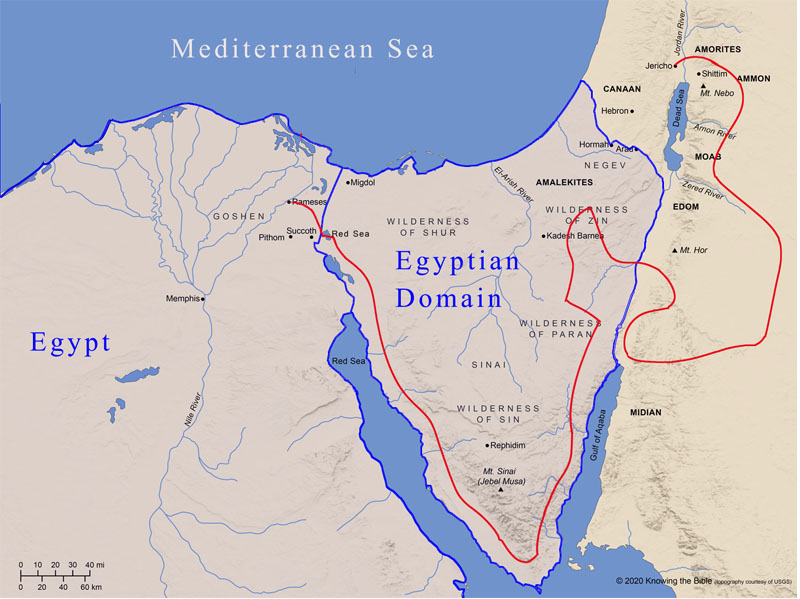
Israelite Journeys Rameses |
Numbers 14:1 Then the whole congregation lifted up their voices and cried out, and that night the people wept. All the Israelites grumbled against Moses and Aaron, and the whole congregation said to them, "If only we had died in the land of Egypt, or if only we had died in this wilderness! Why is the LORD bringing us into this land to fall by the sword? Our wives and children will become plunder. Would it not be better for us to go back to Egypt?"
This sentiment is reminiscent of a previous incident, where the Israelites complained about how they longed for the food in Egypt. "If only we had died by the Lord's hand in the land of Egypt!" (Exodus 16:3) Once again, their fear and unbelief overcame them. This pattern of complaining about difficult conditions and lack of trust in God began in Egypt and continued throughout their journey from Egypt to the Promised Land, despite miraculous provision and deliverance. Numbers 14:4 So they said to one another, "Let us appoint a leader and return to Egypt."
Forgetting the harsh conditions of slavery, they longed for the familiarity of Egypt each time they were faced with challenges. Being "stiff necked" is a metaphor used throughout the Bible to describe obstinacy and resistance to God's will. Numbers 14:5 Then Moses and Aaron fell facedown before the whole assembly of the congregation of Israel.
In ancient Near Eastern culture, falling face down was a gesture of deep humility, submission, and intercession, signifying deep reverence and earnest prayer, often in response to a crisis, anticipating God's great act of judgment. God promised the Israelites the land of Canaan and proved over and over again that He would be with His people. Moses tried to inspire the despondent people with courage and persuade them that God was bigger than all the giants in the land. Numbers 14:6 Joshua son of Nun and Caleb son of Jephunneh, who were among those who had spied out the land, tore their clothes and said to the whole congregation of Israel, "The land we passed through and explored is an exceedingly good land. If the LORD delights in us, He will bring us into this land, a land flowing with milk and honey, and He will give it to us. Only do not rebel against the LORD, and do not be afraid of the people of the land, for they will be like bread for us. Their protection has been removed, and the LORD is with us. Do not be afraid of them!" Joshua and Caleb tore their clothes to signify utter despair and/or extreme anguish over the people's blasphemy against God. They saw it with their own eyes. They were convinced God would lead His people into the Promised Land. The term "they will be like bread for us" is similar to our phrase "it will be a piece of cake" or something easily achieved. Numbers 14:10 But the whole congregation threatened to stone Joshua and Caleb. Stoning was a common form of execution for blasphemy or rebellion, indicating the severity of the people's anger.
The words spoken by Moses, Aaron, Joshua and Caleb didn't calm the people, but inflamed them even more. In spite of the warnings by Joshua and Caleb, the angry mob, swayed by fear and unbelief, willfully rebelled against them, forgetting God's power. Then the glory of the LORD appeared to all the Israelites at the Tent of Meeting. And the LORD said to Moses, "How long will this people treat Me with contempt? How long will they refuse to believe in Me, despite all the signs I have performed among them? I will strike them with a plague and destroy them—and I will make you into a nation greater and mightier than they are." Seeing the eminent danger to Joshua and Caleb, the Lord moved from above the Tent to right in front of it to rescue his faithful servants, and to stop the rage of the people. God's patience had reached a breaking point once again. The people's deep-seated lack of trust and outright spurning of God's promises and power, was a rejection of His very person. God confronted Israel, setting the stage for judgment. In His anger, He once again threatened to annihilate the Israelites and start over with Moses, replacing Abraham, Isaac, and Jacob's promise to make a nation from their descendants. Moses Intercedes for Israel Once again, Moses interceded with God on behalf of His people. Numbers 14:13 But Moses said to the LORD, "The Egyptians will hear of it, for by Your strength You brought this people from among them. And they will tell it to the inhabitants of this land. They have already heard that You, O LORD, are in the midst of this people, that You, O LORD, have been seen face to face, that Your cloud stands over them, and that You go before them in a pillar of cloud by day and a pillar of fire by night. Moses dismissed the offer to begin a new nation through him. Instead, he begged forgiveness for his people in order to spare God's own glory and reputation. The heathen nations, especially Egypt, have seen how God had shown his power and faithfulness to the Israelites. Numbers 14:15 If You kill this people as one man, the nations who have heard of Your fame will say, 'Because the LORD was unable to bring this people into the land He swore to give them, He has slaughtered them in the wilderness.' "If you kill this people as one man" means suddenly and at once. Moses asked God not to destroy his rebellious people, lest other nations mock him, saying he was weak, unable to finish what he began. Numbers 14:17 So now I pray, may the power of my Lord be magnified, just as You have declared: 'The LORD is slow to anger and abounding in loving devotion, forgiving iniquity and transgression. Yet He will by no means leave the guilty unpunished; He will visit the iniquity of the fathers upon their children to the third and fourth generation.' God's character, holiness and purpose do not change. The holiness of the Lord requires a just punishment of sin. A change in man's conduct, however, can influence how God responds. Prayer and intercession are one of the ways to bring salvation rather than judgment. Moses pleaded with God to show mercy to the people rather than inflicting immediate judgment for their rebellion. Moses' appeal was for God to extend His mercy and forgiveness, emphasizing the lasting impact of both divine punishment and grace that would affected their descendants. Numbers 14:19 Pardon, I pray, the iniquity of this people, in keeping with the greatness of Your loving devotion, just as You have forgiven them ever since they left Egypt." Moses recalls the numerous instances of God's forgiveness since the Exodus, highlighting God's promise that He would be patient and long-suffering with His people, despite their repeated failures. God's Forgiveness and Judgment Numbers 14:20 "I have pardoned them as you requested," the LORD replied. "Yet as surely as I live and as surely as the whole earth is filled with the glory of the LORD, not one of the men who have seen My glory and the signs I performed in Egypt and in the wilderness—yet have tested Me and disobeyed Me these ten times— not one will ever see the land that I swore to give their fathers. None of those who have treated Me with contempt will see it. God granted Moses' request to spare the Israelites from complete destruction, but still punished their lack of faith. The people, fearing their enemies more than God's anger, refused to enter the Promised Land of Canaan. As a consequence of their rebellion, God swore an oath ("As surely as I live") that they would receive the outcome they seemed to desire: dying in the wilderness instead of fighting for the land. Everyone aged twenty or older at that time, except for Joshua and Caleb who had remained faithful, died over the next thirty-eight years.
Although the exact list is not detailed in the text, many examples of the Israelites complaints have been recorded in the Bible; (See Israelites Complaints). Ten is used as the number of completeness and full measure. God is merciful but He can reach His limit for those who deliberately sin after knowing the truth, leading to judgment rather than mercy.
Numbers 14:24 But because My servant Caleb has a different spirit and has followed Me wholeheartedly, I will bring him into the land he has entered, and his descendants will inherit it. The term "servant" signifies a close relationship with God, highlighting Caleb's loyalty and dedication. Caleb's unique attitude and perspective set Caleb apart from the fearful majority. His spirit of faith, courage, and complete devotion to God resulted in the blessing that was denied to the rebellious generation. Numbers 14:25 Now since the Amalekites and Canaanites are living in the valleys, turn back tomorrow and head for the wilderness along the route to the Red Sea." A fearful army is an army that has already lost. This is why God commanded the Israelites to retreat; their fear and lack of faith had rendered them ineffective, meaning they were already defeated in their hearts before any physical battle had even begun. Numbers 14:26 Then the LORD said to Moses and Aaron, "How long will this wicked congregation grumble against Me? I have heard the complaints that the Israelites are making against Me. So tell them: As surely as I live, declares the LORD, I will do to you exactly as I heard you say. Your bodies will fall in this wilderness—all who were numbered in the census, everyone twenty years of age or older—because you have grumbled against Me. God expressed frustration with the Israelites due to their ongoing lack of faith and trust, a pattern that had persisted since their rescue from Egypt. The people's complaints were directed not only at Moses and Aaron, but ultimately at God, as they questioned His plan and power. God made their sin their ruin, He took them at their word, "If only we had died in the land of Egypt, or if only we had died in this wilderness!" So be it. He sentenced all the people who were over twenty to parish in the wilderness before they could enter the Promised Land. Since the Israelites counted those 20 and over, primarily for military purposes, the Levites were not subject to the same wilderness punishment as the other tribes who lacked faith. Numbers 14:30 Surely none of you will enter the land in which I swore to settle you, except Caleb son of Jephunneh and Joshua son of Nun. But I will bring your children, whom you said would become plunder, into the land you have rejected—and they will enjoy it. As for you, however, your bodies will fall in this wilderness. The people voiced their dissatisfaction, fearing their wives and children would be taken as spoils of war, "Our wives and children will become plunder". But God, in His mercy, did not let that happen. In addition to Joshua and Caleb, the next generation, their children, eventually entered and inherited the land.
The sentence on Moses was not passed when the people rebelled during their first encampment at Kadesh, but some 37 years later, when they had re-assembled in the same neighborhood at Meribah (see Numbers 20:13). The children under twenty were did not have the opportunity to make their own choices and therefore were not held accountable for the rebellion of their parents. Numbers 14:33 Your children will be shepherds in the wilderness for forty years, and they will suffer for your unfaithfulness until the last of your bodies lies in the wilderness. In keeping with the forty days you spied out the land, you shall bear your guilt forty years—a year for each day—and you will experience My alienation. "The sins of the father shall be visited upon the son." Because of the unfaithfulness of the Israelites, the children will suffer the consequences and spend forty years, counting the first year and a half, wandering in the wilderness, allowing their parents to parish. The "year-for-a-day" principle is a rule of biblical interpretation, often used in prophecy, suggesting that a day represents a literal year when measuring divine judgment or prophetic time. This concept is illustrated in several biblical passages, including Ezekiel 4:5-6 and Daniel 9:24-27, among others. Numbers 14:35 I, the LORD, have spoken, and I will surely do these things to this entire wicked congregation, which has conspired against Me. They will meet their end in the wilderness, and there they will die." God didn't abandon the whole nation. The immediate promise of the land was revoked only for that generation. God maintained His covenant, ensuring a new, faithful generation would be allowed to enter the land of Canaan. The Plague on the Ten Spies Numbers 14:36 So the men Moses had sent to spy out the land, who had returned and made the whole congregation grumble against him by bringing out a bad report about the land— those men who had brought out the bad report about the land—were struck down by a plague before the LORD. Of those men who had gone to spy out the land, only Joshua son of Nun and Caleb son of Jephunneh remained alive. The ten spies who exaggerated the challenges of conquering the land were executed. The term "struck down by a plague before the Lord" indicates a direct and immediate divine judgment. Joshua and Caleb were later rewarded for their faithfulness. Numbers 14:39 And when Moses relayed these words to all the Israelites, the people mourned bitterly. Mourning in the ancient Near Eastern culture often involved physical expressions of grief, such as tearing clothes or wearing sackcloth. The Israelites realized the gravity of their sin and consequences. Their regret was for the punishment but not true repentance for their sin. The Defeat at Hormah Numbers 14:40 Early the next morning they got up and went up toward the ridge of the hill country. "We have indeed sinned," they said, "but we will go to the place the LORD has promised."
In a frantic effort to avoid the punishment, they resolved to make amends by pressing forward into Canaan relying solely on their own strength, despite God having already made it clear He would not be with them.
Numbers 14:41 But Moses said, "Why are you transgressing the commandment of the LORD? This will not succeed! Do not go up, lest you be struck down by your enemies, because the LORD is not among you. For there the Amalekites and Canaanites will face you, and you will fall by the sword. Because you have turned away from the LORD, He will not be with you."
Moses tried to warn the stubborn, rebellious people. Ironically, when God was with them, they were afraid of the giants in the land. But when God was not with Israel, they thought they could conquer their enemies who dwelt in the country. Numbers 14:44 But they dared to go up to the ridge of the hill country, though neither Moses nor the ark of the covenant of the LORD moved from the camp. Then the Amalekites and Canaanites who lived in that part of the hill country came down, attacked them, and routed them all the way to Hormah. The Ark of the Covenant was a powerful symbol of God's dwelling presence, covenant relationship, and divine favor with Israel, particularly evident in battle, where its presence was believed to bring protection and victory. Moses refused to go with them, nor did he give them his blessing.
Because they did not obey God's decree not to go up and do battle, the rebellious people were overwhelmed by the inhabitants of the land. The incident took place in Hormah, named on account of the Canaanites' destruction at the hands of the Israelites.
The name Kadesh Barnea is thought to mean "the holy place of the desert of wandering." Some commentators believe that the Israelites returned to Kadesh after wandering around in the desert. However Biblical Archaeology gives a compelling argument that they spent most of the next thirty-eight years at the large oasis of Kadesh Barnea. The Bible, as we know it, is not arranged chronologically. The order reflects ancient Jewish tradition (Tanakh) compiled by various Jewish and Christian leaders, prioritizing theological meaning, rather than historical flow. Therefore, the majority of the events in the Book of Numbers probably occurred in and around Kadesh Barnea and the surrounding wilderness, where the Israelites spent nearly 38 years. |
| Cassie, Matt, Joe |