Numbers 11 — The Israelites Complain and are Punished.
Timeline: 1445 BC
|
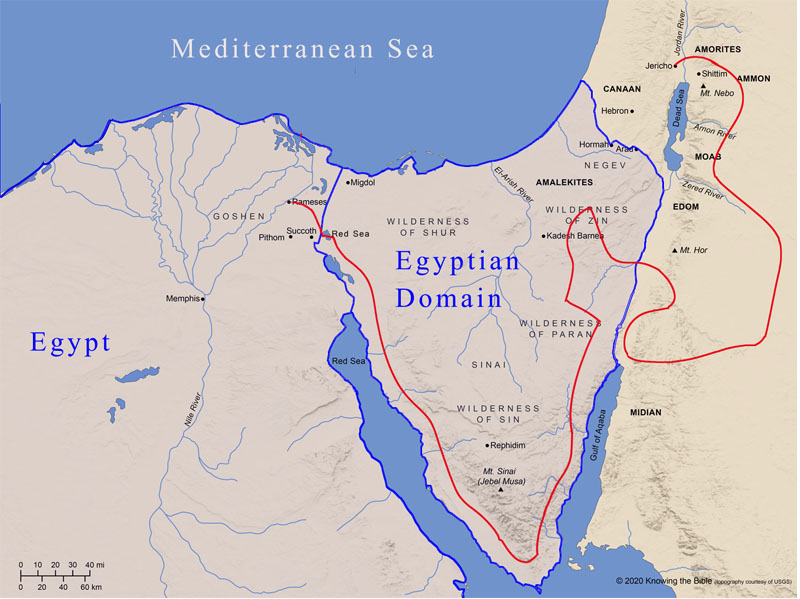
Israelite Journeys Rameses
|
The Complaints of the People Numbers 11:1 Soon the people began to complain about their hardship in the hearing of the LORD, and when He heard them, His anger was kindled, and fire from the LORD blazed among them and consumed the outskirts of the camp. And the people cried out to Moses, and he prayed to the LORD, and the fire died down. So that place was called Taberah, because the fire of the LORD had burned among them. The move from Sinai to Paran was a major transition for the people. They had spent a year at Mount Sinai enjoying God's provision (manna, water) and His divine presence, which led to complacency and a reluctance to move toward the Promised Land. The exhaustion and worry of the trek, coupled with the frightening landscape and uncertain path, were enough to break their nerves and spirits. Their hearts quickly shifted from gratitude to grumbling. They complained frequently and vocally at almost every stage of their wilderness journey which became a pattern of rebellion. God heard their murmurings which brought forth the wrath of God. He sent fire to the outskirts as a drastic measure to stop the spreading attitude of ingratitude and rebellion that threatened the entire nation's journey. Numbers 11:4 Meanwhile, the rabble among them had a strong craving for other food, and again the Israelites wept and said, "Who will feed us meat? We remember the fish we ate freely in Egypt, along with the cucumbers, melons, leeks, onions, and garlic. But now our appetite is gone; there is nothing to see but this manna!" The twelve tribes of Israel had specific, highly organized camping locations around the Tabernacle. The rabble, were most likely the lower end of Egyptian society who joined the Exodus from Egypt. They lived on outskirts of camp. They were the primary instigators of the complaints who persuaded the Israelites to sin against God. They constantly longed for the familiar food of Egypt, the meat, fish and the produce that grew abundantly in the rich soil of the Nile. Numbers 11:7 Now the manna resembled coriander seed, and its appearance was like that of gum resin. The people walked around and gathered it, ground it on a handmill or crushed it in a mortar, then boiled it in a cooking pot or shaped it into cakes. It tasted like pastry baked with fine oil. When the dew fell on the camp at night, the manna would fall with it. Manna looked like small, bead-like coriander seeds but had the appearance of gum resin, specifically bdellium, which was an aromatic substance, with a smooth, slightly shiny surface that could be gathered, ground, and cooked into cakes. The word "manna" literally means "what is it?" in Hebrew. Psalms describes manna as miraculous "bread of angels" that God rained down from opened "doors of heaven." Manna provided essential daily food in a desolate desert where natural food sources were scarce, ensuring the Israelites' survival during their 40-year journey. It contained all the necessary nutrients that met all the Israelites' physical needs during their journey. The supernaturally provided manna continued until they entered the Promised Land. The Complaint of Moses Numbers 11:10 Then Moses heard the people of family after family weeping at the entrances to their tents, and the anger of the LORD was kindled greatly, and Moses was also displeased.The widespread discontent among the people was infectious, spreading rapidly throughout the camp. The people's loud and persistent complaining was easily heard by Moses, who was understandably, and immensely, frustrated. He was overwhelmed by the sheer volume of their grievances, especially given the continuous challenges of leading such a rebellious and ungrateful group. Moses knew firsthand the severe consequences that would follow when God's anger was provoked by their lack of trust and constant grumbling. Numbers 11:11 So Moses asked the LORD, "Why have You brought this trouble on Your servant? Why have I not found favor in Your sight, that You have laid upon me the burden of all these people? Did I conceive all these people? Did I give them birth, so that You should tell me, 'Carry them in your bosom, as a nurse carries an infant,' to the land that You swore to give their fathers? Moses, burdened by the immense difficulty of leading a constantly complaining and rebellious people, directly expressed his deep frustration to God. Despite his underlying faith and commitment to his mission, he questioned his role as their leader and was overwhelmed by their incessant grumbling and demands. Numbers 11:13 Where can I get meat for all these people? For they keep crying out to me, 'Give us meat to eat!' Moses demonstrated profound empathy and a strong sense of responsibility toward his people; rather than ignoring their distress, he took their needs upon himself, striving to satisfy their desires much like a devoted parent would seek to appease their children. Numbers 11:14 I cannot carry all these people by myself; it is too burdensome for me. If this is how You are going to treat me, please kill me right now—if I have found favor in Your eyes—and let me not see my own wretchedness." Moses, feeling completely overwhelmed and inadequate in his leadership role, declared, "I quit!" He had reached a breaking point where the ongoing failure and suffering he witnessed made him wish for death rather than continue in despair. Even prominent figures of faith such as Job and Elijah, had experienced moments of extreme despair, reaching their absolute limit and wishing for death. Seventy Elders Anointed Numbers 11:16 Then the LORD said to Moses, "Bring Me seventy of the elders of Israel known to you as leaders and officers of the people. Bring them to the Tent of Meeting and have them stand there with you. In ancient cultures, leadership positions were held by elders who were often men with past experience. Within the early Christian church, the role of elders often became synonymous with that of pastors, serving as the primary local church leaders. The number 70 combines 7 (perfection) and 10 (completion/law), symbolizing perfection or completeness, a "perfect spiritual order". Numbers 11:17 And I will come down and speak with you there, and I will take some of the Spirit that is on you and put that Spirit on them. They will help you bear the burden of the people, so that you do not have to bear it by yourself. Moses had forgotten his father-in-law Jethro's advice to delegate responsibility. God reiterated the wisdom of shared leadership by commanding Moses to assemble a council of seventy capable, trustworthy elders who feared God to help bear the spiritual burden. Jewish scholars believe this council of 70 elders served as the foundational model for the later development of the Sanhedrin, the supreme judicial body of ancient Israel. Numbers 11:18 And say to the people: Consecrate yourselves for tomorrow, and you will eat meat, because you have cried out in the hearing of the LORD, saying: 'Who will feed us meat? For we were better off in Egypt!' Therefore the LORD will give you meat, and you will eat. You will eat it not for one or two days, nor for five or ten or twenty days, but for a whole month—until it comes out of your nostrils and makes you nauseous—because you have rejected the LORD, who is among you, and have cried out before Him, saying, 'Why did we ever leave Egypt?'" Be careful what you wish for! The people lusted after, wept for, and could not be happy without meat. These were the tears of ungrateful and complaining people. They regretted leaving Egypt, forgetting how hard it was in their bondage. They were consumed by negativity so that they failed to realize that what they perceived as good fortune was actually a punishment. Moses told them to prepare, purify, and set themselves apart for the next day, signifying spiritual readiness for God's action. Consecrating rituals often involving things like washing, confessing grumbling, and renewing gratitude. Numbers 11:21 But Moses replied, "Here I am among 600,000 men on foot, yet You say, 'I will give them meat, and they will eat for a month.' If all our flocks and herds were slaughtered for them, would they have enough? Or if all the fish in the sea were caught for them, would they have enough?" The Israelites did have livestock with them, as they had animals for sacrifices and likely for other purposes. However, they did not—or could not—eat the animals from their flocks. They may have chosen not to eat meat from their livestock for several reasons, including: They had to reserve animals for essential sacrifices to God. The flocks wouldn't be replenished fast enough to sustain the rate of consumption. There was such a significant population relative to the amount of livestock that the meat supply would have run out within a single month. The livestock was a symbol of wealth and status, and killing them for immediate consumption would have been a devastating blow to their economic stability after they entered the Promised Land. They had to preserve their livestock as a valuable resource for their future in the promised land. Egypt had a system in effect wherein they worshiped many animals, cattle among them. Soon after the exodus from Egypt, the children of Israel even worshiped a golden calf, fashioned by Aaron in the absence of Moses. It's possible they were so steeped in Egyptian ways that they couldn't bring themselves to eat animals they worshiped. Numbers 11:23 The LORD answered Moses, "Is the LORD's arm too short? Now you will see whether or not My word will come to pass." Moses' doubt wasn't a lack of belief in God's goodness, he was overwhelmed by the people's demands and couldn't see how God could possibly feed such a vast number of people. So God rebuked Moses, reminding him that God's power is not limited by human constraints or understanding. Numbers 11:24 So Moses went out and relayed to the people the words of the LORD, and he gathered seventy of the elders of the people and had them stand around the tent. Then the LORD came down in the cloud and spoke to him, and He took some of the Spirit that was on Moses and placed that Spirit on the seventy elders. As the Spirit rested on them, they prophesied—but they never did so again. A prophet's primary role is to communicate God's will and word to the people, both to warn of consequences if people didn't repent and to guide them toward God's will. The Spirit was upon Moses, establishing him as God's representative. He was given the wisdom needed to guide the Israelites through their journey and challenges. God appointed seventy elders, enabling them with His Spirit to share in leadership duties, address difficult legal matters, and manage public grievances. This distribution of responsibility significantly lightened Moses's burden, ensuring he did not have to bear the full weight of the people's complaints and the challenges of governance by himself. Numbers 11:26 Two men, however, had remained in the camp—one named Eldad and the other Medad—and the Spirit rested on them. They were among those listed, but they had not gone out to the tent, and they prophesied in the camp. A young man ran and reported to Moses, "Eldad and Medad are prophesying in the camp." Two of the elders selected to assist Moses were absent when the Spirit of God descended upon the assembly at the tabernacle. Their inclusion on the list implies they were respected community leaders chosen for their wisdom and capacity to share the responsibility of leadership. The Targum of Jonathan identifies these men, Eldad and Medad, as Moses' maternal half-brothers. Although they did not join the gathering at the tent—likely detained by some necessary duty—they still received the divine spirit and remained faithful to God's calling. Numbers 11:28 Joshua son of Nun, the attendant to Moses since youth, spoke up and said, "Moses, my lord, stop them!" "Yehoshua," of the tribe of Ephraim (translated as "Joshua" in English), was originally named Hoshea. Moses renamed him, symbolizing his role as a divine savior for the people. Joshua was the political, military, and spiritual leader of Israel and Moses' devoted attendant. Numbers 11:29 But Moses replied, "Are you jealous on my account? I wish that all the LORD's people were prophets and that the LORD would place His Spirit on them!" Joshua wished the individuals to be merely restrained moving forward, not punished. Moses, far from feeling threatened or envious by the gifts of others, embraced their abilities, confident that the Spirit they possessed came from God. This demonstrates Moses' profound meekness and humility. The individuals in question were exercising their spiritual gifts of prayer, preaching, and praising God, speaking under the influence of the Holy Spirit. Numbers 11:30 Then Moses returned to the camp, along with the elders of Israel. Moses returned from the area near the Tent of Meeting where he was appointing leaders, back to the main camp, accompanied by the newly appointed elders. The Quail and the Plague Numbers 11:31 Now a wind sent by the LORD came up, drove in quail from the sea, and brought them near the camp, about two cubits above the surface of the ground, for a day's journey in every direction around the camp. All that day and night, and all the next day, the people stayed up gathering the quail. No one gathered less than ten homers, and they spread them out all around the camp. There is a species of quail that migrates from Northern Europe through The Sinai Peninsula near the sea. Because of their short wings, they fly within 3-4 feet above the ground. God gave the people exactly what they wanted. An uncommon strong wind redirected them within a day's walk all around the camp. The people spent the next 36 hours gathering about 86 gallons, which was enough quail to last for about a month. This is not the first time God provided meat for the Israelites. In Exodus 16, the people complained about not having meat and He sent quail, although not in the same quantity. The difference here is that they were not satisfied with God's blessing and became lustful and glutinous. Numbers 11:33 But while the meat was still between their teeth, before it was chewed, the anger of the LORD burned against the people, and the LORD struck them with a severe plague. So they called that place Kibroth-hattaavah, because there they buried the people who had craved other food. Because of their lack of faith and greed, a severe plague struck the people while they were eating, killing many. Overindulgence of meat, especially spoiled, under-cooked, or contaminated meat, can cause severe illness and death from food poisoning, for example, E. coli, Salmonella, Listeria and C. perfringens. Those who suffered and died from the plague were buried in Kibroth-hattaavah which means "Graves of Craving/Lust" in Hebrew. Some historical sources suggest that around 23,000 people died from the plague. Numbers 11:35 From Kibroth-hattaavah the people moved on to Hazeroth, where they remained for some time. After a stay of at least a month at Kibroth-hattaavah, the travelers moved on to Hazeroth, a location approximately forty miles northeast of Sinai in the northeastern Sinai Peninsula. They remained camped at Hazeroth, a name that translates to "lacking" in Hebrew. |
| Cassie, Matt, Joe |