Leviticus - Aaron and His Sons Consecrated
Timeline: 1451 BC
(Leviticus 8:1-36, Numbers 8:5-15, Numbers 8:20-22)
|
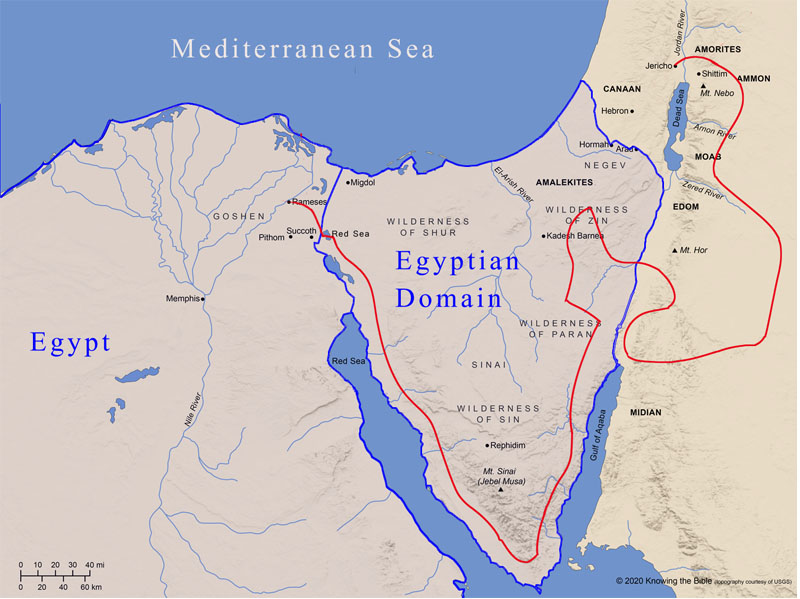
Israelite Journeys Rameses
|
One year after the Israelites left Egypt, the tabernacle has been built, the laws concerning sacrifices have been given and now it is time to ordain the priests.
Moses first received the orders to consecrate Aaron and his sons when he was on mount Sinai. Now he has now been commanded by God to perform the ordination ceremony and give some of his duties over to his brother Aaron and his sons. All the objects Moses brought are described in detail in Exodus 25:31-40. Leviticus 8:4 So Moses did as the Lord commanded him. And the congregation was gathered together at the door of the tabernacle of meeting. And Moses said to the congregation, "This is what the Lord commanded to be done." The door of the tabernacle was located inside the white linen fence. There surely was not enough room for the entire congregation so undoubtedly only the leaders of the tribes were there to eye-witness the ceremony. The rest of the congregation was probably in attendance outside the fence where they could hear the ordination taking place. Leviticus 8:6 Then Moses brought Aaron and his sons and washed them with water. And he put the tunic on him, girded him with the sash, clothed him with the robe, and put the ephod on him; and he girded him with the intricately woven band of the ephod, and with it tied the ephod on him. Then he put the breastplate on him, and he put the Urim and the Thummim in the breastplate. And he put the turban on his head. Also on the turban, on its front, he put the golden plate, the holy crown, as the Lord had commanded Moses. As God's chosen leader, Moses performed the ordination ceremony according to divine instructions. Physical washing was symbolic of purification and spiritual cleansing. In the New Testament, this is paralleled by baptism. Prior to coming to the ceremony, they would have bathed and then Moses washed their hands and feet in the lever as they stood outside the door of the tabernacle. This was necessary so that they may safely enter the realm of the sacred. Leviticus 8:10 Also Moses took the anointing oil, and anointed the tabernacle and all that was in it, and consecrated them. He sprinkled some of it on the altar seven times, anointed the altar and all its utensils, and the laver and its base, to consecrate them. And he poured some of the anointing oil on Aaron's head and anointed him, to consecrate him. Then Moses poured holy anointing compounded specially mixed by a perfumer upon his head. The ointment consisted of olive oil that was mixed with liquid myrrh, cinnamon, cane, and cassia (which is similar to cinnamon but from a different plant). The psalms indicate that no oil was spared in this ritual, for it ran down his beard and to the hem of his garment. Leviticus 8:13 Then Moses brought Aaron's sons and put tunics on them, girded them with sashes, and put hats on them, as the Lord had commanded Moses. 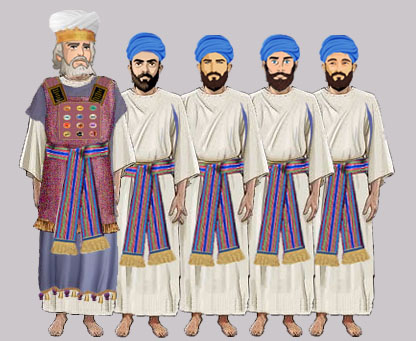 Every aspect of the priests' attire and actions symbolized their unique relationship with God and their role as mediators between Him and the people. Leviticus 8:14-17 And he brought the bull for the sin offering. Then Aaron and his sons laid their hands on the head of the bull for the sin offering, and Moses killed it. Then he took the blood, and put some on the horns of the altar all around with his finger, and purified the altar. And he poured the blood at the base of the altar, and consecrated it, to make atonement for it. Then he took all the fat that was on the entrails, the fatty lobe attached to the liver, and the two kidneys with their fat, and Moses burned them on the altar. But the bull, its hide, its flesh, and its offal, he burned with fire outside the camp, as the Lord had commanded Moses. Normally, when a person brings a sacrifice, he is the one who slays the animal. In this case however, Moses is the one who kills it. the Aaron and his sons put their hands on the head of the bull, to representative the transfer their impure nature and sin to the bull. They made confession of sin and then sacrificed the young bull, thus making atonement. The altar was sanctified with the blood of the sin offering in which some of the blood is smeared on the horns of the altar while the rest poured in a receptacle that protruded around the altar, around a foot and a half above the ground. After the sacrifice, the choicest parts were burned on the altar, the juice from the fat added fuel to the fire. This was a pleasing aroma to the Lord, signifying their acceptance of its substitution. The rest was destroyed outside the camp. Burning the remains of the bull outside the camp symbolized that the sacrifice separated the people from their sins. Leviticus 8:18 Then he brought the ram as the burnt offering. And Aaron and his sons laid their hands on the head of the ram, and Moses killed it. Then he sprinkled the blood all around on the altar. And he cut the ram into pieces; and Moses burned the head, the pieces, and the fat. Then he washed the entrails and the legs in water. And Moses burned the whole ram on the altar. It was a burnt sacrifice for a sweet aroma, an offering made by fire to the Lord, as the Lord had commanded Moses. The ram was cut into pieces, so it could fit entirely on the altar at one time. The internal organs and legs of the ram were washed reflecting the idea of complete and pure offerings. The whole animal was to be consumed by fire as opposed to other sacrificial animals being partially consumed. The combination of both the sacrificial blood and the anointing oil were designed to ensure that they were fully prepared and sanctified for their sacred duties. This total consecration is a reminder that service to God is not just about performing religious duties; it involves a complete commitment of the heart, mind, and body. Leviticus 8:22 And he brought the second ram, the ram of consecration. Then Aaron and his sons laid their hands on the head of the ram, and Moses killed it. Also he took some of its blood and put it on the tip of Aaron's right ear, on the thumb of his right hand, and on the big toe of his right foot. Then he brought Aaron's sons. And Moses put some of the blood on the tips of their right ears, on the thumbs of their right hands, and on the big toes of their right feet. And Moses sprinkled the blood all around on the altar. Then he took the fat and the fat tail, all the fat that was on the entrails, the fatty lobe attached to the liver, the two kidneys and their fat, and the right thigh; and from the basket of unleavened bread that was before the Lord he took one unleavened cake, a cake of bread anointed with oil, and one wafer, and put them on the fat and on the right thigh; and he put all these in Aaron's hands and in his sons' hands, and waved them as a wave offering before the Lord. Then Moses took them from their hands and burned them on the altar, on the burnt offering. They were consecration offerings for a sweet aroma. That was an offering made by fire to the Lord. And Moses took the breast and waved it as a wave offering before the Lord. It was Moses' part of the ram of consecration, as the Lord had commanded Moses. The third sacrifice was a ram of ordination. It began by slaughtering the ram, allowing them again to identify with the animal that it was dying instead of them. The blood that was applied to Aaron and his sons symbolized a total consecration of their life to God. The ear represented the priests' need to listen to God's word. The thumb of the right hand symbolized the diligence in the sacred ministry carrying out God's commands. The big toe of the right foot represented their walk and the direction of their lives, indicating that their entire journey and lifestyle were to be dedicated to God. Leviticus 8:30 Then Moses took some of the anointing oil and some of the blood which was on the altar, and sprinkled it on Aaron, on his garments, on his sons, and on the garments of his sons with him; and he consecrated Aaron, his garments, his sons, and the garments of his sons with him. The combination of both the sacrificial blood and the anointing oil were designed to ensure that they were fully prepared and sanctified for their sacred duties. This total consecration is a reminder that service to God is not just about performing religious duties; it involves a complete commitment of the heart, mind, and body. Leviticus 8:31 And Moses said to Aaron and his sons, "Boil the flesh at the door of the tabernacle of meeting, and eat it there with the bread that is in the basket of consecration offerings, as I commanded, saying, 'Aaron and his sons shall eat it.' What remains of the flesh and of the bread you shall burn with fire. And you shall not go outside the door of the tabernacle of meeting for seven days, until the days of your consecration are ended. For seven days he shall consecrate you. As he has done this day, so the Lord has commanded to do, to make atonement for you. Therefore you shall stay at the door of the tabernacle of meeting day and night for seven days, and keep the charge of the Lord, so that you may not die; for so I have been commanded." The ordination process was detailed and rigorous. They were to stay at the entrance of the tent for seven days. The seven days symbolize completeness and perfection. The daily sin offering involved various sacrifices, rituals, and symbolic acts that set Aaron and his sons apart for their holy duties. Leviticus 8:6 So Aaron and his sons did all the things that the Lord had commanded by the hand of Moses. Everything was done that was ordered, and in the manner in which it was prescribed. Aaron and his sons underwent a ritual cleansing process, which symbolized spiritual and physical purification. It signified spiritual cleansing and dedication to God's service. Following the priests' consecration, Moses brought the rest of the tribe of Levi forward and consecrated them for service.
Just as Aaron and his sons underwent a cleansing process, so too did the Levites have to be purified through a similar ritual in preparation for their service to the Lord.
The Israelites laid their hands on the Levites, which was a symbolic act of transferring responsibility and acknowledging them as the people's representatives before the Lord. Subsequently, the Levites laid their own hands on the heads of the sacrificial bulls for a sin offering and a burnt offering.
Aaron and his sons held the specified portions from the bull and "waved" or lifted up once before the Lord as a symbolic gesture of dedication of the priests to their new role and to God. After being waved, the portions were returned to Moses, who then burned them on the altar with the burnt offering, completing the ordination sacrifice. Once Aaron and his sons were anointed as priests, the rest of the tribe of Levi was also consecrated to serve in the Tabernacle. This consecration made them substitutes for the firstborn sons of all the tribes of Israel, dedicating them to the service of the Lord. |
| Cassie, Matt, Joe | |