Genesis 46 – Jacob and Family to Egypt
Timeline: 1705 BC
Resources
|
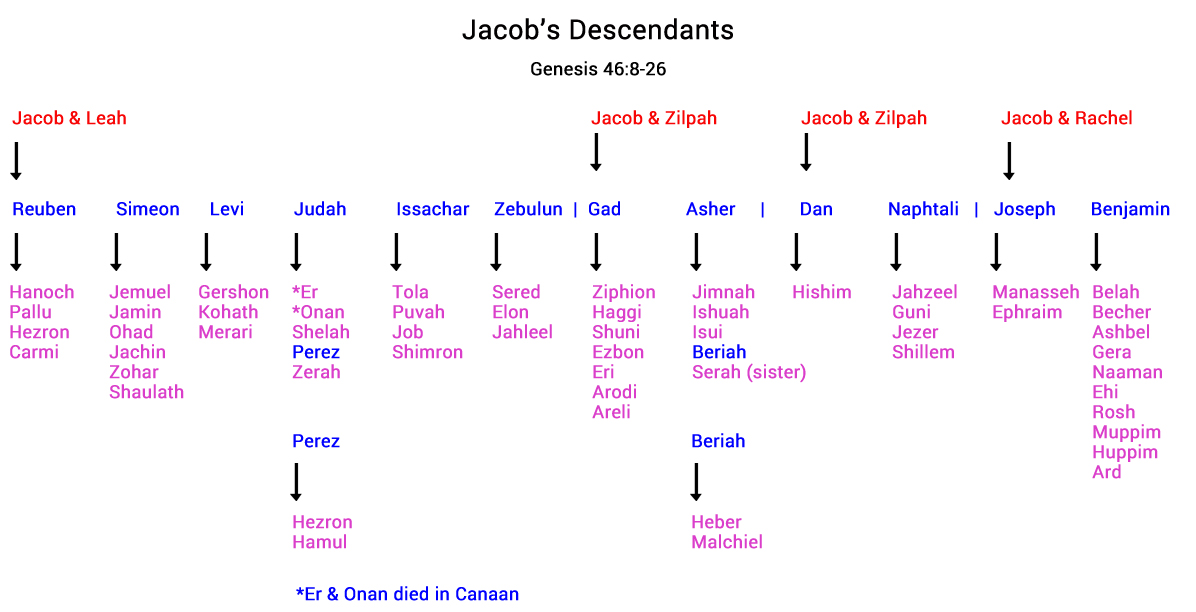
In Genesis 15:13 God promised Abram 'Know certainly that your descendants will be strangers in a land that is not theirs, and will serve them, and they will afflict them four hundred years." Isaac had been forbidden to go down into Egypt. Now Jacob was going to leave the Promised Land to go to the idolatrous country of Egypt. History of Israel: Shem was the oldest son of Noah who received the first-born blessing. He was considered "blameless in his days". The Israelites and the Jewish nation sprang from the line of Shem and are considered Semites. Ham was the youngest son who had sinned against Noah. In turn, Noah cursed Canaan, Ham's son, who became the ancestor of the Canaanites, the group that inhabited the land of Canaan. God promised he would make Abraham and his descendants into a great nation. The Israelites resided in Egypt for 400 years until their deliverance from slavery in Egypt. They then became a nation and settled in many parts of Canaan. In the first century, Rome destroyed the Holy Temple in Jerusalem and conquered the Jewish nation and renamed the region "Palestine". Between 1517 and 1917, Palestine was part of the ottoman Empire. In 1920, the British government took control of Palestine. in 1948 present time when the new nation was established. God's promises are fulfilled in His own time. 1 So Israel took his journey with all that he had, and came to Beersheba, and offered sacrifices to the God of his father Isaac. Then God spoke to Israel in the visions of the night, and said, “Jacob, Jacob!” And he said, “Here I am.” Beersheba is about 26 miles south of Hebron so it took about a week to arrive there. Jacob lived in tents and was used to relocating so there wasn't much he had to leave behind. He knew he woud never revisit Canaan again so he consulted God before he entered into Egypt. Before he crossed the border into Egypt, he went to Beersheba where many significant events had happened. It was the beginning place of God’s master plan for the Nation of Israel. There he offered up sacrifices and worshipped God to express his gratitude for the preservation of Joseph’s life and to seek God's direction. Then God appeared to him in a dream that night to revew His promises and blessings. God called Jacob's name twice as a token of His friendship and to get Jacob's attention. 3 So He said, "I am God, the God of your father; do not fear to go down to Egypt, for I will make of you a great nation there. I will go down with you to Egypt, and I will also surely bring you up again; and Joseph will put his hand on your eyes." Jacob was concerned that his sons whould be tempted with the idolatry of Egypt, intermarry with the women and forget the God of their fathers. Jacob had received the special blessing years ago and had a very large family. So in answer to Jacob's prayer and to remove his doubts, God renewed his promises and blessings. This is the seventh and last revelation given to Jacob from God. "Joseph will put his hand on your eyes" - When a Patriarch of the family died, it was the closest relative son who closed the eyes of the deceased and gave the final kiss before anyone else. Usually it was the one who had the birthright. Tis was a tradition among the Jews, Greeks and Romans. This statement assured Jacob that when he died, Joseph was going to be with him, and he would be buried in the Promised Land of Canaan. 5 Then Jacob arose from Beersheba; and the sons of Israel carried their father Jacob, their little ones, and their wives, in the carts which Pharaoh had sent to carry him. So they took their livestock and their goods, which they had acquired in the land of Canaan, and went to Egypt, Jacob and all his descendants with him. His sons and his sons' sons, his daughters and his sons' daughters, and all his descendants he brought with him to Egypt. Jacob obeyed God's command. He was one hundred and thirty years old and in poor health so he rode on the carts with the woman and children. Jacob left their household stuff behind, but they would carefully carry all valuables, and the records of their house, and their tôldôth (birth records which were generally read each November). Jacob also had daughters who were not mentioned. This Biblical genealogy is not a family tree. It highlights generations where God’s plan and purpose are put forth in the world. Therefore, it does not typically include women by name because the families of Israel were not founded by them, but by their husbands alone. The information given here is to know the number of people who went to Egypt including Joseph and his sons. Jacob's sons, the twelve patriarchs, were all born in Canaan, representing as the rightful heirs Canaan, the Promised Land. 8 Now these were the names of the children of Israel, Jacob and his sons, who went to Egypt: Reuben was Jacob's firstborn. The sons of Reuben were Hanoch, Pallu, Hezron, and Carmi. The sons of Simeon were Jemuel, Jamin, Ohad, Jachin, Zohar, and Shaul, the son of a Canaanite woman. The sons of Levi were Gershon, Kohath, and Merari. The sons of Judah were Er, Onan, Shelah, Perez, and Zerah (but Er and Onan died in the land of Canaan). The sons of Perez were Hezron and Hamul. The sons of Issachar were Tola, Puvah, Job, and Shimron. The sons of Zebulun were Sered, Elon, and Jahleel. These were the sons of Leah, whom she bore to Jacob in Padan Aram, with his daughter Dinah. All the persons, his sons and his daughters, were thirty-three. 16 The sons of Gad were Ziphion, Haggi, Shuni, Ezbon, Eri, Arodi, and Areli. The sons of Asher were Jimnah, Ishuah, Isui, Beriah, and Serah, their sister. And the sons of Beriah were Heber and Malchiel. These were the sons of Zilpah, whom Laban gave to Leah his daughter; and these she bore to Jacob: sixteen persons. 19 The sons of Rachel, Jacob's wife, were Joseph and Benjamin. And to Joseph in the land of Egypt were born Manasseh and Ephraim, whom Asenath, the daughter of Poti-Pherah priest of On, bore to him. The sons of Benjamin were Belah, Becher, Ashbel, Gera, Naaman, Ehi, Rosh, Muppim, Huppim, and Ard. These were the sons of Rachel, who were born to Jacob: fourteen persons in all. 23 The son of Dan was Hushim. The sons of Naphtali were Jahzeel, Guni, Jezer, and Shillem. These were the sons of Bilhah, whom Laban gave to Rachel his daughter, and she bore these to Jacob: seven persons in all. The Missing Tribe of Dan: Interestingly enough, Dan is not listed among the sealed tribes in Revelation 7. It seams that Manasseh, Joseph's son was added in his place. During the time of the Judges, the tribe of Dan sinned by viewing the land God alloted to them as unacceptable so they rejected it's claim and stole idols from a Levite in Ephriam. They were the first tribe in Israel to embrace idol worship. God presents his case against the Ephriamites in Hosea 3-14. The tribe of Levi did not receive an allotment or inheritance as did his brothers. They were chosen to oversee the sacrifices and offerings of the people. The Levites were to receive as their inheritance, the firstfruits their grain, new wine and olive oil as well as the first wool from the shearing of their sheep in return for their service. 26 All the persons who went with Jacob to Egypt, who came from his body, besides Jacob’s sons' wives, were sixty-six persons in all. And the sons of Joseph who were born to him in Egypt were two persons. All the persons of the house of Jacob who went to Egypt were seventy. When Jacob and his family went to Egypt, there were a total of seventy persons. Four hundred years later, they left Egypt, with "...about six hundred thousand men on foot, besides children". Exodus 12:37 It is estimated that at least 2.1 million people will leave Egypt and inherit the Promised Land. 28 Then he sent Judah before him to Joseph, to point out before him the way to Goshen. And they came to the land of Goshen. So Joseph made ready his chariot and went up to Goshen to meet his father Israel; and he presented himself to him, and fell on his neck and wept on his neck a good while. Jacob sent Judah because he had endeared himself to Joseph by his speech to him and therefore the fittest person to be sent to Joseph. He was to get instructions as to the location of their future settlement. Goshen was the first part of the land of Egypt that lay nearest to Canaan, near the entrance of Egypt. Rather than waiting for Jacob to come to him, Joseph went to meet his father and greeted him, as he had done upon his brethren before, but wept over him longer; their embraces were no doubt mutual and extremely affectionate, that for a while they were not able to speak a word to each other. Then Jacob spoke first. 30 And Israel said to Joseph, "Now let me die, since I have seen your face, because you are still alive." It was not that he was impatient to die but that the remainder of his life would be without mourning for Joseph. Jacob would live another seventeen years, having all his heart could wish for, an interview with his beloved son. 31 Then Joseph said to his brothers and to his father's household, "I will go up and tell Pharaoh, and say to him, "My brothers and those of my father's house, who were in the land of Canaan, have come to me. And the men are shepherds, for their occupation has been to feed livestock; and they have brought their flocks, their herds, and all that they have.' So it shall be, when Pharaoh calls you and says, 'What is your occupation?' that you shall say, 'Your servants' occupation has been with livestock from our youth even till now, both we and also our fathers,' that you may dwell in the land of Goshen; for every shepherd is an abomination to the Egyptians." The Pharaoh had already given Joseph's family permission to dwell in the best of the land. He knew they were shepherds which is why he permitted them to live in Goshen. As a tribute of respect, Joseph informed him of their arrival which was very proper, prudent, and politic to do. He explained the local customs and prejudices to his family, and instructed them on how to address the king. Joseph knew that by stressing their occupation as shepherds, that Pharaoh would isolate them from the rest of the Egyptian population. Joseph's intention was to keep them from the idolatrous and superstitious customs of the Egyptians. In addition, it Goshen was near the border of Canaan and land would be easier vacated when the time arrived for their return. The Armstrong Institute of Biblical Archaeology reveals evidence of Jacob's family in Ancient Egypt and explains why the Egyptians have such hatred for shepherds. Pharaoh and the Egyptians had sheep and cattle, however, the women and children probably took care of them while th emen were left to cultivate of their fields. God permits the world to hate His own, so they will forsake the filth of the world, and cling to Him.
1. Why did Jacob stop at Beersheba.?
2. What happened to Jacob when he was in Beersheba?
3. Who endorsed the exodus of Jacob and his household to Egypt?
4. How many sons of Judah were left at the time of the exodus to Egypt?
5. Which of these were the sons of Levi at the time of the exodus to Egypt?
6. Besides Jacob’s sons' wives how many settled in Egypt?
7. Whom did Jacob send ahead of him to Joseph to ask for directions to Goshen?
8. Where did Joseph meet his father Jacob?
9. The Egyptians regarded ...
10. Why did Joseph tell his family to say to Pharaoh that they were shepherds?
|
| Joe, Cassie, Matt, Sue, Mary, Cordie, Deb | |