Genesis 40 – The Prisoner's Dreams
Timeline: 1887 BC
|
Resources |
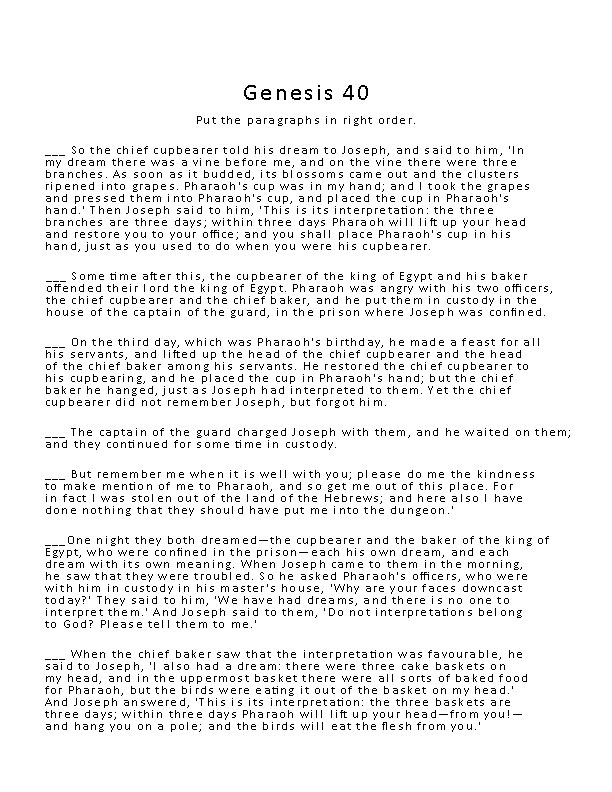
At this point Joseph is 28 years old. He had been confined to the state-prison for which, according to Eastern custom, was part of the same building where the chief of the executioners resided. But God was with Joseph where ever he went. 1 Some time after this, the cupbearer of the king of Egypt and his baker offended their lord the king of Egypt. Pharaoh was angry with his two officers, the chief cupbearer and the chief baker, and he put them in custody in the house of the captain of the guard, in the prison where Joseph was confined. The cupbearer and baker positions were more than just servants of the Pharaoh. They were officers of high rank, generally the highest nobles or princes of the blood. The cupbearer was the overseer of the royal vineyards, as well as the cellars; having, probably, some hundreds of people under him. The baker was the superintendence of every thing relating to providing and preparing of meals for the royal table. Whatever was their crime, they were imprisoned, until their case could be investigated. Some assume that they had attempted to poison the king but this is just conjecture. 4 The captain of the guard charged Joseph with them, and he waited on them; and they continued for some time in custody. Potiphar ordered Joseph to serve these two prisoners many days, a year, as Jarchi and Ben Gersom interpret it. 5 One night they both dreamed—the cupbearer and the baker of the king of Egypt, who were confined in the prison—each his own dream, and each dream with its own meaning. When Joseph came to them in the morning, he saw that they were troubled. So he asked Pharaoh's officers, who were with him in custody in his master's house, 'Why are your faces downcast today?' They said to him, 'We have had dreams, and there is no one to interpret them.' And Joseph said to them, 'Do not interpretations belong to God? Please tell them to me.' These dreams of the cupbearer and baker were not ordinary dreams. They were spiritual, prophetic messages from God. At that time, Egypt had magicians and wise men that would interpret dreams but since they were in prison, they did not have access to them. Joseph made use of his God-given ability to explain them. He is very perceptive when it comes to dreams, having experience with his own. Notice that in this instance there were two dreams. Joseph had two dreams and in the upcoming chapters, the Pharoah will also have two dreams in two years after this. 9 So the chief cupbearer told his dream to Joseph, and said to him, 'In my dream there was a vine before me, and on the vine there were three branches. As soon as it budded, its blossoms came out and the clusters ripened into grapes. Pharaoh's cup was in my hand; and I took the grapes and pressed them into Pharaoh's cup, and placed the cup in Pharaoh's hand.' Then Joseph said to him, 'This is its interpretation: the three branches are three days; within three days Pharaoh will lift up your head and restore you to your office; and you shall place Pharaoh's cup in his hand, just as you used to do when you were his cupbearer. The spiritual significance of this dream reminds us of the death and resurrection of the Lord Jesus. He was born (budded) and grew up (blossomed) into a man. Then He was persecuted (pressed) on the cross. The juice of the grapes represents the shedding of His blood and three days he was in the tomb. Because of this we are restored to a right relationship with God. 14 But remember me when it is well with you; please do me the kindness to make mention of me to Pharaoh, and so get me out of this place. For in fact I was stolen out of the land of the Hebrews; and here also I have done nothing that they should have put me into the dungeon.' Joseph was confident that the dream interpretation would prove correct. He was hoping that the cupbearer would put in a good word for him since just like Jesus, Joseph was also innocent. 16 When the chief baker saw that the interpretation was favourable, he said to Joseph, 'I also had a dream: there were three cake baskets on my head, and in the uppermost basket there were all sorts of baked food for Pharaoh, but the birds were eating it out of the basket on my head.' And Joseph answered, 'This is its interpretation: the three baskets are three days; within three days Pharaoh will lift up your head—from you!—and hang you on a pole; and the birds will eat the flesh from you.' Could it be that the reason the baker was hesitant to hear about his dream was that he was the guilty one? The chief baker was hoping for a similar interpretation. but was disappointed with what Joseph had to tell him. When baked good were carried across the open court from the bakery to the dining area, birds would often swoop down to help themselves. Birds were considered sacred to Egyptians so it was unlawful to hurt or destroy them. Hanging on a pole - when a criminal was condemed, he was decapitated and his body was hung on a tree by the highway as an example. The birds would then devour the remains. Egyptians belived that there was a river which carried the desceased into the afterlife. But the body would have to be intact. So the Pharaoh desecrated the body so the prisoner would not be there when he got there. 20 On the third day, which was Pharaoh's birthday, he made a feast for all his servants, and lifted up the head of the chief cupbearer and the head of the chief baker among his servants. He restored the chief cupbearer to his cupbearing, and he placed the cup in Pharaoh's hand; but the chief baker he hanged, just as Joseph had interpreted to them. Yet the chief cupbearer did not remember Joseph, but forgot him. It was customary for the Pharaoh to release a prisoner on his birthday, just as it was up to Pilot to release a prisoner in honor of the Passover festival. Jesus was brought before the crowd and was sentenced to death while Barabbas was set free. Likewise the Baker was condemned and the wine steward was set free. Do you recognize The lord's supper and communion? The baker represents bread and a wine steward, the wine. Bible Study Questions 1. Why was Pharaoh angry with his chief cupbearer (butler) and his chief baker?
2. In his anger, what did Pharaoh do to his two officers?
3. The chief cupbearer had a dream ...
4. What was the mood of these officers of Pharaoh after each of them had had his dream? 5. According to Joseph, the interpretation of every dream is with ...
6. What moved the chief baker to tell his dream?
7. Joseph, Pharaoh's chief cupbearer, and Pharaoh's chief baker eventually died at a point. Which of them, according to the Bible, did not die a natural death?
8. From which of the officers of Pharaoh did Joseph ask for help?
9. On which day did Pharaoh release his two officers from their punishment?
10. The chief cupbearer was eventually restored to his post. How many days from the time he had the dream was he restored to his post?
|
| Kelly, Cassie, Matt, Noah, Joe, Sue | |