Exodus 33 - Intercession and Renewal of the Covenant
Timeline: 1450 BC
|
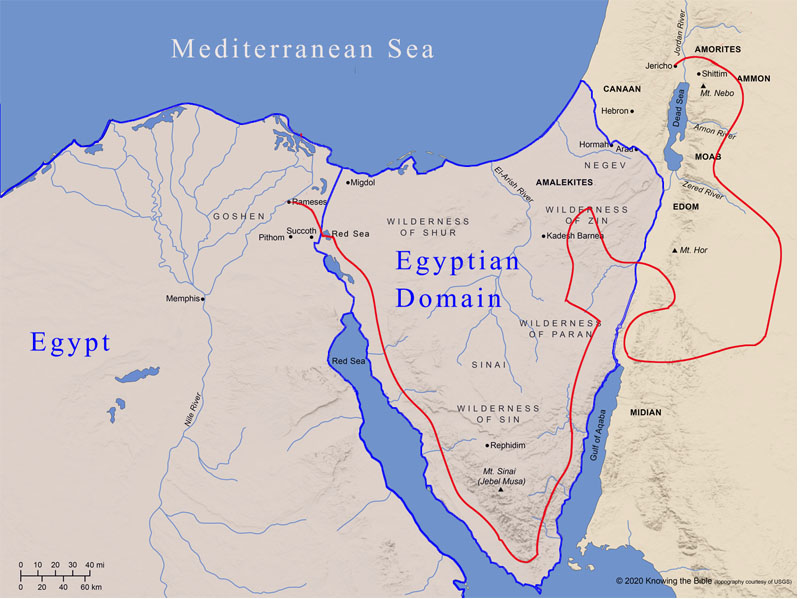
Israelite Journeys Rameses
|
"What is the significance of the number 40 in the Bible? Moses lived in Egypt for 40 years and then spent 40 years in Midian, preparing to become the leader of the Hebrews. Then he spent 40 days and nights on Mount Sinai without any food or drink while getting instructions from God. The number forty is used by God to represent a period of testing or judgment. In this case, it was both. Moses had a deep affection for his people. When he was in Egypt, he had a life full of opportunities and yet he sacrificed it all while trying to defend his fellow Hebrew. After the golden calf incident, God seemed to wash His hands of His people. But Moses offered to sacrifice his eternal life as he prayerfully intervened on their behalf. What a demonstration of love he had for his people!
Exodus 33:1 Then the Lord said to Moses, “Depart and go up from here, you and the people whom you have brought out of the land of Egypt, to the land of which I swore to Abraham, Isaac, and Jacob, saying, ‘To your descendants I will give it.’ And I will send My Angel before you, and I will drive out the Canaanite and the Amorite and the Hittite and the Perizzite and the Hivite and the Jebusite. Go up to a land flowing with milk and honey; for I will not go up in your midst, lest I consume you on the way, for you are a stiff-necked people.” God restated His covenant and notice that he had planned to send the pre-incarnate Jesus Christ to lead the people into the Promised Land.
Exodus 33:4 And when the people heard this bad news, they mourned, and no one put on his ornaments. For the Lord had said to Moses, “Say to the children of Israel, ‘You are a stiff-necked people. I could come up into your midst in one moment and consume you. Now therefore, take off your ornaments, that I may know what to do to you.’ ” So the children of Israel stripped themselves of their ornaments by Mount Horeb. The warning was given. If God were to stay with His people, He could be compelled to destroy them for their actions. To strip oneself of his ornaments was an act of self-denial. It was commonly done in the case of mourning on account of a family bereavement, and sometimes in the case of national misfortunes. This was a visible sign and profession of their inward humiliation and repentance for their sin, and of their deep sense of God’s displeasure. They gave Aaron their earrings for the golden calf but they still wore a lot more jewelry. Now they were humbling themselves by removing their prideful embellishments. Exodus 33:7 Moses took his tent and pitched it outside the camp, far from the camp, and called it the tabernacle of meeting. And it came to pass that everyone who sought the Lord went out to the tabernacle of meeting which was outside the camp. So it was, whenever Moses went out to the tabernacle, that all the people rose, and each man stood at his tent door and watched Moses until he had gone into the tabernacle. And it came to pass, when Moses entered the tabernacle, that the pillar of cloud descended and stood at the door of the tabernacle, and the Lord talked with Moses. All the people saw the pillar of cloud standing at the tabernacle door, and all the people rose and worshiped, each man in his tent door. So the Lord spoke to Moses face to face, as a man speaks to his friend. And he would return to the camp, but his servant Joshua the son of Nun, a young man, did not depart from the tabernacle. When the tabernacle was built, it was placed in the center of the camp. But before the tabernacle was constructed, God met with Moses in a temporary tent of meeting outside of the camp where Moses could meet and communicate with God, away from the people whom He had threated to annihilate. It was obviously much simpler in structure than the tabernacle, but it worked for the purpose it was intended.
The mountain was covered with that same cloud but now it only appears when Moses went into the tent. God would appear to Moses “face to face,” an idiom meaning “intimately.” God spoke to Moses in conversational language.
Moses was still the one who handled the difficult matters. He was still the acting intercessor between God and the people of Israel and would tend to his duties. No doubt, the people were still afraid of the wrath of God. Each Israelite stood at the door of their tents in reverence, as an act of obedience or recognition of the reality of who God is. They would watch Moses as he experienced fellowship and harmony with the LORD on the basis of his faithful obedience, while the Israelites were made distant from God because of their transgressions. Joshua remained at the tent. One would assume that it should have been Aaron who stood by the tent of meeting but due to his transgressions, it was Joshua, who had a heart for God. Joshua was willing to wait alone for forty days while Moses witnessed the glory of God and now he continues to be faithfully committed to God and Moses. Exodus 33:12 Then Moses said to the Lord, “See, You say to me, ‘Bring up this people.’ But You have not let me know whom You will send with me. Yet You have said, ‘I know you by name, and you have also found grace in My sight.’ Now therefore, I pray, if I have found grace in Your sight, show me now Your way, that I may know You and that I may find grace in Your sight. And consider that this nation is Your people. Moses said in effect, “You chose me for the task of leading the people and you say I have demonstrated my faithfulness to You. Now You are going to send someone else to lead us but you haven’t said who He is. Now, please show me what I have to do to maintain our relationship and do not abandon Your people. Grace is getting something you don’t deserve. It is a gift that cannot be earned or purchased. Mercy is not getting what you do deserve. The Hebrew word khen is also sometimes translated as "grace," but it can also mean "delight," "favor," "charm," or "beauty". Exodus 33:14 And He said, “My Presence will go with you, and I will give you rest.” Moses dreaded the thought of going forward without the Lord's presence. God was saying that He was removing His presence from the people but He would continue to be with Moses. So he continued to plead with God. Exodus 33:15 Then he said to Him, “If Your Presence does not go with us, do not bring us up from here. For how then will it be known that Your people and I have found grace in Your sight, except You go with us? So we shall be separate, Your people and I, from all the people who are upon the face of the earth.” Exodus 33:17 So the Lord said to Moses, “I will also do this thing that you have spoken; for you have found grace in My sight, and I know you by name.” God agreed to provide His presence with the Israelites as they go to the Promised Land. God granted favor to an entire nation because of His favor of one man. This underscores the immense impact any one person can have through their faithfulness. Moses treasured God’s presence so much that he says, “Go with us or leave us here. How else will we know that you have accepted us unless you are with us? He wanted to be certain that God would stay with them. Though the people had sinned against God, they were the people He had chosen above all people to be His; He had made a covenant with them, and He was their covenant God. Exodus 33:18 And he said, “Please, show me Your glory.” Moses understood that the greatest experience available in this life is to know God. He had been on the mountain with God, and had intimate communion with God, yet he still desires a further acquaintance. Moses asked for mercy for his people which relates to forgiveness or withholding punishment. The word “racham”, or mercy means "price paid." God has a right to pardon whom he pleases. God’s mercy comes from His own good will: No people, much less a rebellious people, can claim due justice or equity. God spared the Jews; not because Moses interceded for them nor because they themselves deserved God’s favor, but it was because of God’s own free and sovereign grace that He chose to show them mercy and compassion. God gives His salvation in His own way and on His own terms. Exodus 33:19 Then He said, “I will make all My goodness pass before you, and I will proclaim the name of the Lord before you. I will be gracious to whom I will be gracious, and I will have compassion on whom I will have compassion.” But He said, “You cannot see My face; for no man shall see Me, and live.” And the Lord said, “Here is a place by Me, and you shall stand on the rock. So it shall be, while My glory passes by, that I will put you in the cleft of the rock, and will cover you with My hand while I pass by. Then I will take away My hand, and you shall see My back; but My face shall not be seen.” God tells Moses he cannot see His face in his fallen form, nor has anyone ever seen the face of God except for Jesus. However He allows Moses to see his glory. The word glory generally refers to someone or something's observable essence. The sun has a glory that cannot be looked upon without becoming blinded. So has the moon but we can gaze upon it without injury. So the Lord allowed Moses to see the reflection of His glory, protecting him from death. Bible Study Questions 1. What did God send before the people? 1. An angel. 2. Why did God tell the people He would not go with them? 1. Because they were a stiff-necked people and He might destroy them on the way. 3. What did the people do when they heard the distressing words? 1. The Israelites stripped off their ornaments at Mount Horeb. 4. What did Moses call the tent he pitched outside the camp? 1. The “tent of meeting.” 5. How did the Lord speak to Moses? 1. With the authority of God. 6. Where did Joshua, son of Nun, go when Moses left the tent? 1. Back to his own tent. 7. What did Moses tell God to remember? 1. That this nation will eventually obey your word. 8. Why did the Lord do what Moses asked? 1. Because God was pleased with Moses and He knew him by name. 9. What wouldn’t God let Moses see His face? 1. Because His glory is bright as the sun. 10. What did Moses see when God passed by? 1. Moses saw God's face. Cassie, Matt |