Resources
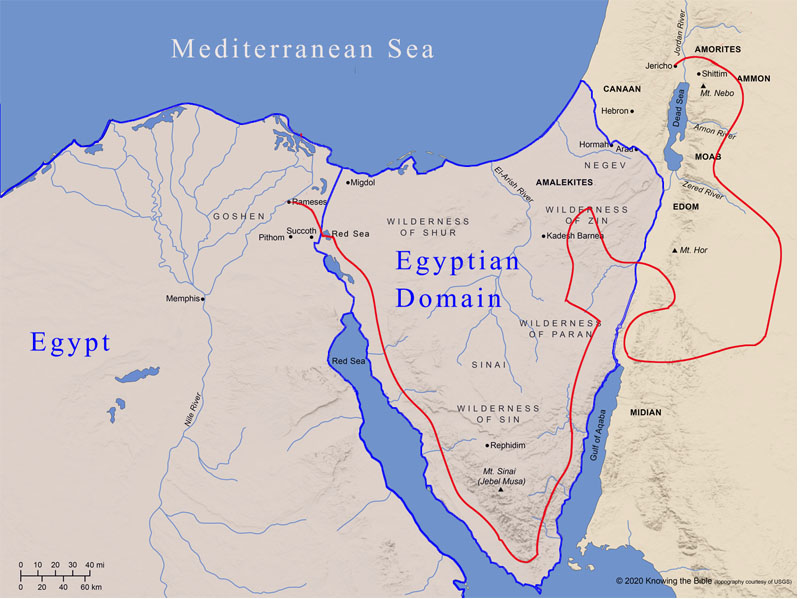
Israelite Journeys
Rameses
Succoth
Etham
Pi-hahiroth
By the Red Sea
Wilderness of Etham
Marah
Elim
By the Red Sea
Wilderness of Sin
Dophkah
Alush
Rephidim
Wilderness of Sinai
Kibroth-hattaavah
Hazeroth
Rithmah
Rimmon-perez
Libnah
Rissah
Kehelathah
Mount Shepher
Haradah
Makheloth
Tahath
Terah
Mithkah
Hashmonah
Moseroth
Bene-jaakan
Hor-haggidgad
Jotbathah
Abronah
Ezion-geber
Kadesh
Mount Hor
Zalmonah
Punon
Oboth
Iye-abarim
Dibon-gad
Almon-diblathaim
Abarim
Moab
Beth-jeshimoth
Abel-shittim
In Exodus chapter 24, God spoke to the people of Israel and they heard, first hand, the commandments He gave to them. Then Moses went up the mountain and spent 40 days and 40 nights leaving Joshua half way up and Aaron at the bottom with seventy of the elders of Israel. Aaron and Hur were supposed to be in charge of the people in Moses’ absence.
Now when the people saw that Moses delayed coming down from the mountain, the people gathered together to Aaron, and said to him, “Come, make us gods that shall go before us; for as for this Moses, the man who brought us up out of the land of Egypt, we do not know what has become of him.”
Only five months have passed since the people of Israel sang the song praising God for rescuing them from slavery. It is obvious that the people were indoctrinated in the ways of the Egyptians and they longed for their superstitious idol worship since it was less than six weeks that many of them became anxious in the absence of Moses and strayed so far that they decided to take matters into their own hands. They credited their exodus with Moses rather than acknowledging and trusting in the God who delivered them. They wanted to replace Moses, who apparently to them had left them or had perished, with gods of the their own making.
This is the fifth time since the Israelites escaped Egypt and once again began complaining.
Isaiah 63:11 Then he [the prophet] remembered the days of old, Moses and his people, saying: “Where is He who brought them up out of the sea with the shepherd of His flock? Where is He who put His Holy Spirit within them, who led them by the right hand of Moses, with His glorious arm, dividing the water before them to make for Himself an everlasting name who led them through the deep, as a horse in the wilderness, that they might not stumble?”
14 As a beast goes down into the valley, and the Spirit of the Lord causes him to rest, so You lead Your people, to make Yourself a glorious name.
Acts 7:39 And in their hearts they turned back to Egypt, saying to Aaron, ‘Make us gods to go before us; as for this Moses who brought us out of the land of Egypt, we do not know what has become of him.’ And they made a calf in those days, offered sacrifices to the idol, and rejoiced in the works of their own hands.
2 And Aaron said to them, “Break off the golden earrings which are in the ears of your wives, your sons, and your daughters, and bring them to me.” So all the people broke off the golden earrings which were in their ears, and brought them to Aaron. And he received the gold from their hand, and he fashioned it with an engraving tool, and made a molded calf. Then they said, “This is your god, O Israel, that brought you out of the land of Egypt!”
The golden earrings were probably those that the Israelites acquired from the Egyptians which they brought with them when they left Egypt.
Aaron was under pressure from the people. They were being rebellious and would not listen to him when he attempted to restrain them. Many commentators suggest that Aaron, in order to appease them, created an image that was intended to direct the people to God Himself. He wanted the people to celebrate God and nothing more. He felt that the calf could function as an appropriate symbolic animal for the God of Israel. Other commentators consider the calf was meant as a seat for God, something for God to ride on, like the Ark of the Covenant. Still others suggest that the reason for making it in the shape of a calf was to represent the Egyptian god Apis, the symbol of strength, which was familiar to the people for them to worship.
Psalm20:19-22 They made a calf in Horeb, and worshiped the molded image. Thus they changed their glory into the image of an ox that eats grass. They forgot God their Savior, who had done great things in Egypt, wondrous works in the land of Ham, awesome things by the Red Sea.
In the NKJV, this verse refers to “god” singular. In many other versions, it is “gods”. The Hebrew term Elohim can be translated either “God” or “gods” depending on context. Whatever Aaron’s intention, the people proclaimed the golden calf as an idol and began to worship it.
5 So when Aaron saw it, he built an altar before it. And Aaron made a proclamation and said, “Tomorrow is a feast to the Lord.” Then they rose early on the next day, offered burnt offerings, and brought peace offerings; and the people sat down to eat and drink, and rose up to play.
If it was Aaron’s intention that the calf was a representation of God, it would not be extraordinary to offer a Burnt Offering and a Peace Offering. Aaron also participated in the worship by building the altar and declaring a feast for the next day (there are many designated feasts but there are no feasts in the third or the fourth month). The purpose of the burnt offerings was considered atonement for sin and the renewal of the relationship between God and His people. The Peace Offering was a commitment to God and was to be shared as a type of thanksgiving meal. However the people took it to a whole other level. Their worship included eating, drinking excessively and sexual immorality. The people immediately fell to worship the calf and violated the First and Second Commandments of idolatry and polytheism.
7 And the Lord said to Moses, “Go, get down! For your people whom you brought out of the land of Egypt have corrupted themselves. They have turned aside quickly out of the way which I commanded them. They have made themselves a molded calf, and worshiped it and sacrificed to it, and said, ‘This is your god, O Israel, that brought you out of the land of Egypt!’ ” And the Lord said to Moses, “I have seen this people, and indeed it is a stiff-necked people! Now therefore, let Me alone, that My wrath may burn hot against them and I may consume them. And I will make of you a great nation.”
Moses was at the top of the mountain, far removed from the camp, so he had neither seen nor heard anything unusual until God told Moses about the wickedness that was going on below. At this point, God disassociated Himself from His sinful nation calling them “Moses’ people”. It was as if a husband and wife are each attempting to assign responsibility to the other parent for a child’s misbehavior. Stiff-necked people means “out of control, willful, and stubborn,” a metaphor taken from the horse that stiffens his neck against the pull of the rein, and will not be guided by the rider.
God’s intention was to consume all the people in fire and start over with Moses. They certainly were deserving of the wrath of God to the uttermost. They were hand-picked to be His people and it only took them just over a month from the time they made their covenant with God to the time they completely dishonored their agreement. But Moses was relentless:
11 Then Moses pleaded with the Lord his God, and said: “Lord, why does Your wrath burn hot against Your people whom You have brought out of the land of Egypt with great power and with a mighty hand? Why should the Egyptians speak, and say, ‘He brought them out to harm them, to kill them in the mountains, and to consume them from the face of the earth’? Turn from Your fierce wrath, and relent from this harm to Your people. Remember Abraham, Isaac, and Israel, Your servants, to whom You swore by Your own self, and said to them, ‘I will multiply your descendants as the stars of heaven; and all this land that I have spoken of I give to your descendants, and they shall inherit it forever.’” So the Lord relented from the harm which He said He would do to His people.
Psalm 106:23 Therefore He said that He would destroy them, had not Moses His chosen one stood before Him in the breach, to turn away His wrath, lest He destroy them
It would seem that Moses changed God’s mind concerning what He was about to do when Moses pleaded to Him on behalf of the people. Rather than appealing to God’s compassion, Moses chose to focus on God’s reputation. First he called them “His people”, and reminded God that “He” redeemed them from the house of bondage. Next he acknowledged the greatness of His power. Then Moses defended God’s honor among the enemies of his people so that they may not disdain God's glory and wisdom. Finally, he reminded God of His pledge that he swore to their fathers. God promised the Messiah would be in the royal lineage of Judah. God’s promises to Abraham, Isaac and Jacob could not have been fulfilled through Moses. Moses was not in that lineage His promise to Abraham that he would be the father of a great nation would not have been fulfilled. God always keeps His promises.
Scripture explains God’s behavior in human terms. God did not actually change His mind as the literal language would indicate. God clearly said that His intention was to judge the people. He never was planning to destroy all the people at that time for that particular sin. The judgment was merely postponed. None of the people of that generation of Israel, except for Joshua and Caleb, were allowed to enter the Promised Land.
From humanity’s point of view God’s mind was changed but God had known all along what would happen. Consider this story from Chuck Missler:
"I have seen in public corporations by very seasoned administrators in a large organization and have tried to fight for some particular reform or facility that your organization needs very badly. I was in this position the Ford Motor Company. Once we were part of a team pushing hard for a very specialized type of laboratory.We were fighting against the vice president of engineering who was considered by the engineers to be the most reactionary, pragmatic, old-fashioned character and we fought and had meetings and got arguments and numbers and pushed and pushed until finally, by just the brutality of our facts managed to get the lab committed. I found out through some very peculiar circumstances that the lab was originally his idea and he quietly planted the seeds around. He knew if it was his idea that it would become just another big expensive facility that no one would really use so he knew the smart way to do this was to get the product people to think it was their idea and to fight for it. He resisted it until they convinced him that they needed it and made all kinds of commitments as the wonderful things they were going to achieve when they got it. When those commitments were really strong enough, he caved in and gave them their Laboratory. Now it happened, because of organizational changes, I ended up taking over the Computing Center of that company and so I got to know him better than most the other people did. I discovered much to my amazement that his style worked because your biggest problem is to get other people to invent the idea and have their own vision and fight for it and you resist it just long enough until they're really committed."
It is said that faith is not tested is not proven. God’s threat was not meant to prove anything to Heaven as much as it was meant to prove the potential of greatness of Moses to himself.
Psalm 105:42 For He remembered His holy promise, and Abraham His servant.15 And Moses turned and went down from the mountain, and the two tablets of the Testimony were in his hand. The tablets were written on both sides; on the one side and on the other they were written. Now the tablets were the work of God, and the writing was the writing of God engraved on the tablets.
Revelation 5:1 And I saw in the right hand of Him who sat on the throne a scroll written inside and on the back, sealed with seven seals.
Ezekiel 2:9-10 Now when I looked, there was a hand stretched out to me; and behold, a scroll of a book was in it. Then He spread it before me; and there was writing on the inside and on the outside, and written on it were lamentations and mourning and woe.
Both the Tablets and the scroll have writing on both sides. Could it be that when God provides some kind of covenant, law, or legal document to us, it’s two sided – as in a bi-lateral agreement? Promises that must be kept by both parties in the agreement? If so, it’s no wonder the first set was broken by Moses.
And when Joshua heard the noise of the people as they shouted, he said to Moses, “There is a noise of war in the camp.”
18 But he said: “It is not the noise of the shout of victory, Nor the noise of the cry of defeat, but the sound of singing I hear.”
After Moses finished his defense; he obeyed God and began his descent from the top of the mountain carrying the two stone tablets inscribed with the Ten Commandments. On his way down he reconnected with Joshua, whom he had left at some intermediate point between the top of Mt. Sinai and the camp of Israel. When he saw Moses, he told him about noise he was hearing from the camp below. He assumed the people were at war, but then Moses told him what was really going on.
19 So it was, as soon as he came near the camp, that he saw the calf and the dancing. So Moses’ anger became hot, and he cast the tablets out of his hands and broke them at the foot of the mountain. Then he took the calf which they had made, burned it in the fire, and ground it to powder; and he scattered it on the water and made the children of Israel drink it. And Moses said to Aaron, “What did this people do to you that you have brought so great a sin upon them?”
Deuteronomy 9:17 Then I took the two tablets and threw them out of my two hands and broke them before your eyes.
Moses was furious Aaron and the people! Here he was on the mountain, speaking with God and getting instructions for them to proceed into the Promised Land while they were down below participating in an orgy to a molten idol. When he saw it with his own eyes he could not contain himself. He took the stones on which God had written the commandments and broke them as a sign that Israel had broken the covenant.
Deuteronomy 9:21 Then I took your sin, the calf which you had made, and burned it with fire and crushed it and ground it very small, until it was as fine as dust; and I threw its dust into the brook that descended from the mountain.
Revelation: 16:4-6 Then the third angel poured out his bowl on the rivers and springs of water, and they became blood. And I heard the angel of the waters saying:
“You are righteous, O Lord, the One who is and who was and who is to be, because You have judged these things. For they have shed the blood of saints and prophets, and You have given them blood to drink. For it is their just due.”
Rashi and most other commentators explan that Aaron was trying to stall the people. He knew that they wouldn’t listen to him, but he hoped that if he delayed them long enough, Moses would return before any major damage was done. They also commented that Aaron knew Jewish women had too much faith in Moses to be roped into such mutiny, and hoped they would further delay their husbands. Building the altar himself was also a delay tactic.
22 So Aaron said, “Do not let the anger of my lord become hot. You know the people, that they are set on evil. For they said to me, ‘Make us gods that shall go before us; as for this Moses, the man who brought us out of the land of Egypt, we do not know what has become of him.’ And I said to them, ‘Whoever has any gold, let them break it off.’ So they gave it to me, and I cast it into the fire, and this calf came out.”
Aaron begins like many people, “I’m sorry but it is not my fault, the people made me do it.“ Aaron states the when he threw the gold into the fire, a miracle happens and the calf came out on its own. How ridiculous this must have seemed to Moses that he did not even reply to Aaron but turned to the people and addressed them.
25 Now when Moses saw that the people were unrestrained (for Aaron had not restrained them, to their shame among their enemies), then Moses stood in the entrance of the camp, and said, “Whoever is on the Lord’s side—come to me!” And all the sons of Levi gathered themselves together to him. And he said to them, “Thus says the Lord God of Israel: ‘Let every man put his sword on his side, and go in and out from entrance to entrance throughout the camp, and let every man kill his brother, every man his companion, and every man his neighbor.’ ” So the sons of Levi did according to the word of Moses. And about three thousand men of the people fell that day. Then Moses said, “Consecrate yourselves today to the Lord, that He may bestow on you a blessing this day, for every man has opposed his son and his brother.”
Even if Aaron had merely acted from weakness in carrying out the will of the people, he was the most to blame. Aaron was supposed to be in charge of the people but allowed them to run wild and become a laughing stock to their enemies. However, as a son of Levi, Aaron must have been one of those who repented, and God forgave.
Deuteronomy 9:20 And the Lord was very angry with Aaron and would have destroyed him; so I [Moses] prayed for Aaron also at the same time.
Those who did not give into the idolatry of the calf had gathered around Moses.
1 Corinthians 10:7 And do not become idolaters as were some of them. As it is written, “The people sat down to eat and drink, and rose up to play.”
Most commentators feel these were the main leaders of the wickedness. God ordered those who were the most obstinate and would not turn away from their idolatry to be slain.
1 Corinthians 10:7-8 And do not become idolaters as were some of them. As it is written, “The people sat down to eat and drink, and rose up to play.” Nor let us commit sexual immorality, as some of them did, and in one day twenty-three thousand fell;
There were a total of approximately 600,000 men of military age, the estimate of all the people was about 2 million. Undoubtedly, the total number of people who died not only by the sword but also by the plague amounted to twenty-three thousand.
The term “holiness” refers to the absolute perfection of the character of God, expressing His purity of character or moral perfection and excellence, thus making God totally separate from sin and sinners. God cannot tolerate such gross sin without responding with judgment since He is holy. God’s punishment of those Israelites involved in idolatrous worship was severe because of the seriousness of their offense. This discipline was merciful since the Lord could have destroyed the entire nation as He had threatened.
The Levites were to set themselves apart from the rest of the Israelites in order to carry out the Lord’s purpose to discipline the unrepentant idolaters in Israel with the death penalty. Moses tells the Levites that they will receive a blessing for their loyalty to God and this blessing came in the form of being selected by God to be the priestly tribe of Israel. According to Jewish writers, the seventeenth of Tammuz, or June 17th, on which day the Jews keep a fast upon this account. This day is the beginning of the Three Weeks in which Jews the world over fast and lament to commemorate the many calamities that have befallen their people.
30 Now it came to pass on the next day that Moses said to the people, “You have committed a great sin. So now I will go up to the Lord; perhaps I can make atonement for your sin.” Then Moses returned to the Lord and said, “Oh, these people have committed a great sin, and have made for themselves a god of gold! Yet now, if You will forgive their sin—but if not, I pray, blot me out of Your book which You have written.”
It sounds as if Moses wasn’t sure he could convince God to forgo the destruction of children of Israel. He displayed genuine love for them and offered to not only suffer physical death but also forfeit his eternal life as well on their behalf. Atonement for sin requires a perfect sacrifice and although Moses was righteous, he was not perfect. God could not accept the death of one person for another until Jesus, who was perfect, did indeed die for all. God showed mercy on the unfaithful nation by not destroying them, but he punished individuals who rebelled against him.
Deuteronomy 9:25-29 “Thus I prostrated myself before the Lord; forty days and forty nights I kept prostrating myself, because the Lord had said He would destroy you. Therefore I prayed to the Lord, and said: ‘O Lord God, do not destroy Your people and Your inheritance whom You have redeemed through Your greatness, whom You have brought out of Egypt with a mighty hand. Remember Your servants, Abraham, Isaac, and Jacob; do not look on the stubbornness of this people, or on their wickedness or their sin, lest the land from which You brought us should say, “Because the Lord was not able to bring them to the land which He promised them, and because He hated them, He has brought them out to kill them in the wilderness.” Yet they are Your people and Your inheritance, whom You brought out by Your mighty power and by Your outstretched arm.’
33 And the Lord said to Moses, “Whoever has sinned against Me, I will blot him out of My book. Now therefore, go, lead the people to the place of which I have spoken to you. Behold, My Angel shall go before you. Nevertheless, in the day when I visit for punishment, I will visit punishment upon them for their sin.”
Their act was considered a supreme act of apostasy, because it represented a complete rejection of God and a blatant disregard for the covenant established with the Israelites. Choosing a false idol over their one true God was seen as a grave betrayal of their faith and loyalty and their punishment was considered extremely severe.
Revelation 20:15 And whosoever was not found written in the book of life was cast into the lake of fire.
35 So the Lord plagued the people because of what they did with the calf which Aaron made.
Deuteronomy 7:9 “Therefore know that the Lord your God, He is God, the faithful God who keeps covenant and mercy for a thousand generations with those who love Him and keep His commandments; and He repays those who hate Him to their face, to destroy them. He will not be slack with him who hates Him; He will repay him to his face.
Genesis 15:16 But in the fourth generation they shall return here, for the iniquity of the Amorites is not yet complete.”
The Jews have a metaphorical saying, "No affliction has ever happened to Israel in which there was not some particle of the dust of the golden calf." - Adam Clarke Bible Commentary
October 20, 2022: Biblical Mt. Sinai Discovered Provided with Pictures and Bible Verses
Bible Study Questions
1. Why did the people ask Aaron to make gods?
1. Because they didn’t want to worship God anymore.
2. Because they wanted to have a celebration.
3. Because they thought Moses was not coming back.
2. What was the molded calf supposed to represent?
1. The God who brought them out of Egypt.
2. The god who represented the sun.
3. All the gods they left behind.
3. What did God call the people in this chapter?
1. Sons of Israel.
2. Children of God.
3. A stiff-necked people.
4. What did Moses have in his hand when he came down from the mountain?
1. Two-sided tablets of the Testimony.
2. The Ten Commandments written on one side of the tablet
3. Scrolls with the instructions for the tabernacle.
5. Who said to Moses, “There is a noise of war in the camp?
1. God
2. Aaron
3. Joshua
6. Whom did the people say was responsible for their freedom?
1. The God who brought us out of the land of Egypt.”
2. The man who brought us out of the land of Egypt.”
3. The gods who brought us out of the land of Egypt.”
7. Aaron collected gold from the people. What did he tell Moses he did with it?
1. He cast it into the fire, and melted it so they could drink it.
2. He cast it into the fire, and this calf came out.
3. He cast it into the fire, and carved an idol.
8. When Moses asked, “whoever is on the Lord’s side – come to me!”, who came forth?
1. Aaron and his sons.
2. All the sons of Levi.
3. All the elders from the tribes.
9. What did Moses ask God to do if He would forgive their sins?
1. “Blot me out of Your book which You have written.”
2. “Take my life and let them survive.”
3. “Give them plagues instead of death.”
10. When will God punish the people for their sin?
1. In the evening.
2. In the morning.
3. In the day He comes to visit.
Cassie, Matt, Joe