Exodus 31 - Bezalel and Oholiab Appointed for Tabernacle Work
Timeline: 1450 BC
|
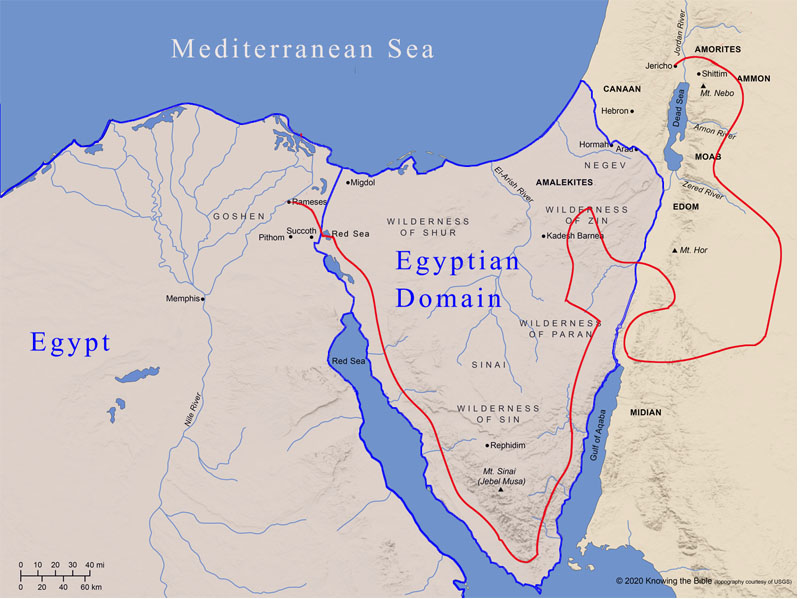
Israelite Journeys Rameses
|
Then the Lord spoke to Moses, saying: "See, I have called by name Bezalel the son of Uri, the son of Hur, of the tribe of Judah. And I have filled him with the Spirit of God, in wisdom, in understanding, in knowledge, and in all manner of workmanship, to design artistic works, to work in gold, in silver, in bronze, in cutting jewels for setting, in carving wood, and to work in all manner of workmanship. The name "Bezalel" means "in the shadow [protection] of God." Bezalel was the grandson of Hur who was married to Miriam, Moses’ sister. Hur was the man who held up Moses’ arms during a fierce battle (Exodus 17:12). He belonged to the tribe of Judah. We would see an entire history of Spirit-filled men from Judah building a dwelling place for God with his people. David and his son Solomon were from the tribe of Judah who were ultimately responsible for the building of the temple. David wanted to build a temple for the Lord to honor God and create a place of peace and rest for the Ark of the Covenant but God chose David's son Solomon to actually build the temple. At 13 years of age, Bezalel was a highly gifted master craftsman in engraving precious metals and stones. He was also a master-workman. God chose him to be overseer of the whole work relating to building the Tabernacle, the Ark of the Covenant and the rest of the items in house of God. He was also in charge of the holy oils, incense, and priestly vestments. Moses was given an oral Torah to clarify how the laws of the Torah were to be carried out. After the destruction of the Second Temple in 70 CE, the Oral Torah was written, first on scrolls, and eventually in book form called the Talmud. The Talmud was written by rabbis and Torah scholars throughout several generations which include rabbinic commentaries and writings between different rabbis. According to Jewish tradition, God gave Bezalel wisdom and understanding to make all that the Lord had commanded Moses – even those things that Moses had not told him. The William Davidson Talmud - Berakhot 55a records the following: Moses went and reversed the order and told Bezalel: “Make an ark, and vessels, and a tabernacle” (see Exodus 25–26). He said to Moses: Moses, our teacher, the standard practice throughout the world is that a person builds a house and only afterward places the vessels in the house, and you say to me: Make an ark, and vessels, and a tabernacle. If I do so in the order you have commanded, the vessels that I make, where shall I put them? Perhaps God told you the following: “Make a tabernacle, ark, and vessels” (see Exodus 36). Moses said to Bezalel: Perhaps you were in God’s shadow [betzel El], and you knew precisely what He said. You intuited God’s commands just as He stated them, as if you were there. 6 "And I, indeed I, have appointed with him Aholiab the son of Ahisamach, of the tribe of Dan; and I have put wisdom in the hearts of all the gifted artisans, that they may make all that I have commanded you: the tabernacle of meeting, the ark of the Testimony and the mercy seat that is on it, and all the furniture of the tabernacle— the table and its utensils, the pure gold lampstand with all its utensils, the altar of incense, the altar of burnt offering with all its utensils, and the laver and its base— the garments of ministry, the holy garments for Aaron the priest and the garments of his sons, to minister as priests, and the anointing oil and sweet incense for the holy place. According to all that I have commanded you they shall do." God gave Bezalel a second-in-command to lead the other craftsmen. Aholiab, whose name means “father’s tent”(tabernacle) in Hebrew, was an engraver, a designer, and an embroiderer of fine linen. He was from the tribe of Dan, the last tribe, and so all Israel was represented. Bezalel and Aholiab were gifted the ability to teach. God empowered all the people who worked on the tabernacle with wisdom and the desire to complete the tasks required. They carried on the work with zeal, however, they were ordered to cease work and to rest on Shabbat, the Jewish Sabbath, the seventh day. 12 And the Lord spoke to Moses, saying, "Speak also to the children of Israel, saying: 'Surely My Sabbaths you shall keep, for it is a sign between Me and you throughout your generations, that you may know that I am the Lord who sanctifies you. You shall keep the Sabbath, therefore, for it is holy to you. Everyone who profanes it shall surely be put to death; for whoever does any work on it, that person shall be cut off from among his people. Work shall be done for six days, but the seventh is the Sabbath of rest, holy to the Lord. Whoever does any work on the Sabbath day, he shall surely be put to death. Therefore the children of Israel shall keep the Sabbath, to observe the Sabbath throughout their generations as a perpetual covenant. It is a sign between Me and the children of Israel forever; for in six days the Lord made the heavens and the earth, and on the seventh day He rested and was refreshed.' " The Jewish people are ordered to observe the Sabbath throughout their generations, as an eternal covenant which reaches forward into eternity. The laws were very stringent and the penalty for working on the Sabbath resulted in death. This was their part of the covenant between them and God. In the New Covenant we are not bound by the Sabbath. The Hebrew word “Sabbath” signifies rest, or ceasing from labor. Romans 14:5 One person esteems one day above another; another esteems every day alike. Let each be fully convinced in his own mind.; Colossians 2:16-17 So let no one judge you in food or in drink, or regarding a festival or a new moon or Sabbaths, which are a shadow of things to come, but the substance is of Christ. The Sabbath law was not a sign between God and other nations. No other nation adopted it. The Israelites were under a special covenant with God; they were a distinct people, having distinct laws from all others, and particularly this. If this law had been given to all nations, it could not have distinguished them from others. We who are not Jews, are not obligated to rest in the same measure as they did in the Old Testament, as our rest comes from Christ and not just from abstaining from work and other actions. We must not get caught up in legalism. At the same time, resting is not about doing nothing, it’s about rejuvenating ourselves. God “rested and was refreshed” on the seventh day. He rested from work and enjoyed His creation on the Sabbath. We are to worship God continually, every day, not just on Sunday. We should, however, follow his lead and take a day to refresh and enjoy God’s wonderful gifts to us. 18 And when He had made an end of speaking with him on Mount Sinai, He gave Moses two tablets of the Testimony, tablets of stone, written with the finger of God. According to Jewish tradition, each tablet contained five commandments, divided into two groups, one of four concerning worship and six of the other dealing with one’s neighbor. Loving God: 5. Honor your father and your mother 6. You shall not murder 7. You shall not commit adultery 8. You shall not steal 9. You shall not bear false witness 10. You shall not covet The phrase “the finger of God” is found four times in the Bible, three times in the Old Testament and once in the New. In Exodus, the phrase is used literally, describing God writing the Ten Commandments on stone tablets with his finger. In other passages, "finger of God" is used metaphorically. The phrase is used to symbolize the power and might of God highlighting the idea that even a small part of God's being can exert immense influence. The earliest known stone inscription of the Ten Commandments written on stone was uncovered in 1913 during excavations for a railroad station near the modern city of Yavneh in Western Israel. The marble slab is two-foot-square, 115-pounds, inscribed in an early Hebrew script. The tablet was likely inscribed during the late Roman or Byzantine era between 300 and 800 AD; making the tablet about 1,500 years old. It is currently on display at the Living Torah Museum in Brooklyn, New York. Bible Study Questions 1. From what tribe was Bezalel the son of Uri? 1. Judah 2. Why was Bezalel called? 1. To be a priest. 3. From what tribe was Aholiab the son of Ahisamach? 1. Judah 4. For what purpose did God appoint Ahobiab? 1. To be a priest in case Bezalel could not perform his duties. 5. Why did God command the children of Israel to keep His commandments? 1. So they may know that He is the Lord who sanctified them. 6. How long should the children of Israel keep the Sabbath? 1. Until Jesus came. 7. What happened if they profane the Sabbath? 1. They would be cut off from among His people. 8. What happened if they worked on the Sabbath? 1. They would be cut off from among His people. 9. What should they do on the Sabbath? 1. Worship the Lord. 10. Who wrote on the tablets of the Testimony. 1. God |
| Sue, Matt, Cassie, Joe | |