Exodus 30 - The Altar of Incense and the Laver for Washing
Timeline: 1450 BC
|
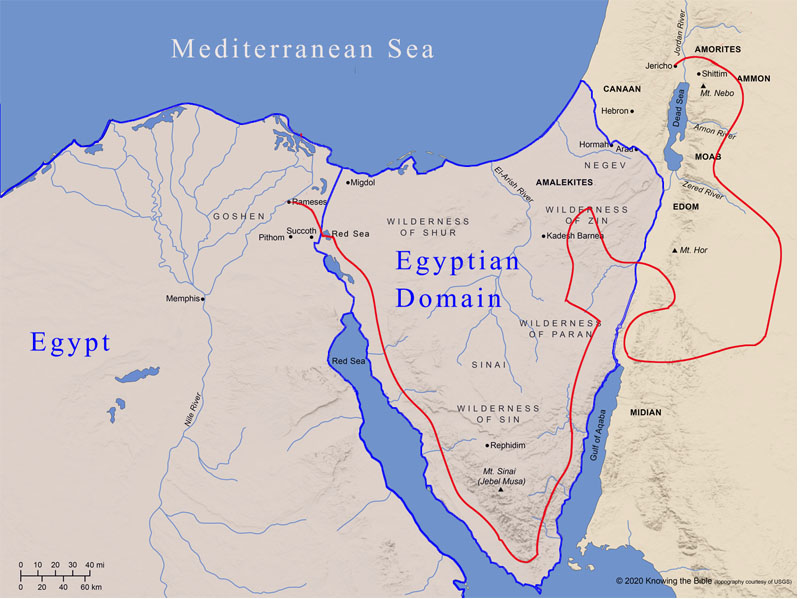
Israelite Journeys Rameses
|
Exodus 30:1 "You shall make an altar to burn incense on; you shall make it of acacia wood. A cubit shall be its length and a cubit its width—it shall be square—and two cubits shall be its height. Its horns shall be of one piece with it. And you shall overlay its top, its sides all around, and its horns with pure gold; and you shall make for it a molding of gold all around. Two gold rings you shall make for it, under the molding on both its sides. You shall place them on its two sides, and they will be holders for the poles with which to bear it. You shall make the poles of acacia wood, and overlay them with gold. And you shall put it before the veil that is before the ark of the Testimony, before the mercy seat that is over the Testimony, where I will meet with you. 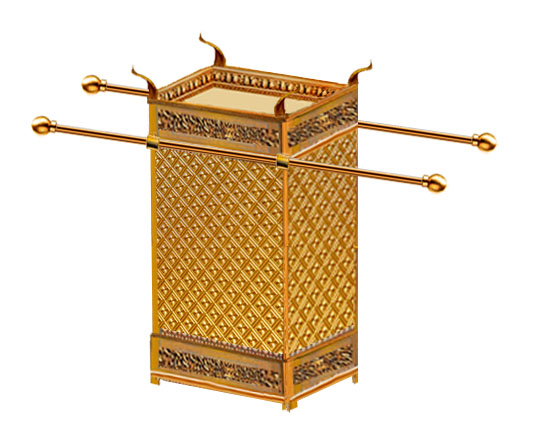 Similar to the brazen altar, the incense altar was made from acacia wood and designed to be carried by poles. But unlike the brazen altar which was overlaid with bronze, this altar was overlaid with gold. It measured 18 inches square and 3 feet high. It was located outside the veil that separated the Holy Place from the Holy of Holies, along with the lampstand and the table of showbread. This altar of incense filled the tabernacle with a pleasant scent in the place where the Glory of the Lord appeared. 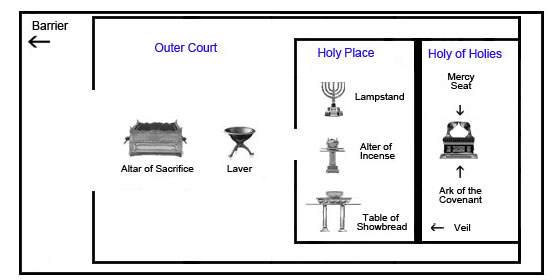 Exodus 30:7 "Aaron shall burn on it sweet incense every morning; when he tends the lamps, he shall burn incense on it. And when Aaron lights the lamps at twilight, he shall burn incense on it, a perpetual incense before the Lord throughout your generations. You shall not offer strange incense on it, or a burnt offering, or a grain offering; nor shall you pour a drink offering on it. And Aaron shall make atonement upon its horns once a year with the blood of the sin offering of atonement; once a year he shall make atonement upon it throughout your generations. It is most holy to the Lord."
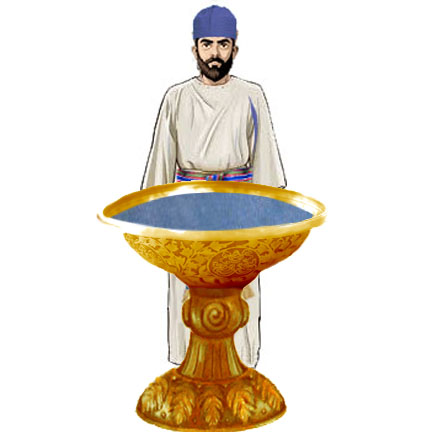
Every morning and evening, Aaron would tend to the lamps and keep them burning uninterrupted. God gave the recipe for making the incense and stipulated that no other incense ever be burned on the altar. The fire that used to burn the incense was always taken from the altar of burnt offering outside the sanctuary. Every year hereafter the priest offered incense for atonement. Day of Atonement (Yom Kippur) occurred once a year. Yom Kippur literately means "day of covering" or in other words the day the sins were covered with blood. On that day, the high priest would put blood on the horns of the altar and then enter the Holy of Holies and sprinkle blood Mercy Seat to atone for the sins of the people. It was on this day, many years later that an angel met with Zacharias as he was performing this ceremony to tell him that Elizabeth was going to have a son, John the Baptist. Exodus 30:11 Then the Lord spoke to Moses, saying: "When you take the census of the children of Israel for their number, then every man shall give a ransom for himself to the Lord, when you number them, that there may be no plague among them when you number them. This is what everyone among those who are numbered shall give: half a shekel according to the shekel of the sanctuary (a shekel is twenty gerahs). The half-shekel shall be an offering to the Lord. Everyone included among those who are numbered, from twenty years old and above, shall give an offering to the Lord. The rich shall not give more and the poor shall not give less than half a shekel, when you give an offering to the Lord, to make atonement for yourselves. And you shall take the atonement money of the children of Israel, and shall appoint it for the service of the tabernacle of meeting, that it may be a memorial for the children of Israel before the Lord, to make atonement for yourselves." When God ordered a census taken, Jewish males over age 20, were required to pay a ransom to remind them that the nation and every citizen in it belonged to the Lord. This first "tax" provided the silver needed for making the foundation of the tabernacle which was made of silver sockets that secured the boards of the tabernacle. It took 3000 shekels to form each one of the 100 sockets. The shekel of the sanctuary (unlike the Roman Denarius) always had a high level of silver, between 90 and 95 percent. A half-shekel contained one-fifth of an ounce of silver. This was the ransom money for 12,000 men. Today that would be worth about $8.25 for a half-shekel. In time it became a yearly "temple tax" that was used for the upkeep and maintenance of the temple. In the ancient world, a census was taken for one of only two purposes: to prepare for war or to impose some sort of taxation. God warned the people that a census was only to be taken when He sanctioned it. David took an unauthorized census (I Chron. 21), and the Lord struck Israel with a plague in which killed 70,000 men. Jesus protested the unfair exchange of the money changers around the Temple who offered their services, converting foreign money to this coin type. Exodus 30:17 Then the Lord spoke to Moses, saying: "You shall also make a laver of bronze, with its base also of bronze, for washing. You shall put it between the tabernacle of meeting and the altar. And you shall put water in it, for Aaron and his sons shall wash their hands and their feet in water from it. When they go into the tabernacle of meeting, or when they come near the altar to minister, to burn an offering made by fire to the Lord, they shall wash with water, lest they die. So they shall wash their hands and their feet, lest they die. And it shall be a statute forever to them—to him and his descendants throughout their generations."
"Cleanliness is next to Godliness." This statement is very appropriate here. Being clean is a sign of spiritual purity or goodness. God insisted that Aasron and his sons have clean hands and feet before they began their services. A bronze laver was placed between the altar and the Tabernacle itself. That they should wash their hands and feet was repeated indicates the importance for this rule. Bronze was commonly used in Egypt, where mirrors were bronze plates, round or oval, with a handle. In ancient times, they would brightly burnish and polish the metal to create a mirror finish. In the laver these mirrors were either artfully joined together or else melted down to cast into a bowl shaped laver. It is possible that the sides of it still served for mirrors, so that the priests, when they came to wash, might there see their reflection, and discover the spots to wash them clean. The priests understood the significance of being consecrated and ready before approaching God's presence. Exodus 30:22 Moreover the Lord spoke to Moses, saying: "Also take for yourself quality spices—five hundred shekels of liquid myrrh, half as much sweet-smelling cinnamon (two hundred and fifty shekels), two hundred and fifty shekels of sweet-smelling cane, five hundred shekels of cassia, according to the shekel of the sanctuary, and a hin of olive oil. And you shall make from these a holy anointing oil, an ointment compounded according to the art of the perfumer. It shall be a holy anointing oil. With it you shall anoint the tabernacle of meeting and the ark of the Testimony; the table and all its utensils, the lampstand and its utensils, and the altar of incense; the altar of burnt offering with all its utensils, and the laver and its base. You shall consecrate them, that they may be most holy; whatever touches them must be holy. And you shall anoint Aaron and his sons, and consecrate them, that they may minister to Me as priests. Along with being a unit of money, the shekel was a unit of weight measurement. "Five hundred shekels" would have been equivalent to about 12 ½ pounds. A hin of olive oil is a unit of measurement in the Hebrew system that is equal to about 1.6 US gallons or 6 liters. Liquid myrrh is a pale yellow to amber oily liquid warm, sweet-balsamic, slightly spicy-medicinal odor. Cinnamon was so highly prized among ancient nations that it was regarded as a gift fit for monarchs. Sweet-smelling cane has an aromatic smell when its knotted stalk is cut and dried and reduced to powder. The bark of cassia is closely related to true cinnamon but has a more pungent, less delicate flavor and is thicker than cinnamon bark. Consecrating Aaron and his sons meant that they were not to do any other type of occupation. Likewise, the tabernacle and all of the furniture in it was also dedicated to the Lord was not to be used for anything that could be interpreted as pagan practice. Exodus 30:31 "And you shall speak to the children of Israel, saying: 'This shall be a holy anointing oil to Me throughout your generations. It shall not be poured on man's flesh; nor shall you make any other like it, according to its composition. It is holy, and it shall be holy to you. Whoever compounds any like it, or whoever puts any of it on an outsider, shall be cut off from his people.' " God declared this kind of mixture and preparation holy and was never to be used for anything else. Man's flesh refers to any man other than the priests. To be cut off from the people could mean excommunication from the people or even physical death. Exodus 30:34 And the Lord said to Moses: "Take sweet spices, stacte and onycha and galbanum, and pure frankincense with these sweet spices; there shall be equal amounts of each. You shall make of these an incense, a compound according to the art of the perfumer, salted, pure, and holy. And you shall beat some of it very fine, and put some of it before the Testimony in the tabernacle of meeting where I will meet with you. It shall be most holy to you. But as for the incense which you shall make, you shall not make any for yourselves, according to its composition. It shall be to you holy for the Lord. Whoever makes any like it, to smell it, he shall be cut off from his people." The incense that was to be burned within the tabernacle was to be made with an equal part of each of stacte (stak-tee) and onycha and galbanum which were mixed with frankincense which is earthy, woody, piney, or balsamic, and at the same time soft, sweet, and citrusy. Stacte is a extracted from myrrh resin. Onycha (On-ē-ka) is an aromatic substance that comes from the shell of a mollusk. Galbanum (găl-bă-nŭm) is a very intense, green, leafy-earthy aroma, with a smooth woody/balsamic undertone. Salt was added as a preservative. Moses was instructed to beat it, producing a fine powdery substance. The results produced a very strong, possibly pungent odor. Again, this particular combination is not to be made for any other purpose. Of all our sensory perceptions, smell is the most directly connected to the seat of our emotions. It is said to be the most sensitive of the senses. The sense of smell is emphasized in the Bible and is considered a spiritual sense that can be used to interact with God. When a sincere heart offers anything to God, Scripture always mentions that it is accepted as a "pleasing aroma" to Him. Bible Study Questions 1. What should the incense altar be made of? 1. Silver 2. Where should they put the incense altar? 1. Before the mercy seat. 3. What should Aaron burn on the incense altar? 1. A burnt offering. 4. What is the ransom use for? 1. To make atonement for themselves. 5. How much is the ransom for each man? 1. Half a shekel. 6. What is the laver made of? 1. Silver. 7. What is the laver used for? 1. Washing hands and feet. 8.What is the holy anointing oil made of? 1. Frankincense, myrrh and gold. 9. Who is to make the anointing oil? 1. A perfumer. 10. What should they do with the anointing oil? 1. Anoint Moses before he goes into the tabernacle. |
| Matt, Sue, Cassie, Joe | |