Exodus 3 – Moses at the Burning Bush
Timeline: 1450 BC
|
|
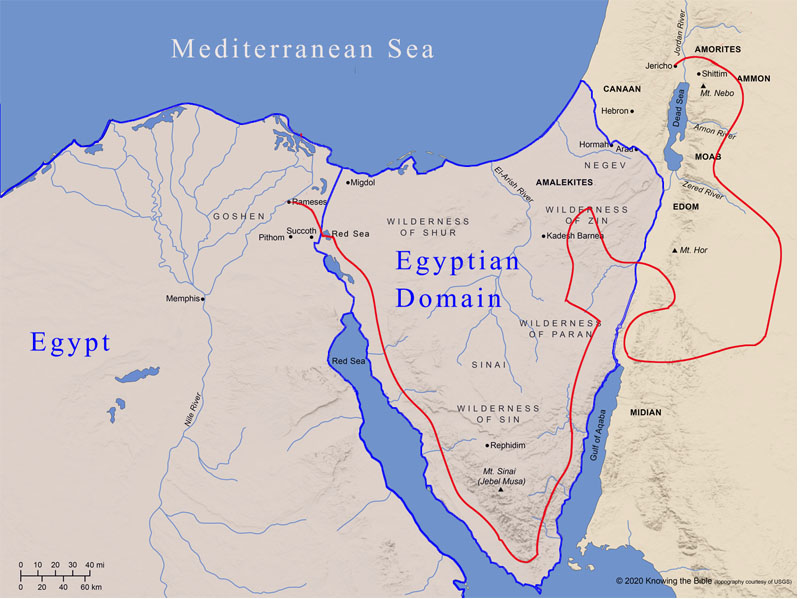
The years of the life of Moses are divided into three forty year segments; the first forty he spent as a prince in Pharaoh's court, the second as a shepherd in Midian, the third as a deliverer of the people of Israel. In this second segment, Moses was perfectly content living as a shepherd in spite of his upbringing as a prince of Egypt, until the Angel of the Lord appeared to tell him it was time for him to lead Israel out of slavery. We should take note that although the world at that time thought of shepherds as outcasts. God thought otherwise. He used many shepherds to accomplish His plans. 1 Now Moses was tending the flock of Jethro his father-in-law, the priest of Midian. And he led the flock to the back of the desert, and came to Horeb, the mountain of God. And the Angel of the Lord appeared to him in a flame of fire from the midst of a bush. So he looked, and behold, the bush was burning with fire, but the bush was not consumed. Then Moses said, "I will now turn aside and see this great sight, why the bush does not burn." The word "father-in-law" in Hebrew is a word signifying relative by marriage. When Moses arrived in Midian forty years ago, Reuel was an elderly man. So it would seem that Jethro was his son, who, upon his father's death, succeeded into his office. Jethro was probably the eldest son whom received the birthright and would have been responsible for taking his father's place. Mount Sinai is a specific peak which is also called the "Mountain of God" located on the row of mountains called Horeb. God appeared there a number of times. This desert area is very hot and dry. It virtually never rains so it is not uncommon for shrubs to catch on fire. Moses would have had to hunt to find suitable land for his flock to feed so he found himself on the back side of the desert. Although Moses was used to seeing bushes on fire, this particular one was burning but did not turn to ash. Instead it continued to burn as if it were a torch. Fire, in the Bible, always refers to judgement. The fiery bush was a actually a thorn bush. When God cursed the earth, he instituted the thorn as a symbol of sin. When Jesus was crucified, the Romans placed a crown of thorns on his head...which symbolized our sin for which he died. The "Angel of the Lord" appears over 50 times in the Old Testament. that phrase refers to a Christophany, a pre-incarnate Christ which means "the appearance of God." The only Member of the Godhead Who is ever made visible in the Creation is the Second Person. Man cannot look upon God and live so He manifested Himself in a way in which He could communicate with Moses. 4 So when the Lord saw that he turned aside to look, God called to him from the midst of the bush and said, "Moses, Moses!" And he said, "Here I am." When God calls the name of a person twice, He's getting ready to to something radical in that person's life. Moses answers "Here I am" to indicate that he is ready to hear what shall be said, and to obey whatever is commanded. 5 Then He said, "Do not draw near this place. Take your sandals off your feet, for the place where you stand is holy ground." Moreover He said, "I am the God of your father—the God of Abraham, the God of Isaac, and the God of Jacob." And Moses hid his face, for he was afraid to look upon God. Removing the sandals was a token of respect and submission. This barren spot became Holy because of God's presence. Notice that God does not say, I was the God of Abraham, Isaac, and Jacob, but I am, indicating the everlasting existence of God in the past, present and future. Moses hid his face as a man brought suddenly into the sunlight, from a darkened chamber, confronted the light of the divine nature. Just as Adam and Eve hid from God after they ate the forbidden fruit, our sinfulness and unworthiness cannot be hidden from God. Sin causes man to fear God's justice. 7 And the Lord said: "I have surely seen the oppression of My people who are in Egypt, and have heard their cry because of their taskmasters, for I know their sorrows. So I have come down to deliver them out of the hand of the Egyptians, and to bring them up from that land to a good and large land, to a land flowing with milk and honey, to the place of the Canaanites and the Hittites and the Amorites and the Perizzites and the Hivites and the Jebusites. Now therefore, behold, the cry of the children of Israel has come to Me, and I have also seen the oppression with which the Egyptians oppress them. God saw the affliction of His people, heard the cry of His people, and knew the sorrow of His people, He was moved with compassion to move on behalf of His people. The time had come for Him to deliver His people from their oppression. The prophecy that was given to Abraham in Genesis 15:13-14 was about to be fulfilled. They were to inherit the land flowing with milk and honey. Milk was a graphic way of highlighting the agricultural richness of the land. The inhabitants were descendants of Ham who was cursed by Noah. 10 Come now, therefore, and I will send you to Pharaoh that you may bring My people, the children of Israel, out of Egypt." But Moses said to God, "Who am I that I should go to Pharaoh, and that I should bring the children of Israel out of Egypt?" Moses failed in his early attempt to be the children of Israel's deliverer when he came to the aid of a fellow Hebrew. They said, "Who made you a prince and a judge over us?" Those words resonated with him for forty years. His confidence was crushed and now the Lord is asking HIM to save his people? 12 So He said, "I will certainly be with you. And this shall be a sign to you that I have sent you: When you have brought the people out of Egypt, you shall serve God on this mountain." What better comrade to have with you in face of opposition than to have the Lord your God with you? Essentially, God is making a promise that Moses will be back on this very mountain with His people to serve Him. 13 Then Moses said to God, "Indeed, when I come to the children of Israel and say to them, 'The God of your fathers has sent me to you,' and they say to me, 'What is His name?' what shall I say to them?" 14 And God said to Moses, "I AM WHO I AM." And He said, "Thus you shall say to the children of Israel, 'I AM has sent me to you.' " A Tetragrammaton is a combination of four Hebrew letters to form the ancient Hebrew name of God, YHWH. The name Yahweh means God is the unchanging, everlasting, all-powerful, undefinable Creator of all. The original pronouncement of His name is unknown today. When God gave the Hebrews His name, they revered His name so highly that they felt they weren't worthy to pronounce it. It became unpronounceable so they use the tetragrammaton Yahweh instead. 15 Moreover God said to Moses, "Thus you shall say to the children of Israel: 'The Lord God of your fathers, the God of Abraham, the God of Isaac, and the God of Jacob, has sent me to you. This is My name forever, and this is My memorial to all generations.' Go and gather the elders of Israel together, and say to them, 'The Lord God of your fathers, the God of Abraham, of Isaac, and of Jacob, appeared to me, saying, "I have surely visited you and seen what is done to you in Egypt; and I have said I will bring you up out of the affliction of Egypt to the land of the Canaanites and the Hittites and the Amorites and the Perizzites and the Hivites and the Jebusites, to a land flowing with milk and honey." ' The elders would have known God's name. It would be as if Moses showed them a certified document proving the authenticity of the message that he was going to be their amassador and deliverer. In God's message, He recognized the suffering of the Israelites and promised to free them and give them a land extremely well-suited to growing food and raising livestock. God first made this promise to Abraham then to Isaac and then to Jacob. The six nations who were occuping Canaan were condemned for worshipping other gods and living immorally. God would remove these nations to provide a land for His people to live holy before Him. 18 Then they will heed your voice; and you shall come, you and the elders of Israel, to the king of Egypt; and you shall say to him, 'The Lord God of the Hebrews has met with us; and now, please, let us go three days' journey into the wilderness, that we may sacrifice to the Lord our God.' But I am sure that the king of Egypt will not let you go, no, not even by a mighty hand. So I will stretch out My hand and strike Egypt with all My wonders which I will do in its midst; and after that he will let you go. And I will give this people favor in the sight of the Egyptians; and it shall be, when you go, that you shall not go empty-handed. But every woman shall ask of her neighbor, namely, of her who dwells near her house, articles of silver, articles of gold, and clothing; and you shall put them on your sons and on your daughters. So you shall plunder the Egyptians." God stated that the heads of the tribes would listen to Moses and told him to go to Pharoah to deliver the message. They are to request that they go to Mount Sinai, which is about three days' journey from Gochen, to make their sacrifice. Since the worship of the Israelites offended the Egyptians, they could not celebrate any religious festival in Egypt. God offered a test of obedience to Pharoah. Although He knew the results, it is His nature to allow people to make their own choices. Nevertheless, He warned Moses that his efforts will be rejected. God tells Moses that in the end, Pharoah will let them go. The Israelites will not leave Egypt empty-handed. Bible Study Questions 1. How long was Moses serving his father-in-law in Midian?
2. Who is the Angel of the Lord?
3. Why did God call Moses' name twice?
4. What made the place where Moses stood considered "holy ground"? 5. What does the phrase "I AM WHO I AM" mean?
6. Why was Moses afraid to look at God?
7. Why did God command Moses to lead His people out of Egypt?
8. Why was Moses reluctant to lead the Israelites from Egypt?
9. In this chapter, who did God tell Moses to take with him when he approach Pharoah?
10. What did God tell the people to take with them when they left?
|
| Cassie, Matt, Joe, Sue, Kelly | |