Exodus 27 - The Altar of Burnt Offering and the Courtyard
Timeline: 1450 BC
|
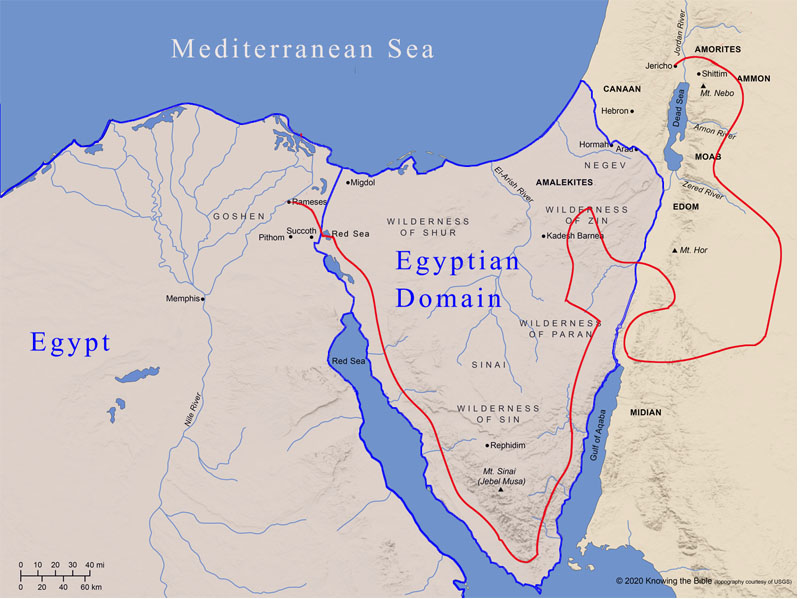
Israelite Journeys Rameses
|
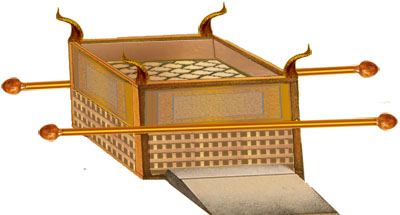
Moses spent 40 days on the mountains and in this chapter, God is explaining the instructions for the altar, the court and how they should keep the lampstand burning. Exodus 27:1 "You shall make an altar of acacia wood, five cubits long and five cubits wide—the altar shall be square—and its height shall be three cubits. You shall make its horns on its four corners; its horns shall be of one piece with it. And you shall overlay it with bronze. Also you shall make its pans to receive its ashes, and its shovels and its basins and its forks and its firepans; you shall make all its utensils of bronze. You shall make a grate for it, a network of bronze; and on the network you shall make four bronze rings at its four corners. You shall put it under the rim of the altar beneath, that the network may be midway up the altar. And you shall make poles for the altar, poles of acacia wood, and overlay them with bronze. The poles shall be put in the rings, and the poles shall be on the two sides of the altar to bear it. You shall make it hollow with boards; as it was shown you on the mountain, so shall they make it." The word "altar" comes from the Latin words altārium, which means "high", and adorare, which means "to ritually burn or sacrifice". There were two altars in the tabernacle, one inside the Holy Place, and the other outside in the outer court. The one inside was the altar of incense. The smoke from the incense symbolized the prayers of God's people ascending to God. The one outside was the altar of sacrifice. God's law requires death as the penalty for sin. In the Old Testament days He provided an animal as a substitute for a human life. The Israelites offered regular sacrifices for atonement. When God saw the death of the innocent sacrifice, He was satisfied that the demands of His law had been carried out. The blood provided a symbolic covering for debt of the broken law, which was contained in the ark. The altar was 7 feet 6 inches square, and 4 feet 6 inches high and made of bronze. This was open at the bottom, with a grate on which to lay the sacrifice. The tools used for sacrifice, included basins and shovels for removing the ashes, bowls to hold the blood, meat forks used to place the sacrifice on the altar, and firepans used for taking coals from the altar to be used in burning incense. Bronze is harder than gold and silver and better able to resist heat and fire so all the tools were also made from bronze. The brazen altar was located between the entrance to the courtyard and the doorway to the Holy Place of the sanctuary. The fire of the altar was to be kept burning at all times. The priests could not enter the Holy Place or the Holy of Holies without first sacrificing at the altar. Horns were a symbol power and strength in biblical times. When the sacrifice was made, blood was smeared on the horns in ceremonial atonement for sins and offerings were burned completely. The horns of the altar represented a holy place. Scripture indicates they were used as a refuge for fugitives. No one would dare kill a person at the same place where offerings were made to the Lord. People who sought to be "saved" from being killed would run to the "altar" of God, and "take hold of the horns" for protection. Some who did so were given "grace," while others faced "justice". The cross was the last altar. Jesus came to fulfill the purpose that our sin required. Once He died on the cross, this sacrificial altar was no longer necessary. He would not just cover up our sins but actually take them away for good. The crucifixion was the perfect sacrifice, made once for all, and for all time. The altar we go to in church reminds us that our sin requires a substitute for forgiveness and our sins are forgiven through the Messiah.Exodus 27:9 "You shall also make the court of the tabernacle. For the south side there shall be hangings for the court made of fine woven linen, one hundred cubits long for one side. And its twenty pillars and their twenty sockets shall be bronze. The hooks of the pillars and their bands shall be silver. Likewise along the length of the north side there shall be hangings one hundred cubits long, with its twenty pillars and their twenty sockets of bronze, and the hooks of the pillars and their bands of silver." The tabernacle was surrounded by the outer court. The wall was made of linen hangings placed between bronze pillars. Linen in the Bible is a symbol of Righteousness. The fine white linen that made the fence was of exceptional quality, imported from Egypt. It is made from the fibers of the flax plant, a labor intensive process, making it very valuable. The Ancient Egyptians sometimes used linen as a type of currency. The "fine twined linen" was smooth, silk like texture, white, glistening and reflective in appearance and the fibers provide great insulation It is interesting that the length of the linen fence hangings is the same as the coverings over the tabernacle. "And along the width of the court on the west side shall be hangings of fifty cubits, with their ten pillars and their ten sockets. The width of the court on the east side shall be fifty cubits. The hangings on one side of the gate shall be fifteen cubits, with their three pillars and their three sockets. And on the other side shall be hangings of fifteen cubits, with their three pillars and their three sockets." The "wall" stood much taller than a person of average height, 8½ feet high. The multi-colored gate was the only entrance from outside to the tabernacle in the courtyard. This court area separated the tabernacle from the surrounding tents. It made a clear distinction between the dwelling place of the Lord and the dwelling place of the people. The priests camped immediately outside the gate on the east side, and the Levites it on the other three sides. Wherever the people went, the Tabernacle went with them, taken down and re-erected every time they moved until the fourth year of King Solomon nearly five hundred years later when it was superseded by the Temple in Jerusalem.In Jesus' time, the outermost court of the temple was called the "Court of Gentiles" where gentiles are allowed to go. During the high holy days, hundreds of thousands of people would go through this court. This was a bazaar filled with pilgrims, money changers, people selling livestock and doves for sacrifice, priests directing people, etc. It was in this court that Jesus drove out the money changer. Prophecy tells us that a new temple will be built. During the tribulation, God will allow unbelievers to "trample" or defile the temple by reintroducing idolatry to Israel. The temple's outer court and Jerusalem will be under Gentile control for forty-two months, the second half of the tribulation. Then, the false prophet will desecrate its altar by placing a statue of the first beast in the holy of holies and demand that the Jewish people worship him.
Ezekiel 40-42 describes the construction of the largest and most magnificent temple ever at the end of the tribulation when Jesus returns to earth in all His glory. He will establish His Kingdom and throne in Jerusalem and begin His thousand-year reign. Exodus 27:16 "For the gate of the court there shall be a screen twenty cubits long, woven of blue, purple, and scarlet thread, and fine woven linen, made by a weaver. It shall have four pillars and four sockets. All the pillars around the court shall have bands of silver; their hooks shall be of silver and their sockets of bronze. The length of the court shall be one hundred cubits, the width fifty throughout, and the height five cubits, made of fine woven linen, and its sockets of bronze. All the utensils of the tabernacle for all its service, all its pegs, and all the pegs of the court, shall be of bronze." There was only one gate by which people could enter into the tabernacle courtyard. The gate was 30 feet wide. It was located directly in the center of the outer court on the east end. The gate was covered by a curtain or screen made of finely twisted linen in blue, purple and scarlet. The screen gate was the only entrance into the court which surrounded the tabernacle on the east. Pans were designed to hold the fat-soaked ashes when they were removed from the hearth by the shovels. Basins were made to catch the blood of the animals slain beside the altar to be sprinkled on the altar's base. Three-pronged forks were used for arranging the sacrifice or retracting the priest's portion. Firepans were filled with coals and taken to the altar of incense inside the Holy Place. All these utensils were made of bronze. Exodus 27:20 "And you shall command the children of Israel that they bring you pure oil of pressed olives for the light, to cause the lamp to burn continually. In the tabernacle of meeting, outside the veil which is before the Testimony, Aaron and his sons shall tend it from evening until morning before the Lord. It shall be a statute forever to their generations on behalf of the children of Israel." The menorah stood in the holy place of the temple. It held seven lamps filled with a special type of oil that only Aaron and his descendants were allowed prepare. One of the jobs of the priests was to fill the little cups each day to provide light in the holy place. According to the Talmud, each lamp held about 9 ounces of oil which was enough to last throughout the night. Bible Study Questions 1. What shape should the altar be? 1. The altar shall be circular. 2. What should be on the corners of the altar? 1. Four horns. 3. After the altar, what was the next thing God instructed to build? 1. The ark of the covenant. 4. What should the hooks of the pillars and their bands be made of? 1. Bronze 5. How wide will the court on the east side be? 1. Ten cubits. 6. What was the screen used for? 1. The gate of the tabernacle. 7. What should the screen be made of? 1. Woven of gold, silver, and scarlet thread, and fine woven linen. 8. What should the utensils of the tabernacle be made from? 1. Bronze 9. What did Aaron and his sons use for lamp oil? 1. Pure olive oil. 10. How long should they leave the lamp burning? 1. Only till morning. |
| Cassie, Matt, Joe, Mary, Sue | |