Exodus 26 - The Dwelling Place (Mishkan)
Timeline: 1450 BC
|
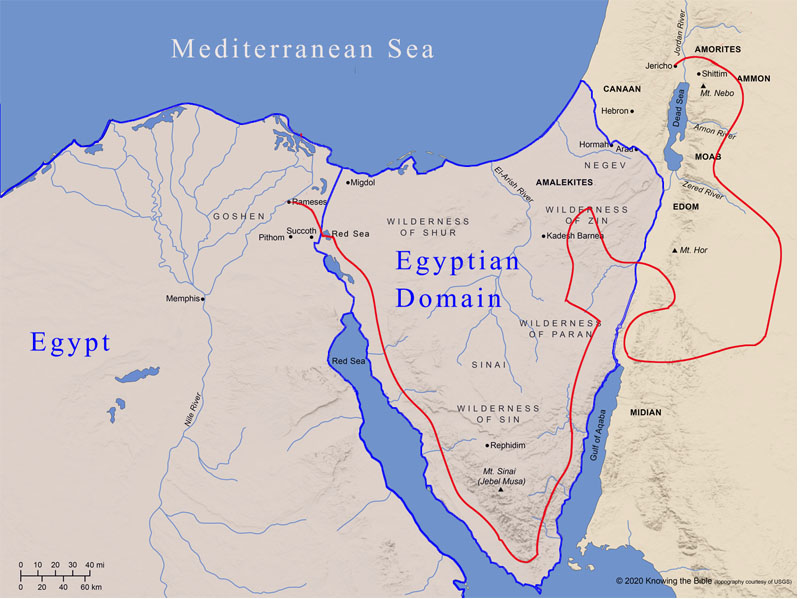
Israelite Journeys Rameses
|
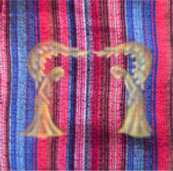
God emphasizes His desire to dwell among His people. This Chapter details the intricate design that God called the 'Tabernacle'. The word "tabernacle" simply means "tent" or "dwelling". Before the tabernacle was built, Moses put up a tent called a "Tent of Meeting" that he would use to go in and speak to God. In future verses, the tabernacle is used interchangeably with the Tent of Meeting. Over the last two thousand years, synagogue construction has followed the outlines of the original tabernacle. The tabernacle was built in seven months and formally set up on the first day of the first month of the second year after the Exodus. It was portable and set up by the Levi priests only. Exodus 26:1 "Moreover you shall make the tabernacle with ten curtains of fine woven linen and blue, purple, and scarlet thread; with artistic designs of cherubim you shall weave them. The length of each curtain shall be twenty-eight cubits, and the width of each curtain four cubits. And every one of the curtains shall have the same measurements. Five curtains shall be coupled to one another, and the other five curtains shall be coupled to one another. And you shall make loops of blue yarn on the edge of the curtain on the selvedge of one set, and likewise you shall do on the outer edge of the other curtain of the second set. Fifty loops you shall make in the one curtain, and fifty loops you shall make on the edge of the curtain that is on the end of the second set, that the loops may be clasped to one another. And you shall make fifty clasps of gold, and couple the curtains together with the clasps, so that it may be one tabernacle.
The Israelites used their craftsmanship skills and offerings of materials to build the tabernacle, with everyone playing a role, no matter how small. Ten ornamented tapestries formed the Dwelling itself. These were each 42 ft. long and 6 ft. wide. Each one had figures of cherubim interwoven by a designer. They were joined together by fifty golden hooks to form a single large curtain, 60 ft. long and 42 ft. wide. These would cover the ceiling of the tabernacle. The cherubim that was woven into the curtains represented the actual ones that are in the heavenly tabernacle. Exodus 26:7 "You shall also make curtains of goats' hair, to be a tent over the tabernacle. You shall make eleven curtains. The length of each curtain shall be thirty cubits, and the width of each curtain four cubits; and the eleven curtains shall all have the same measurements. And you shall couple five curtains by themselves and six curtains by themselves, and you shall double over the sixth curtain at the forefront of the tent. You shall make fifty loops on the edge of the curtain that is outermost in one set, and fifty loops on the edge of the curtain of the second set. And you shall make fifty bronze clasps, put the clasps into the loops, and couple the tent together, that it may be one. The remnant that remains of the curtains of the tent, the half curtain that remains, shall hang over the back of the tabernacle. And a cubit on one side and a cubit on the other side, of what remains of the length of the curtains of the tent, shall hang over the sides of the tabernacle, on this side and on that side, to cover it.
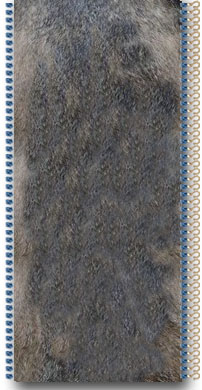
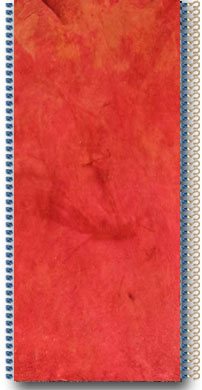
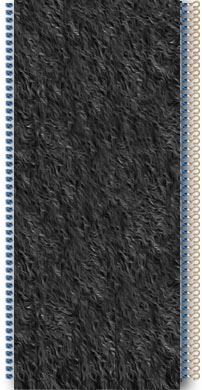
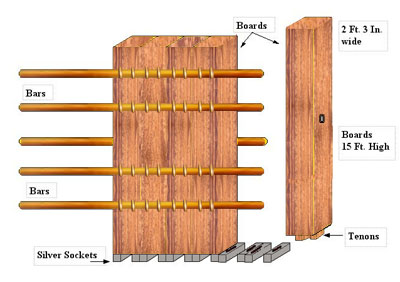
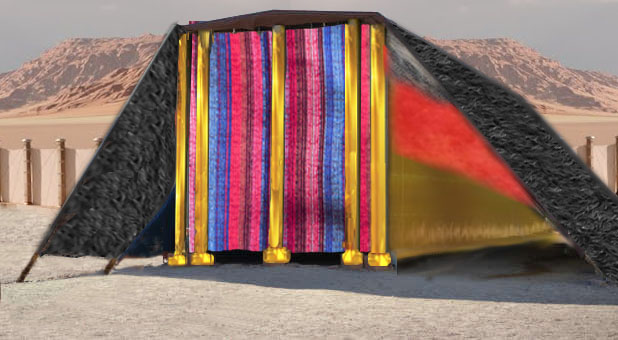
On top of the linen ceiling was the curtain of goat's hair which came from long-haired goats and most likely was black in color. It was a coarse material that often was used to weave tents. Today it would be more like felt. These curtains were coupled with bronze clips where the linen curtains were covered with gold clips. The goats' hair layer was six feet longer and three feet wider than the fine linen layer so it completely covered over the fine linen layer, the extra length covered over the back portion of the tent. Interesting point: Rebecca had Jacob put goat's hair on his arms to deceive Isaac. Then Joseph's brothers put goat's blood on his robe to deceive Jacob. Goats are used to be sin offering. They were to make eleven curtains – there are eleven types of goat sin offerings. Exodus 26:14 "You shall also make a covering of ram skins dyed red for the tent, and a covering of badger skins above that. Exodus 26:15 "And for the tabernacle you shall make the boards of acacia wood, standing upright. Ten cubits shall be the length of a board, and a cubit and a half shall be the width of each board. Two tenons shall be in each board for binding one to another. Thus you shall make for all the boards of the tabernacle. And you shall make the boards for the tabernacle, twenty boards for the south side. You shall make forty sockets of silver under the twenty boards: two sockets under each of the boards for its two tenons. And for the second side of the tabernacle, the north side, there shall be twenty boards and their forty sockets of silver: two sockets under each of the boards. For the far side of the tabernacle, westward, you shall make six boards. And you shall also make two boards for the two back corners of the tabernacle. They shall be coupled together at the bottom and they shall be coupled together at the top by one ring. Thus it shall be for both of them. They shall be for the two corners. So there shall be eight boards with their sockets of silver—sixteen sockets—two sockets under each of the boards. Ram's skin was laid on top of the goat's hair layer. Abel offered a lamb for an offering of faith, God substituted a ram for Isaac when Abraham was about to sacrifice his son, and finally, the Son of man was considered a sacrificial lamb. The significance of badger skin is durability. The Israelites wandered for 40 years in the desert but their shoes never wore out. They were undoubtedly made with the badger skin. God provided them with everything they needed to survive.
Exodus 26:26 "And you shall make bars of acacia wood: five for the boards on one side of the tabernacle, five bars for the boards on the other side of the tabernacle, and five bars for the boards of the side of the tabernacle, for the far side westward. The middle bar shall pass through the midst of the boards from end to end. You shall overlay the boards with gold, make their rings of gold as holders for the bars, and overlay the bars with gold. And you shall raise up the tabernacle according to its pattern which you were shown on the mountain. Moses received a vision of exactly how the tabernacle should look. He had to communicate this vision to the craftsmen who did the actual building. Every detail of the tabernacle points to the cross at Calvary. Goat skins: sin offering, Ram skins: substitutionary offering, Badger skins: complete provision, Acacia wood: Humanity covered by Gold (Diety), Foundation of silver: speaks of His shed blood.
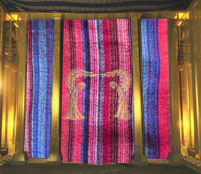
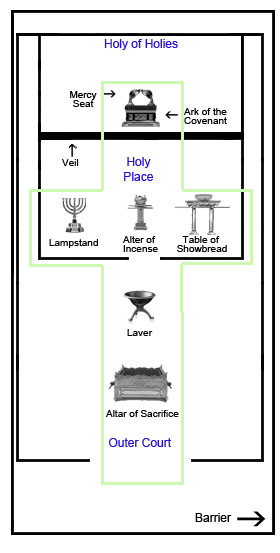
Exodus 26:31"You shall make a veil woven of blue, purple, and scarlet thread, and fine woven linen. It shall be woven with an artistic design of cherubim. You shall hang it upon the four pillars of acacia wood overlaid with gold. Their hooks shall be gold, upon four sockets of silver. And you shall hang the veil from the clasps. Then you shall bring the ark of the Testimony in there, behind the veil. The veil shall be a divider for you between the holy place and the Most Holy. You shall put the mercy seat upon the ark of the Testimony in the Most Holy. You shall set the table outside the veil, and the lampstand across from the table on the side of the tabernacle toward the south; and you shall put the table on the north side. The Holy of Holies is separated from the Holy Place with a very thick veil. This eighteen inch thick veil is the one God tore after Jesus died on the cross. In the Old Testament, this veil separated man from God and guarded by the cherubim. Once Jesus died, God allowed us to have access directly to God through Jesus.
Exodus 26:36 "You shall make a screen for the door of the tabernacle, woven of blue, purple, and scarlet thread, and fine woven linen, made by a weaver. And you shall make for the screen five pillars of acacia wood, and overlay them with gold; their hooks shall be gold, and you shall cast five sockets of bronze for them. There is only one way into the tabernacle – Jesus said, "I am the way and the truth and the life. No one comes to the Father except through me."
Bible Study Questions 1. What should the curtains be made from? 1. Sewn together linen of blue, purple, and scarlet thread. 2. What artistic design should be woven into the curtains 1. Cheribum 3. How many loops should be made on the edge of the curtain? 1. 10 4. What should the coverings be made from? 1. Goats hair, Ram skin, Badger Skin 5. What color should the Ram skin be dyed? 1. Red 6. What should the acacia wood be covered in? 1. Bronze 7. How many sockets of silver should there be under each of the boards? 1. 2 8. What should the be in put in the Holy Place? 1. The table of showbread and the golden lampstand. 9. What should be behind the veil in the Holy of Holies? 1. The golden lampstand. 10. Who made the screen for the door of the tabernacle? 1. A seamstress. |