Exodus 24 - Israel Affirms the Covenant
Timeline: 1450 BC
|
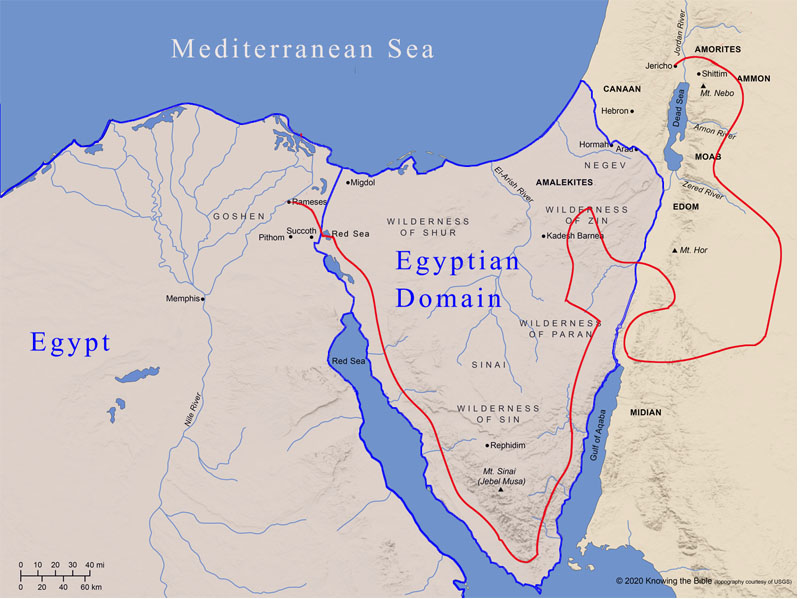
Israelite Journeys Rameses
|
God gave his commandments and laws to the children of Israel. They promised twice that they would live by everything that was written. Now it is time to "sign the contract." Two of the most ancient expressions of bonding between two parties required eating together and establishing blood ties. During the Last Supper, Jesus used similar words to seal His contract with us:
At Sinai, the Old Covenant key words were "if you" (Exodus 19:5), but in the New Covenant, the key words are "I will". The Old Covenant was confined to the descendants of Abraham through Isaac and Jacob according to the flesh. The Old Covenant didn't "work" was because of the weakness and inability of man. The offerings they made were to cover over their sins. The Old Covenant was written by God on tablets of stone . Exodus 24:1 Now He said to Moses, "Come up to the Lord, you and Aaron, Nadab and Abihu, and seventy of the elders of Israel, and worship from afar. And Moses alone shall come near the Lord, but they shall not come near; nor shall the people go up with him." Aaron, Nadab, Abihu and the seventy elders came inside the barriers. At this point, they were at the foot of the mountain. Aaron, Moses' brother, was born to a family of Levites during Israel's enslavement in Egypt. God chose Aaron to act as Moses' spokesperson as he confronted Pharaoh and brought the plagues upon Egypt. Then He selected Aaron to be the first high priest of God's people. The high priests were to be from the tribe of Levi, as Moses and Aaron were, but specifically from Aaron's family line. Nadab and Abihu were the two oldest of the four sons born to Aaron. God also invited seventy of the elders, who were the heads of the tribes and families. However they were not allowed to go up the mountain. Exodus 24:3 So Moses came and told the people all the words of the Lord and all the judgments. And all the people answered with one voice and said, "All the words which the Lord has said we will do." And Moses wrote all the words of the Lord. And he rose early in the morning, and built an altar at the foot of the mountain, and twelve pillars according to the twelve tribes of Israel. Then he sent young men of the children of Israel, who offered burnt offerings and sacrificed peace offerings of oxen to the Lord. And Moses took half the blood and put it in basins, and half the blood he sprinkled on the altar. Then he took the Book of the Covenant and read in the hearing of the people. And they said, "All that the Lord has said we will do, and be obedient." And Moses took the blood, sprinkled it on the people, and said, "This is the blood of the covenant which the Lord has made with you according to all these words." "All the words of the Lord" refers to the Ten Commandments and the judgments and the laws which Moses wrote in the Book of the Covenant (Exodus 20:22-23:33). The people verbally agreed, for the third time, to obey the Lord. Moses constructed an altar at the foot of the mountain, along with 12 pillars representing the 12 tribes of Israel. The purpose of the burnt offerings was intended to atone for sin and renew the relationship between God and His people. A burnt offering was entirely burnt on the altar. The Peace Offering was made as a commitment to God and was to be shared as a type of thanksgiving meal. To seal the Covenant between God and His people, Moses sprinkled half the blood on the altar and the other half on the people. The earthly service was glorious in the eyes of man but merely covered the sins of man. Exodus 24:9 Then Moses went up, also Aaron, Nadab, and Abihu, and seventy of the elders of Israel, and they saw the God of Israel. And there was under His feet as it were a paved work of sapphire stone, and it was like the very heavens in its clarity. But on the nobles of the children of Israel He did not lay His hand. So they saw God, and they ate and drank. Under normal circumstances, a person would die immediately if they saw God in all His glory. However, several passages mention the angel of the Lord appearing to people, and this "angel" is often referred to as God in some passages. When God appears this way, he does not display his full glory because no one would survive the encounter. The phrase translated as "face to face" is simply a "Hebrew way of saying that there was a personal communication between God and a human being. They encountered the pre-incarnate Christ, or "Christophany." The sapphire is frequently used in the Bible to describe the throne of God. It is a precious and beautiful gemstone, and its blue color is often associated with the sky and the divine. Exodus 24:12 Then the Lord said to Moses, "Come up to Me on the mountain and be there; and I will give you tablets of stone, and the law and commandments which I have written, that you may teach them." So God told Moses to come up the mountains and He would write The Constitution of the people of Israel (The Ten Commandments) and the supreme law (the Book of the Covenant) "written in stone". According to the Targum, the Aramaic translation of the Bible, "Then it was said to Moses: Ascend to the firmament and I will give you two tablets of stone, hewn from the sapphire of the throne of My glory, gleaming like fine gold, arranged in lines and written by My finger. Engraved on them are the Ten Words, refined more than silver that has been refined in seven times seven [ways]-that is the sum. - Targums Chapter 1:82-88 Exodus 24:13 So Moses arose with his assistant Joshua, and Moses went up to the mountain of God. And he said to the elders, "Wait here for us until we come back to you. Indeed, Aaron and Hur are with you. If any man has a difficulty, let him go to them." Then Moses went up into the mountain, and a cloud covered the mountain. Moses left his brother Aaron and Hur, the son of Miriam (Moses and Aaron's nephew), in charge and took Joshua half way up the mountain. Then Joshua stayed there while Moses continued. Exodus 24:16 Now the glory of the Lord rested on Mount Sinai, and the cloud covered it six days. And on the seventh day He called to Moses out of the midst of the cloud. The sight of the glory of the Lord was like a consuming fire on the top of the mountain in the eyes of the children of Israel. So Moses went into the midst of the cloud and went up into the mountain. And Moses was on the mountain forty days and forty nights.
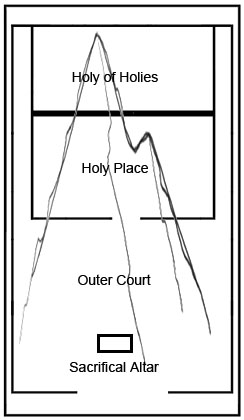
Before God gave Moses the plans for constructing the Tabernacle, the mountain presented itself as a diagram. The tabernacle consisted of three parts: Surrounding the Tabernacle is a boundary just as Moses was told to build.
An alter was built at the foot of the mountain - the outer court of the Tabernacle was where the sacrificial altar was placed for atonement and worship.
The first section inside the boundary of the Tabernacle was the Holy Place where priests were allowed. Joshua went with Moses half way up the mountain but the elders had to wait in the "outer court" or at the foot of the mountain.
The innermost section in the Tabernacle was the Holy of Holies. The Holy of Holies was accessible only to the Israelite high priest. God said that He would appear in the Holy of Holies.
The three parts of the tabernacle complex represented different parts of the mountain. The Most Holy Place paralleled the top of the mountain; the Holy Place paralleled the side of the mountain; the courtyard with its bronze altar paralleled the foot of the mountain. Just as the representatives of the people had to be consecrated through sacrifices on an altar before ascending Mount Sinai, the priests had to be consecrated before entering the Holy Place. Bible Study Questions 1. How many elders did God invite to the mountain? 1. 4 2. Who said, "All the words which the Lord has said we will do." 1. Moses 3. What did the twelve pillars represent? 1. Twelve tribes of Israel 4. What did Moses do with the blood of the covenant?
5. What did the blood represent?
6. Who went up the mountain with Moses? 1. Aaron 7. What did they do when they saw God? 1. They bowed down and worshipped God 8. What was was under Gods feet? 1. Stairs made of gold 9. What did God give Moses? 1. Tablets of stone, and the law and commandments 10. How many days did Moses stay on the mountain? 1. 24 hours |
| Cassie, Matt, Sue, Mary | |