Exodus 23 - Laws Regarding Justice and Social Responsibility
Timeline: 1450 BC
|
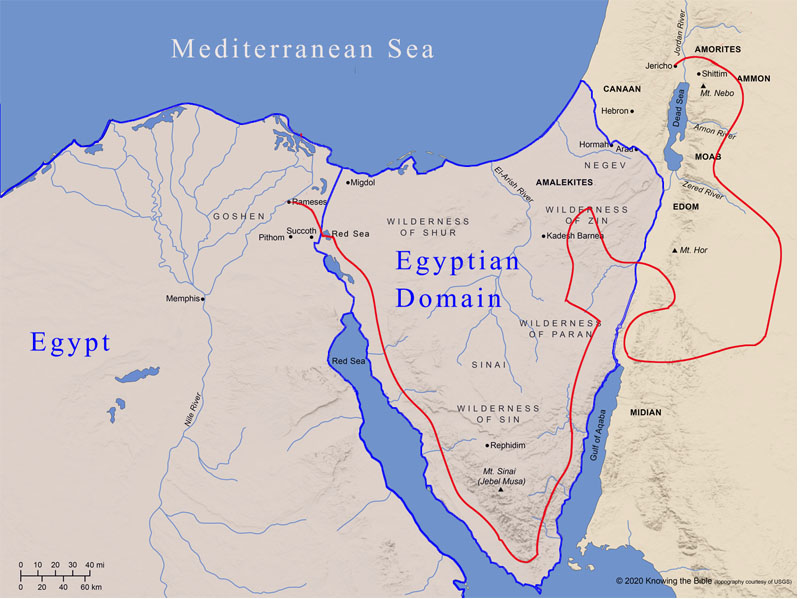
Israelite Journeys Rameses
|
There were 613 laws given by Moses, 365 were negative 248 were positive. This generation of Hebrews had been living among the Egyptians since birth and had learned a lot of bad habits. They needed to be taught God's moral law and justice because they were specially chosen people who were to set an example for the rest of the world. Exodus 23:1 "You shall not circulate a false report. Do not put your hand with the wicked to be an unrighteous witness. You shall not follow a crowd to do evil; nor shall you testify in a dispute so as to turn aside after many to pervert justice. Do not give into spreading rumors that you cannot prove. Do not even listen to a rumor for it may be false. Two or three witnesses are required to convict a person in the Mosaic Law. Bandwagon effect or herd mentality is very difficult to overcome. We have a tendency to adopt behaviors or beliefs because other people are doing it, regardless of our own beliefs, which we may ignore or override. Jesus faced a crowd that was infected by this phenomenon. The Sanhedrin provoked the crowd to order His crucifixion. We see it today as riots begin as a protest and then elevated to a mob. The best way to prevent this is to step back from the crowd and give ourselves time to think. Identify the potential consequences of that influence. Remind ourselves that ultimately, we are responsible for our actions. Decide what kind of person you want to be and avoid people who will likely persuade you to influence you in a negative way. On the other hand, surround yourself with people who have positive influences over you. Exodus 23:3 You shall not show partiality to a poor man in his dispute. Racism is not a political issue — it is a moral issue. People of all races, gender, cultures and experiences are equal in God's eyes. God shows no partiality. When it comes to disputes, both the poor and the rich should be treated equally. The poor should not have a lighter sentence just because he is not influential, nor should a rich man be treated any differently just because he has money. Judges in ancient Persian courts wore blindfolds when hearing a case so that they would not be influenced by the manner of dress and could render a verdict based on the facts. The Roman goddess of justice held a sword, speaking of swift justice in one hand and a set of scales in the other. She was also blindfolded to assure fairness in judgment. Today, many countries around the world recognize Lady Justice as a symbol for their courts. However, the scales have become unbalanced and the blindfold has been removed everywhere in the world. From 3rd world to 1st world countries, all shared stories of corruption and injustice in their nations. Justice is mine says the Lord. It is not our calling to fix this world. God will deal with the corruption and chaos of sin in His own timing. We don't know what's ahead for this world—how much worse it might get before the Lord returns. But in the short time we have, stay alert, keep the faith, pray for strength from God to resist the temptation to join the world in their neglect of worship of God as the most valuable treasure. Exodus 23:4 "If you meet your enemy's ox or his donkey going astray, you shall surely bring it back to him again. If you see the donkey of one who hates you lying under its burden, and you would refrain from helping it, you shall surely help him with it." How you feel about another does not mean you can pervert the law. Showing goodness and kindness is required for all, including the enemy and one who hates you. Consider the "Good Samaritan." He fulfilled this law. We are not to show contempt to someone who is our enemy. If you see a donkey has fallen due to his heavy load, help your enemy pick it up. Exodus 23:6 "You shall not pervert the judgment of your poor in his dispute. Keep yourself far from a false matter; do not kill the innocent and righteous. For I will not justify the wicked. And you shall take no bribe, for a bribe blinds the discerning and perverts the words of the righteous." We must defend the poor against the oppression of the rich, but also to keep our feelings of pity to sway us into making false accusations against the underprivileged. Do not take a bribe or testify against the poor for it may cause the slaying if the innocent and righteous. God will surely take care of the wicked. Exodus 23:9 "Also you shall not oppress a stranger, for you know the heart of a stranger, because you were strangers in the land of Egypt." A stranger ought to be treated no differently than a native. Exodus 23:10 "Six years you shall sow your land and gather in its produce, but the seventh year you shall let it rest and lie fallow, that the poor of your people may eat; and what they leave, the beasts of the field may eat. In like manner you shall do with your vineyard and your olive grove. Six days you shall do your work, and on the seventh day you shall rest, that your ox and your donkey may rest, and the son of your female servant and the stranger may be refreshed." Allowing the land to rest every seventh year was beneficial for soil health, as it helped prevent nutrient depletion and reduced the risk of pests and diseases. This practice ensured the sustainability and fertility of the land for future generations. Another reason the commandment was given was to provide for those in need as well as for animals. The people of Judah rebelled against the principles upon which their nation had been founded in spite of the warnings by the prophet Jeremiah. The Jews committed idolatry, child sacrifice, and ritual prostitution. Because they didn't keep the Sabbath of the land for 490 years, they were enslaved to pay back the 70 missed Sabbath years. After that, they were allowed to return to their land to start again because the land had enjoyed her Sabbaths (see Chronicles 36:21). Man was given six days to work and one day to rest. The Land was given six years to plant and harvest and then one year to rest. For almost 6,000 years the earth has been corrupted by sin. Then the earth will have a Sabbath rest for 1,000 years in the millennial reign. Exodus 23:13 "And in all that I have said to you, be circumspect and make no mention of the name of other gods, nor let it be heard from your mouth." The Sabbath was to be dedicated to the LORD God, and not to any foreign or false god. Exodus 23:14 "Three times you shall keep a feast to Me in the year. You shall keep the Feast of Unleavened Bread (you shall eat unleavened bread seven days, as I commanded you, at the time appointed in the month of Abib, for in it you came out of Egypt; none shall appear before Me empty); and the Feast of Harvest, the firstfruits of your labors which you have sown in the field; and the Feast of Ingathering at the end of the year, when you have gathered in the fruit of your labors from the field. Three times in the year all your males shall appear before the Lord God. You shall not offer the blood of My sacrifice with leavened bread; nor shall the fat of My sacrifice remain until morning. There are seven Mosaic feasts but only three are outlined here. Three times per year, the children of Israel celebrate the Feast of Harvest, the Feast of First Fruits and the Feast of Weeks (Pentecost). The Feast of Leavened Bread was celebrated on the fifteenth of the first month – Nisan (mid-March to mid-April on our calendar), the day after Passover. When the children of Israel left Egypt, they were to make bread without yeast because they didn't have time to let it rise. The unleavened bread represents the Israelites' hasty departure from Egypt, leaving behind sin, idolatry, and false religion. This festival lasts for seven days, and during that time the bread you eat must be made without yeast. The nation of Israel prepares for the Feast of Unleavened Bread by cleaning their homes from any trace of yeast. Interestingly enough, during the Passover week, it is forbidden by law to sell bread in Israel. Grocery stores only sell Matzah (unleavened bread), and all bread or yeast-containing products are removed from the shelves. The Feast of Weeks (Pentecost) is a spring festival taking place on the first day of the week after the Sabbath (50 days after Passover). It usually falls between late March and early April. This feast marks thanksgiving to God for the firstfruits of the harvest. The Israelites were to offer the very first sheaf of the harvest and were not allowed to eat anything from the crop until they gave its initial portion to the Lord. The Feast of Tabernacles is observed in the seventh month on the fifteenth day of Tisri (late September to mid-October). The Israelites celebrated God's continued provision for them in the current harvest and remembered His provision and protection during the 40 years in the wilderness. During this time, all "native born" male Jews were encouraged to repair to the tabernacle in the desert and afterwards the temple that was built by Solomon. Exodus 23:18 The first of the firstfruits of your land you shall bring into the house of the Lord your God. You shall not boil a young goat in its mother's milk." Pagans practiced a superstitious ritual where they would boil a young goat in its mother's milk and sprinkle the trees, fields and gardens with the broth in order to make them more fruitful the following year. Some say that the goat was alive when it was boiled. The Rabbinic law forbids consuming of dairy and meat together because of this. In Israel, meat is never eaten in the same meal where dairy products are eaten. This is part of the kosher kitchen. Exodus 23:20 "Behold, I send an Angel before you to keep you in the way and to bring you into the place which I have prepared. Beware of Him and obey His voice; do not provoke Him, for He will not pardon your transgressions; for My name is in Him. But if you indeed obey His voice and do all that I speak, then I will be an enemy to your enemies and an adversary to your adversaries. For My Angel will go before you and bring you in to the Amorites and the Hittites and the Perizzites and the Canaanites and the Hivites and the Jebusites; and I will cut them off." The Angel here is most often referred to as a pre-incarnate form of Jesus Christ also known as a Christophany. Notice the first sentence? Jesus spoke similar words to the apostles: John 14:3 And if I go and prepare a place for you, I will come again and receive you to Myself; that where I am, there you may be also.God made conditional promises to the children of Israel. He expected obedience and faithfulness from them. If they obeyed, He would give them protection against their enemies. The Amorites, the Hittites, the Perizzites, the Canaanites, the Hivites and the Jebusites we cut off because of they refused to repent. They doomed themselves. Exodus 23:24 "You shall not bow down to their gods, nor serve them, nor do according to their works; but you shall utterly overthrow them and completely break down their sacred pillars. So you shall serve the Lord your God, and He will bless your bread and your water. And I will take sickness away from the midst of you. No one shall suffer miscarriage or be barren in your land; I will fulfill the number of your days. "I will send My fear before you, I will cause confusion among all the people to whom you come, and will make all your enemies turn their backs to you. And I will send hornets before you, which shall drive out the Hivite, the Canaanite, and the Hittite from before you. I will not drive them out from before you in one year, lest the land become desolate and the beast of the field become too numerous for you. Little by little I will drive them out from before you, until you have increased, and you inherit the land. And I will set your bounds from the Red Sea to the sea, Philistia, and from the desert to the River. For I will deliver the inhabitants of the land into your hand, and you shall drive them out before you. You shall make no covenant with them, nor with their gods. They shall not dwell in your land, lest they make you sin against Me. For if you serve their gods, it will surely be a snare to you." Some commentaries believe the word hornet was a metaphore. However others believe they were a sort of wasp that, when it stings a man, it throws him into the rage of a fever. If God drove all their enemies at once, the land would be desolate and uninhabitable. God drove them out slowly, and then He enabled the Hebrews to take over the land. He warned them about co-habitation lest it be too much of a temptation for them to turn to other gods. Bible Study Questions 1. It's ok to testify against the wicked to make sure they get justice. True or False 2. It is ok to testify on behalf of the poor man. True or False 3. If your enemy is lying under his ox, you should not help him or he might kill you. True or False 4. God will justify the wicked because only He knows the heart of men. True or False |
| Cassie, Matt, Joe, Mary | |