Exodus 22 - Further Laws and the Renewal of the Covenant
Timeline: 1450 BC
|
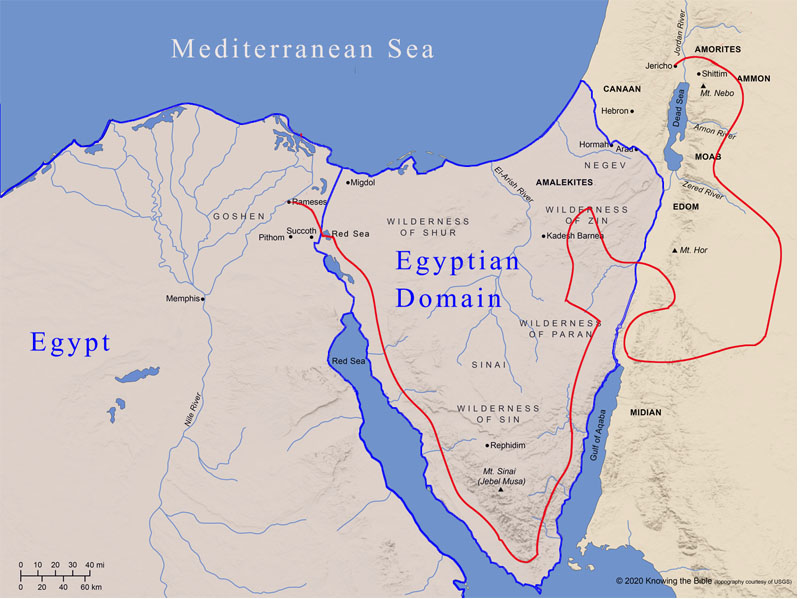
Israelite Journeys Rameses
|
The laws were given to the Hebrews three months after they left Egypt. This chapter continues the detailed laws begun in the previous chapters giving more specific principles to judges, so they could apply that principle in the daily life and administration of justice among the people of Israel. This chapter is all about property and social responsibility. It covers topics such as damage, theft, and how to treat others. Exodus 22:1 "If a man steals an ox or a sheep, and slaughters it or sells it, he shall restore five oxen for an ox and four sheep for a sheep. If the thief is found breaking in, and he is struck so that he dies, there shall be no guilt for his bloodshed. If the sun has risen on him, there shall be guilt for his bloodshed. He should make full restitution; if he has nothing, then he shall be sold for his theft. If the theft is certainly found alive in his hand, whether it is an ox or donkey or sheep, he shall restore double. The penalty for theft did not include jail time. The thief was required to restore what he stole, plus an additional penalty. Should he not be able to pay, the indentured servant law took effect. If a thief breaks in at night, the homeowner has no way of knowing if the perpetrator has a weapon so if he kills the intruder, he is not liable for his death. However, if he breaks in during the day and is caught with the "goods", the thief must pay back twice what he has stolen. If he cannot pay, he is sold as an indentured servant until the debt is paid. Exodus 22:5 "If a man causes a field or vineyard to be grazed, and lets loose his animal, and it feeds in another man's field, he shall make restitution from the best of his own field and the best of his own vineyard. The owner of an animal was responsible for the grazing of his animals. Most of the laws were designed to prevent over-penalizing the victims. Exodus 22:6 "If fire breaks out and catches in thorns, so that stacked grain, standing grain, or the field is consumed, he who kindled the fire shall surely make restitution. Vandalism or foolish negligence: Restitution was paid according to a pre-determined amount or percentage. Exodus 22:7 "If a man delivers to his neighbor money or articles to keep, and it is stolen out of the man's house, if the thief is found, he shall pay double. If the thief is not found, then the master of the house shall be brought to the judges to see whether he has put his hand into his neighbor's goods. A neighbor is asked to keep and guard the other's property. If the neighbor refuses to give it back or if it was damaged, they go before the judges to settle the matter. If it was stolen, the laws of stealing would come into effect. Exodus 22:9 "For any kind of trespass, whether it concerns an ox, a donkey, a sheep, or clothing, or for any kind of lost thing which another claims to be his, the cause of both parties shall come before the judges; and whomever the judges condemn shall pay double to his neighbor. If a man delivers to his neighbor a donkey, an ox, a sheep, or any animal to keep, and it dies, is hurt, or driven away, no one seeing it, then an oath of the Lord shall be between them both, that he has not put his hand into his neighbor's goods; and the owner of it shall accept that, and he shall not make it good. But if, in fact, it is stolen from him, he shall make restitution to the owner of it. If it is torn to pieces by a beast, then he shall bring it as evidence, and he shall not make good what was torn. In every case of fraud, both parties shall come before the judges to consider the nature of the evidence given. The one proven to be guilty must pay twice the value of the property. If a beast killed the animal, proof of such shall be brought to the judges and restitution to the owner will not be made. Exodus 22:14 "And if a man borrows anything from his neighbor, and it becomes injured or dies, the owner of it not being with it, he shall surely make it good. If its owner was with it, he shall not make it good; if it was hired, it came for its hire. Basically, if you borrow something, take care of it or replace it. If the owner is present, then the borrower does not take responsibility. 16 "If a man entices a virgin who is not betrothed, and lies with her, he shall surely pay the bride-price for her to be his wife. If her father utterly refuses to give her to him, he shall pay money according to the bride-price of virgins. This law against seduction required a man to either marry or provide for a woman he had pre-marital sex with. If her father does not approve, he must pay the dowry without receiving the bride. Exodus 22:18 "You shall not permit a sorceress to live. Sorcery, at the time, was mainly practiced by females. They would contact dark, demonic powers or use drugs and potions. The practice of sorcery was an act of rebellion against God as idolatry or blasphemy, and was considered a capital crime. Exodus 22:19 "Whoever lies with an animal shall surely be put to death. Bestiality was common among the Canaanitish nations and formed part of the Egyptian religion. Today, The practice is legal in Germany, Hungary, Finland, Mexico, and the states of Nevada, New Hampshire, New Mexico, Ohio, Texas, Vermont, West Virginia, and Wyoming. In Alabama, 2014 legislation would have outlawed the act, but the governor vetoed it. 20 "He who sacrifices to any god, except to the Lord only, he shall be utterly destroyed. In ancient Israel, it was strictly prohibited to sacrifice to the pagan gods which would require things like worshiping them by killing a child, or whipping your body until you bleed, sex orgies, having homosexual sex, etc. Exodus 22:21 "You shall neither mistreat a stranger nor oppress him, for you were strangers in the land of Egypt. This law required the Israelites to "love the stranger who dwelt with them as themselves" by assisting them with advice or to trade with him, or to give him lodging, and furnish him with the necessaries of life. Exodus 22:22 "You shall not afflict any widow or fatherless child. If you afflict them in any way, and they cry at all to Me, I will surely hear their cry; and My wrath will become hot, and I will kill you with the sword; your wives shall be widows, and your children fatherless. The weak and defenseless widow and orphan are to have special attention. Because of their vulnerability, God commanded special care and concern for them, promising to protect them. Exodus 22:25 "If you lend money to any of My people who are poor among you, you shall not be like a moneylender to him; you shall not charge him interest. If you ever take your neighbor's garment as a pledge, you shall return it to him before the sun goes down. For that is his only covering, it is his garment for his skin. What will he sleep in? And it will be that when he cries to Me, I will hear, for I am gracious. This law prohibits interest only on loans to the poor that borrowed for necessity. The poor would use the upper garment, consisting of a large square piece of cloth, to sleep in. Exodus 22:28 "You shall not revile God, nor curse a ruler of your people. Don't criticize strongly, or say unpleasant things to or about God. The "ruler of your people" refers to the heads of families and tribes. Exodus 22:29 "You shall not delay to offer the first of your ripe produce and your juices. The firstborn of your sons you shall give to Me. Likewise you shall do with your oxen and your sheep. It shall be with its mother seven days; on the eighth day you shall give it to Me. The first fruits were to be offered in sacrifice, but the first-born of their children were to be redeemed by a money payment. This was brought the priests as soon and as early as could be. Exodus 22:31 "And you shall be holy men to Me: you shall not eat meat torn by beasts in the field; you shall throw it to the dogs. Animals killed by another were considered unclean because the carnivorous beasts that tore it were unclean, and also the blood of such a slain animal would remain in its tissues, leaving it unclean. However it would make a good meal for the dogs. Bible Study Questions 1. If a man steals an ox, how many does he have to give back to the victim? a. one ox 2. A thief breaks in at night and the homeowner kills him. Is the homeowner guilty of murder? a. Yes 3. A man asks a neighbor to watch his money or articles and it is stolen. What is the thief required to pay? a. Double the amount. 4. What happens to a man who plans and kills another?
5. What if a man borrows anything from his neighbor, and it becomes injured or dies? a. The borrower shall surely make it good. 6. If a man lies with a virgin who is not betrothed, and her father refuses to give her to him, what happens?
7. Which of the following are under the penalty of death? a. A thief. 8. Why shouldn't the Hebrews mistreat a stranger? a. Because there were strangers in the land of Egypt 9. What interest should a Hebrew charge the poor when they make a loan? a. Ten percent. 10. What shall be done with meat torn by beasts in the field? a. He shall make a sacrifice with it. |
| Matt, Cassie, Mary | |