Exodus 20 - The Ten Commandments
Timeline: 1450 BC
|
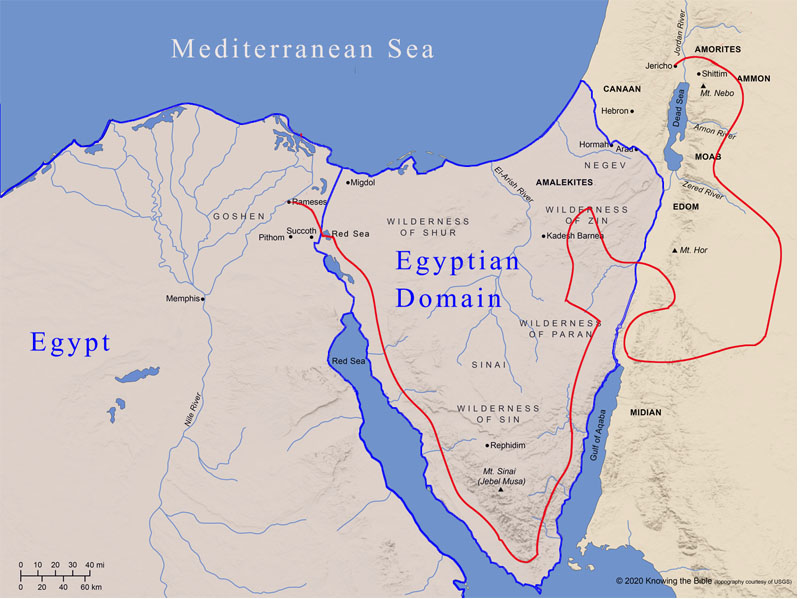
Israelite Journeys Rameses
|
The Hebrew name "The Ten Commandments" literally means "the Ten Words." They are also called the law, commandment, the words of the covenant, the tables of the covenant, the covenant, the two tables, and, most frequently, the testimony, or the two tables of the testimony. In the New Testament they are called simply the commandments. Moses never referred to them as the "Ten Commandments". The Ten Commandments are Ten Promises that God made to the Jews. His states the promises in future tense and God promises that His people will, in the age of the Messiah, be enabled not do these thing. He says that we must believe and do our best to obey in order for God to help us obey the Words. 2 Corinthians 2-5 You are our epistle written in our hearts, known and read by all men; clearly you are an epistle of Christ, ministered by us, written not with ink but by the Spirit of the living God, not on tablets of stone but on tablets of flesh, that is, of the heart. And we have such trust through Christ toward God. Not that we are sufficient of ourselves to think of anything as being from ourselves, but our sufficiency is from God. God's commandments and decrees were in place long before the laws that were given at Mount Sinai. The first law God ever gave was "Thou shall not eat of the Tree of the Knowledge of Good and Evil." All through Genesis He establishes laws and practices. When we enter into an agreement, sometimes it is just verbal. However, sometimes we need a formal agreement so we sign a contract that legally binds us to the agreement. The Ten Commandments that were written on stone tablets are a contract. Genesis 26:4-5 And I will make your descendants multiply as the stars of heaven; I will give to your descendants all these lands; and in your seed all the nations of the earth shall be blessed; because Abraham obeyed My voice and kept My charge, My commandments, My statutes, and My laws." God's Law is generally seen as consisting of three types of laws - the moral law, the ceremonial law, and the civil law. The moral law reflects what is right and just. Law was given because of our sin nature. Lawlessness can plunge a nation into a downward spiral of chaos, corruption, and instability. Although the laws were given specifically to the Jewish nation, the Ten Commandments are still applicable to everyone today. Our Founding Fathers used the Bible as a foundation when they created the American Declaration of Independence and Constitution. No civilized society or government can exist successfully without the recognition, acceptance, adherence and submission to Moral law and the standard for value judgment. Galatians 3:19 What purpose then does the law serve? It was added because of transgressions, till the Seed should come to whom the promise was made; and it was appointed through angels by the hand of a mediator. Exodus 20:1 And God spoke all these words, saying: "I am the LORD your God, who brought you out of the land of Egypt, out of the house of bondage. God's law was written in the heart of man since the time of Adam, they were not invented at Mount Sinai. We make agreements all the time, but occasionally, we draw up a contract so that the intention is very clear. These commandments were a written legal document between God and His people, signed personally by God Himself. The Ten Commandments can also be divided into two categories, the first four deal with your relationship to God, the second six deals with your relationship to humanity. Jesus summed up the commandments in these verses: Matthew 22: 36-40 "Teacher, which is the great commandment in the law?" Jesus said to him, "'You shall love the LORD your God with all your heart, with all your soul, and with all your mind.' This is the first and great commandment. And the second is like it: 'You shall love your neighbor as yourself.' On these two commandments hang all the Law and the Prophets." Exodus 20:2 "I am the Lord your God, who brought you out of the land of Egypt, out of the house of bondage. God established that this people, this nation of Israel, belonged to Him. He proved Himself when He demonstrated his superiority over the Egyptian gods. He asserts his own authority to enact this law. God would have the Israelites clearly understand, that He Himself gave them the commandments. First CommandmentExodus 20:3 "You shall have no other gods before Me. This first commandment tells us whom to worship. The term "before" was not intended to suggest we can have multiple gods so long as God is first among them. The phrase means to have no gods apart from the Lord. "Before me" literally, "before my face," is a Hebrew idiom, and equivalent to "beside me," "in addition to me." The true God is not only to be number one, He is the only one. Nothing else can qualify as God in your life. The Bible defines "other gods" as idols. Most people view idols as an image or representation of a god used as an object of worship. In reality, they can be anything from money and possessions to food and working out or people and relationships. Anything or anyone we place above God is another god. Second CommandmentExodus 20:4 "You shall not make for yourself a carved image—any likeness of anything that is in heaven above, or that is in the earth beneath, or that is in the water under the earth; you shall not bow down to them nor serve them. For I, the LORD your God, am a jealous God, visiting the iniquity of the fathers upon the children to the third and fourth generations of those who hate Me, but showing mercy to thousands, to those who love Me and keep My commandments. The second commandment tells us how to worship. Do not make a carved image of any kind that you will bow down and worship. An idol distracts a person from our living God. Think about what idols people worship today: People, money, astrology, Buddha, Crucifixes, rabbit's foot, and even the cross. Anything that we rely on for some blessing, or help, or guidance which takes the place of a wholehearted reliance on the true and living God is an idol. This does not mean we cannot make statues? God instructed Moses to make the cherubs and place them above the mercy-seat, the bronze snake put on a pole, and a lampstand of pure gold. However, do not bow to them and worship them. Third CommandmentExodus 20:7 "You shall not take the name of the LORD your God in vain, for the LORD will not hold him guiltless who takes His name in vain. The word vain can mean "empty," "nothing," "worthless," or "to no good purpose." When we use God's name in an improper way, we are making God irrelevant, unholy and we are denouncing His power. Notice that God's name used as a profanity. You never hear "Oh, Zeus" or "Oh my Buddha"! If the intended meaning is to be disrespectful toward God and His name, the word should not be used. That being said, the name God, simply, is just the English word for the monotheistic god of the Bible. The word God comes from the Gothic translation of the New Testament to represent Greek Theos and Latin Deus. But God, Theos, Deus, Lord, or even Yahweh is not his name. He has many names that describe who He is. Exodus 3:13-14 Then Moses said to God, "Indeed, when I come to the children of Israel and say to them, 'The God of your fathers has sent me to you,' and they say to me, 'What is His name?' what shall I say to them?" And God said to Moses, "I AM WHO I AM." And He said, "Thus you shall say to the children of Israel, 'I AM has sent me to you.' " The Hebrew people would not say this name or write it in full because they felt mortal human beings should not say His name. They wrote the four letters YHWH (known as the tetragrammaton) to represent His name. God is so much more than a name! Society tells us today that one's gender is very important to a person's self-esteem. The Merriam-Webster dictionary defines self-esteem as 1: a confidence and satisfaction in oneself: self-respect and 2: self-conceit: an exaggerated opinion of one's own qualities or abilities, vanity. We were created to glorify God — not ourselves. Anything done out of selfish ambition or vain conceit is done from pride. Pride will always draw us away from God. It's easy to fall into the trap of glorifying ourselves, especially today when the world tells us that we should do what makes us feel good rather than telling us to do what is right in God's eyes. Forth CommandmentExodus 20:8 "Remember the Sabbath day, to keep it holy. Six days you shall labor and do all your work, but the seventh day is the Sabbath of the LORD your God. In it you shall do no work: you, nor your son, nor your daughter, nor your male servant, nor your female servant, nor your cattle, nor your stranger who is within your gates. For in six days the LORD made the heavens and the earth, the sea, and all that is in them, and rested the seventh day. Therefore the LORD blessed the Sabbath day and hallowed it. Most people read this commandment and stop after the first sentence, but read the next ten words; "Six days shall you labor and do all your work." In the ancient world, the Sabbath was unique to Israel. No other ancient people had the privilege of resting one day in seven. Even before they were brought out of slavery, the Jews were forced to labor ten days a week. Ancient Egyptian's week was ten days - 3 units of 10 days each. So when they were free, God gave them the forth commandment, that they should rest on the Sabbath. The Sabbath (Shabbat) is widely observed throughout Israel still today. They observe the Sabbath on Saturday which begins a few minutes before the sun sets on Friday evening and goes until an hour after sundown. If you stay at a hotel where they observe the Sabbath, you will not be able to use the elevator during this time. On March 7, A.D. 321, Constantine the Great issued the first civil Sunday law, compelling all the people in the Roman Empire, except farmers, to rest on Sunday. Then in 364 A.D., the Council of Laodicea urged Christians to honor Sunday by abstaining from work on that day if at all possible, and prohibited them from abstaining from work on the Sabbath. Mark 2:27 And He said to them, "The Sabbath was made for man, and not man for the Sabbath." Colossians 2:16-17 16 So let no one judge you in food or in drink, or regarding a festival or a new moon or sabbaths, which are a shadow of things to come, but the substance is of Christ. God told the Israelites that they were to worship on the Sabbath day and not to work on that day. When we come to the New Testament, we discover that there is no specific command to keep the Sabbath or any other day as a day of worship or day of rest. But this does NOT mean we are exempt from worshiping the Lord! The Bible tells us we need to attend church so we can worship God with other believers and be taught His Word for our spiritual growth. Jesus summarized the first four commandments: to love God with all your heart, soul, strength, and mind. The next six are about your fellow man, you shalt love your neighbor as yourself. Fifth CommandmentThis commandment comes with a promise. Contrary to popular belief, the verse does not promise you personally will live longer if you honor your parents. God promised that if you honor your parents, you will live long as a society. Honoring your parents means to revere; to respect; to treat with deference and submission, and perform relative duties to. It's not about blind obedience but about listening to them, learning from them, respecting their wisdom, and experience. Exodus 20:12 "Honor your father and your mother, that your days may be long upon the land which the LORD your God is giving you. Ephesians 6:1-3 Children, obey your parents in the Lord, for this is right. "Honor your father and mother," which is the first commandment with promise: "that it may be well with you and you may live long on the earth." This commandment also carried a punishment when extreme disobedience is carried out by a son: Deuteronomy 21:18 "If a man has a stubborn and rebellious son who will not obey the voice of his father or the voice of his mother, and who, when they have chastened him, will not heed them, then his father and his mother shall take hold of him and bring him out to the elders of his city, to the gate of his city. And they shall say to the elders of his city, 'This son of ours is stubborn and rebellious; he will not obey our voice; he is a glutton and a drunkard.' Then all the men of his city shall stone him to death with stones; so you shall put away the evil from among you, and all Israel shall hear and fear. This is a judicial law which deals with deep-seated rebellion, sins that would tear a nation and family apart. The ongoing attitude of hatred had to be dealt with severely. In other words, the punishment was not for minor infractions but for determined defiance. Evidently, they obeyed this law since the Bible never records this law being enforced. The Mosaic Law was designed for God's covenant people, Israel, just as we have laws today to protect our general safety, and ensure our rights as citizens against abuses by other people, by organizations, and by the government itself. Sixth CommandmentExodus 20:13 "You shall not murder. The Hebrew word rasah, (used forty-seven times in the Old Testament) denotes the unlawful, premeditated, or immoral murder of another human which was punishable by death. However, God's law differentiated between willful and involuntary killing. The punishment for unintentional or accidental death through carelessness or negligence held a different sentence. The guilty party was banished to a city of refuge, (Deuteronomy 19:1–13). This place offered sanctuary from the vengeful relatives of the deceased, but it this banishment often lasted for life. The Bible never uses the term rasah (murder) regarding wars, nor is it thought to apply to slaughtering animals or defending one's home from invasion. There is a moral distinction. Jesus said that murder comes from the heart: Matthew 5:21 "You have heard that it was said to those of old, 'You shall not murder, and whoever murders will be in danger of the judgment.' But I say to you that whoever is angry with his brother without a cause shall be in danger of the judgment. Hate is based on perceptions persons and groups more because of who they are, than because of what they do. Hate has the goal to eliminate its target. Jesus warned that murder can include more than the act of killing. A person who is angry without cause will be judged by God Himself. Seventh CommandmentExodus 20:14 "You shall not commit adultery. God considers our sexuality a glorious gift. He blesses our sexual activity within marriage only. This law addresses relationships, sexuality, and encompasses both physical and emotional sin. God made this commandment because He knew the pain and devastation it brings to marriages, and the family unit. Matthew 5:27-28 "You have heard that it was said to those of old, 'You shall not commit adultery.' But I say to you that whoever looks at a woman to lust for her has already committed adultery with her in his heart. Adultery begins in the heart. Lust becomes an idol that controls our behavior and gives birth to action. That's why Jesus constantly warns about guarding our hearts. The remedy for an unbiblical divorce is the same as it is for any other sin: to demonstrate godly sorrow, repent of your sin, confess it, and once again believe in the Gospel. Then "go and sin no more". Forgiveness doesn't eliminate the consequences for our bad choices, but God's forgiveness can make a sinner's heart clean again. Two people can be considered married from a biblical perspective if they commit themselves to each other before God, who will hold them accountable to that commitment, expecting them to be committed to each other for life, through thick and thin and every conceivable temptation. However, a legal document is required by the state to receive all the protections, benefits, and privileges that come with state-sanctioned matrimony. Eighth CommandmentExodus 20:15 "You shall not steal. We have the right to certain tangible and intangible things; however this is always in light of God's true ownership of everything. This commandment requires us to respect the property of others. Taking away another man's goods, either by deceit or violence, or without his knowledge and consent is stealing. This includes: private theft, picking of pockets, shoplifting, burglary, public theft, robbing upon the highways; domestic theft, as when wives take away their husbands' money or goods, and conceal them, or dispose of them without their knowledge and will, children robbing their parents, servants taking their masters' effects without consent; stealing of men or children and making slaves of them, selling them against their wills; unjust contracts, not making good and performing payments, detention of worker's wages, advising and encouraging thieves, and receiving from them. "Let him who stole steal no longer, but rather let him labor, working with his hands what is good, that he may have something to give him who has need" (Ephesians 4:28; emphasis added). For every negative, there is a positive. The opposite of stealing is giving. The case of the Israelites borrowing of the Egyptians and spoiling them is not to be objected to this law, since that was by the command of God, and was ONLY taking what was due to them for service. Ninth CommandmentExodus 20:16 "You shall not bear false witness against your neighbor. Two or three witnesses were needed in ancient Hebrew law to establish a claim under civil law or a crime under criminal law. To bear false witness against others is to lie or slander by spreading rumors about them, especially for personal gain. Because we worship and love God, we shouldn't deceive, betray, or speak badly about other people, but instead, we should defend them, speak well of them, and build them up. Bearing false witness has many consequences. Scripture tells us that bearing false witness against another person will not go unpunished. People who slanders or spreads rumors become distrusted. False accusations can have devastating repercussions for innocent individuals. It's very difficult for victims to prove their innocence. The lies are so deeply embedded unto the hearts and souls of those who hear the rumors that they will never believe the truth. Proverbs 25:18 A man who bears false witness against his neighbor is like a war club, or a sword, or a sharp arrow. Tenth CommandmentExodus 20:17 "You shall not covet your neighbor's house; you shall not covet your neighbor's wife, nor his male servant, nor his female servant, nor his ox, nor his donkey, nor anything that is your neighbor's." Businesses spend billions of dollars per year to entice you to covet. They produce advertisements targeted at you to show you how unhappy you are because you don't have their product, how you need their product to fulfill your desires. Coveting is the greedy desire of that which belongs to another man, a secret wish to own what someone else has. This is sinful because it causes the acts and words to proceed. When we meditate about something, think about it, and become obsessed about something, it eats away at us until we satisfy our desire or repent, resist and reject them. God knows what is in our hearts. He knows our desires. When we place our trust in Him, God provides for our every need. Ask the Lord for what you desire, with a motive to serve Him, knowing that everything in the world is at His disposal. James 4:3 You ask and do not receive, because you ask with wrong motives, so that you may spend it on your pleasures. Exodus 20:18 Now all the people witnessed the thunderings, the lightning flashes, the sound of the trumpet, and the mountain smoking; and when the people saw it, they trembled and stood afar off. Then they said to Moses, "You speak with us, and we will hear; but let not God speak with us, lest we die." All the people, not just the Israelites, but all the people who came with them, including the slaves and Egyptians that accompanied them, heard God speak to them. Often times, when we have conflicts with other people, we have to go to court. We hire an attorney to mediate between us and the judge. The Jewish people were afraid and needed a mediator to stand between them and God. They feared death and judgment from God. So they asked Moses to step in. Then God said to Moses: Deuteronomy 5:29 "Oh, that they had such a heart in them that they would fear Me and always keep all My commandments, that it might be well with them and with their children forever!" Exodus 20:20 And Moses said to the people, "Do not fear; for God has come to test you, and that His fear may be before you, so that you may not sin." So the people stood afar off, but Moses drew near the thick darkness where God was. Moses tells the people not to fear death. Then he says the God has come to put fear before them. A healthy fear of God is to respect Him and obey Him for our own good. God did not give us His commandments as a means by which punishment can be inflicted but rather to reveal our sinful nature. Unless we know something is wrong, how are we to avoid it?
As the people withdrew, Moses drew near to the darkness where God was, to receive the further commands of the Lord. Exodus 20:22 Then the LORD said to Moses, "Thus you shall say to the children of Israel: 'You have seen that I have talked with you from heaven. You shall not make anything to be with Me—gods of silver or gods of gold you shall not make for yourselves. An altar of earth you shall make for Me, and you shall sacrifice on it your burnt offerings and your peace offerings, your sheep and your oxen. In every place where I record My name I will come to you, and I will bless you. And if you make Me an altar of stone, you shall not build it of hewn stone; for if you use your tool on it, you have profaned it. Nor shall you go up by steps to My altar, that your nakedness may not be exposed on it.' God descended from heaven to the top of Mount Sinai in a cloud and fire and spoke to them directly so that they could hear His commandments. The first images for idolatrous worship were molten images of gods made generally of silver, sometimes of gold, because being rich and glittering; they more affected the minds of the people. They were objects of worship to Israel throughout the ages preceding their captivity. The law against idolatry is repeated, because the people of Israel were prone unto it, and many of them had been ensnared with it in Egypt and therefore would easily relapse into it. God promises to be present and to bless his people wherever they seek to honor him and demonstrate their faith and devotion. Burnt offerings were a way for the Israelites to demonstrate their devotion and commitment to God, while peace offerings were a way to express gratitude and seek reconciliation with God. The inclusion of sheep and oxen as sacrificial animals emphasizes the idea that worship and sacrifice are costly and a valuable expression of faith. God was very specific about the altar they were to use for sacrifices. They were not to chip away at the stone to make it fit together, but rather to arrange stones in their original form to make an altar. We have a tendency to chip away from or add to the Word of God to fit our presuppositions, agendas or biases. That is what God's warning was about. We are to keep His Holy Word intact. The altar is a place of faith, not works. From the time of Adam and Eve's transgression in the Garden of Eden, nakedness has become associated with the exposure of our sinful being. Nakedness is self-exposure. Contrary to the contemporary emphasis on self-esteem, self-acceptance, and positive self-image, we must approach the Lord and acknowledge our moral uncleanness. Bible Study Questions 1. What is the first commandment? a. You shall have no other gods before me. 2. What does the second commandment warn against? a. Making images that looks like God. 3. What happens if we take the name of the Lord God in vain? a. God will consider us guilty in the day of judgement. 4. What does the Lord expect us to do on the seventh day? a. Worship Him. 5. Why should we honor our father and mother? a. Showing honor to our parents demonstrates the love of God 6. Is killing forbidden in the sixth commandment?
7. Which of the following is considered adultry? a. Having an affair with a married person. 8. Which of the following are considered stealing? a. Shoplifting 9. What does bear false witness against your neighbor mean? a. Telling your neighbor there is a bear in their yard when there is no bear. 10. What is an example of coveting? a. Wishing you could have a better house. |
| Cassie, Matt, Joe, Mary | |