Exodus 2 – The Birth and Adoption of Moses
Timeline: 1530 BC
|
|
In the last chapter, we read about how the midwives refused to throw all the Hebrew boys into the Nile. Shiphrah and Puah chose to obey God and He gave them husbands and families as rewards for their faithfulness. Shiphrah's story continues here. Exodus 2:1 Now a man of the house of Levi married a Levite woman, and she conceived and gave birth to a son. The man and wife are anonymous in this chapter but if we jump ahead, we see that they are Amram and Jochebed. Most of the Rabbinic traditions identify Shiphrah as Jochebed. She was called "Shiphrah" because she would cleanse the newborn by washing it and cleaning it after birth. It could be that the Egyptians used her name Shiphrah while her Hebrew name was Jochebed. Amram was the son of Kohath, who was a son of Levi. Jochebed was Levi's daughter, thus Amram married his aunt. In the early days of humanity, the human genetic code was not corrupted to the extent that it is today. Therefore, marriages between close relatives carried little risk of genetic abnormalities in the children they produced. Once the human race expanded and, due to sin, the human genetic code grew more corrupt, God later made a law against the marriage of close relatives. Leviticus 21:13 says that the priest must marry a virgin from his own people. This is to protect the purity of the priestly lineage. 2 When she saw that he was a beautiful child, she hid him for three months. Then she placed the child in the basket and set it among the reeds along the bank of the Nile. And his sister stood at a distance to see what would happen to him. When Moses was born, Amram and Jochebed already had two children, Miriam and Aaron. Romans 10:7 reads: "So then faith comes by hearing, and hearing by the word of God." So his parents must have received a revelation from God, and therefore knew there was something special about their newborn. The word used to describe Moses usually means good, beautiful or favorable, but it can also mean worthy or pleasing, as in pleasing in the sight of the Lord. We know that Jochebed had faith in God. Acts 7:20 tells us "At this time Moses was born, and was well pleasing to God; and he was brought up in his father's house for three months." Ironically, Jochebed did as Pharaoh commanded. She put her baby in the Nile. The ark was made from the same type of plant that papyrus (early form of paper) is made from. Jochebed made a basket and covered it with asphalt and pitch, a sticky substance they used to make boats waterproof. Noah use the same substance to waterproof the ark he made. Miriam was about 4 years older than her brother Aaron who was about 3 when Moses was born. She was a brave child who looked after her brother to make sure he was taken care of. Exodus 2:5 Soon the daughter of Pharaoh went down to bathe in the Nile, and her attendants were walking along the riverbank. And when she saw the basket among the reeds, she sent her maidservant to retrieve it. When she opened it, she saw the child, and behold, the little boy was crying. So she had compassion on him and said, "This is one of the Hebrew children." Pharaoh's daughter just happened to appear at the Nile to bathe when she sees the ark. Not only were Pharaoh's schemes to kill all the Hebrew baby boys thwarted, but God used Pharoah's own household to preserve Moses. When the daughter of Pharaoh opened the ark she saw that the infant was circumcised, and realized that he was a Hebrew child. Unlike her father, who had ordered infanticide, this woman had a more compassionate heart. She took pity on this seemingly abandoned child. Exodus 2:7 Then his sister said to Pharaoh's daughter, "Shall I go and call one of the Hebrew women to nurse the child for you?" Miriam was a young girl and therefore was more easily received by Princess Thermuthis. To employ the use of other women to provide milk for newborn children if for whatever reason they could not nurse themselves, must have been common practice in that time. Exodus 2:8 "Go ahead," Pharaoh's daughter told her. And the girl went and called the boy's mother. Pharaoh's daughter said to her, "Take this child and nurse him for me, and I will pay your wages." So the woman took the boy and nursed him. When the child had grown older, she brought him to Pharaoh's daughter, and he became her son. She named him Mosesb and explained, "I drew him out of the water." God perfectly orchestrated events to uniquely prepare Moses for his future role. Considering Sarah most probably weaned Isaac from 4-5 years, it would be reasonable to assume that Moses was with Jochebed for as several years. During that time, she taught him all about the history of the Jews and was paid to do so. Once he was weened, she brought him to Pharaoh's daughter to continue to raise him. Josephus identifies Pharaoh's daughter as Princess Thermuthis who had no offspring. Moses was given the best education Egypt could offer. Acts:22 says, "And Moses was learned in all the wisdom of the Egyptians, and was mighty in words and in deeds." By adopting him, he became heir to the throne. He was being groomed to be the next leader of Egypt. Exodus 2:11 One day, after Moses had grown up, he went out to his own people and observed their hard labor. He saw an Egyptian beating a Hebrew, one of his own people. After looking this way and that and seeing no one, he struck down the Egyptian and hid his body in the sand. The next day Moses went out and saw two Hebrews fighting. He asked the one in the wrong, "Why are you attacking your companion?"
Moses gave up a lot. He could have been a king in Egypt and he could have set his people free. But this was not what God had in mind. Moses' people were destined to live in the Promised Land. Exodus 2:14 But the man replied, "Who made you ruler and judge over us? Are you planning to kill me as you killed the Egyptian?" Then Moses was afraid and thought, "This thing I have done has surely become known."
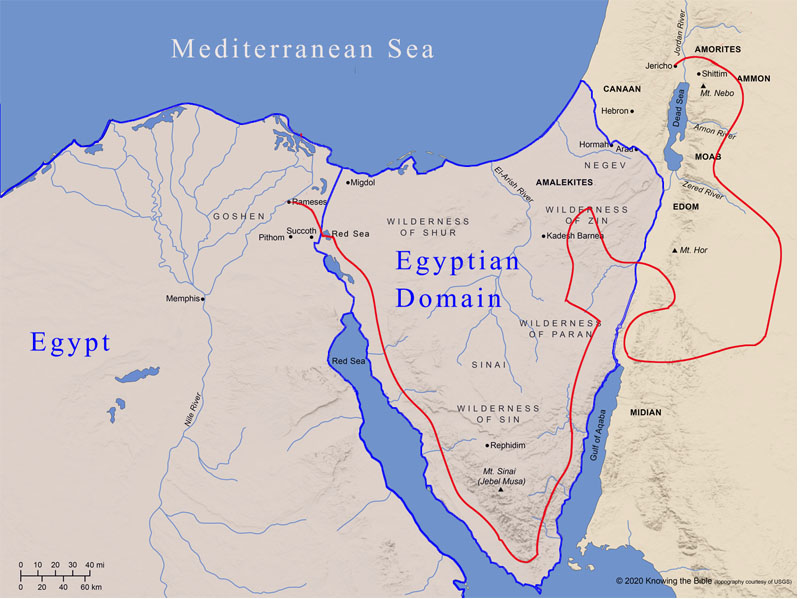
Moses' crime was a type of justifable homicide. He realized that Hebrews were spreading the story about the event, and if the they were speaking about this openly about it, then eventually the news would get back to the Pharaoh. Exodus 2:15 When Pharaoh heard about this matter, he sought to kill Moses. But Moses fled from Pharaoh and settled in the land of Midian, where he sat down beside a well. Indeed the news did reach Pharaoh's ears. Moses didn't realize that another 40 years needed to pass before it would be time to fulfil his destiny. All he knew was that he had to escape. Anytime a traveler stops at a well, good things are about to happen. Exodus 2:16 Now the priest of Midian had seven daughters. And they came and drew water, and they filled the troughs to water their father's flock. And when some shepherds came along and drove them away, Moses rose up to help them and watered their flock. Midian, is the land in the northwestern corner of Saudi Arabia, just south of Jordan. The Levi priest was the ruler of the people called Cushites or Ethiopians, and like many other chiefs of pastoral people in that early age, he still retained the faith and worship of the true God. Moses was obviously a man of character. When he saw oppression, he didn't hesitate to step in just as Jacob had formerly done, helping his daughters to water their father's sheep, and protecting them against the other shepherds. Exodus 2:18 When the daughters returned to their father Reuel, he asked them, "Why have you returned so early today?" Reuel was surprised that they returned after such a short amount of time since it was obvious that being harassed by the shepherds was a common occurance. Exodus 2:19 "An Egyptian rescued us from the shepherds," they replied. "He even drew water for us and watered the flock." The daughters called Moses an Egyptian since he was obviously still in the attire was wearing when he fled and perhaps even from his speech. It would have been offensive to not offer a meal to a traveler. Remember how Abraham welcomed his visitors and offered some curds and milk and a choice, tender calf. Laban welcomed Jacob with a meal as well. Exodus 2:20 "So where is he?" their father asked. "Why did you leave the man behind? Invite him to have something to eat." Exodus 2:21 Moses agreed to stay with the man, and he gave his daughter Zipporah to Moses in marriage. And she gave birth to a son, and Moses named him Gershom,g saying, "I have become a foreigner in a foreign land." So welcomed was Moses that he stayed for stayed for the next forty years while God humbled him and prepared him his final destiny. As the years went by, the family became close and Moses married Zipporah. Together they had two sons: Gershom, for Moses said, "I have become a foreigner in a foreign land"; and Eliezer, for he said, "My father's God was my helper; he saved me from the sword of Pharaoh." Exodus 2:23 After a long time, the king of Egypt died. The Israelites groaned and cried out under their burden of slavery, and their cry for deliverance from bondage ascended to God. So God heard their groaning, and He remembered His covenant with Abraham, Isaac, and Jacob. God saw the Israelites and took notice. or four hundred years, the Hebrew people endured intense suffering and oppression, fulfilling the prophecy to Abraham in Genesis 15. This sets the stage for God's intervention and subsequent deliverance of the Israelites. When the scripture says that "God remembered", it means the time for God to act has come to pass. During the forty years since Moses left Egypt, the slavery the Jews experienced continued and seems to have gotten even worse. The Hebrews prayed, and God heard that prayer. Bible Study Questions 1. How do most of the Rabbinic traditions identify Shiphrah as?
2. Who were Moses' siblings?
3. What was Moses' father's name?
4. What did Pharoah's daughter tell her maids to do? 5. How long did Moses stay with his mother?
6. Where did Moses' go to school?
7. What did Moses do that made him run away?
8. Who was Zipporah?
9. What did Moses call his first son?
10. Why did God remember His covenant with Abraham, Isaac and Jacob?
|
| Cassie, Matt, Joe, Sue | |