Exodus 18 - Jethro's Visit and Delegation of Authority
Timeline: 1450 BC
|
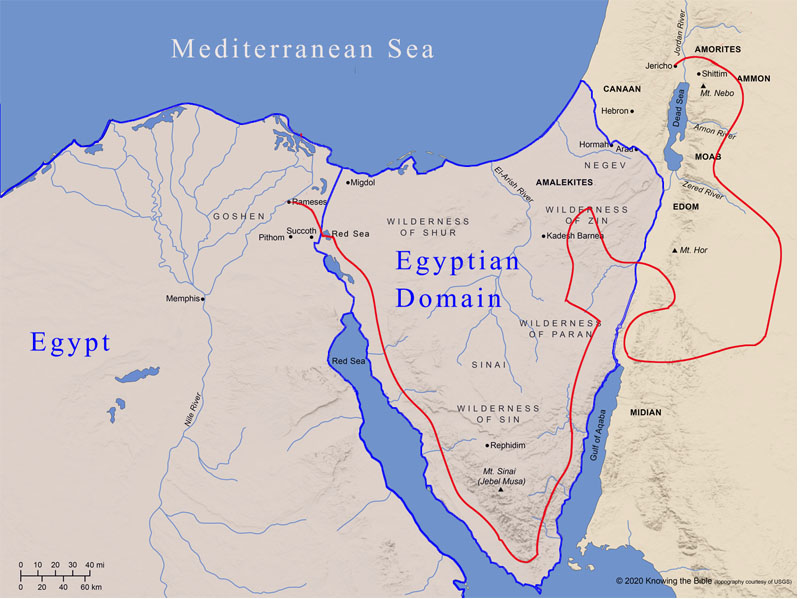
Israelite Journeys Rameses
|
The Mishnah is the first major work of rabbinic literature, consisting of teachings transmitted over hundreds of years and compiled around 200 AD. In it is a story of the staff which Moses used to perform miracles. The Midrash relates that this staff, which was created in the twilight, was given to Adam in the Garden of Eden. The staff was supposedly made of pure sapphire. The staff was passed down from Adam to Enoch, Noah, Shem, Abraham, Isaac, Jacob and Joseph. When Joseph died, the Egyptians pillaged his household goods, and the staff was placed in the palace of Pharaoh. Jethro was formerly a high advisor to Ramesses II who left Egypt for Midian after Ramesses II turned his wrath on the Israelites. When he left he took the "Staff of Adam" and planted it in the ground and no one was ever able to remove, until Moses arrived in Midian years later. Inscribed on the staff was the four Hebrew letters usually transliterated YHWH or JHVH that form a biblical proper name of God. Rabbi Yehuda, a second-century rabbi and chief redactor and editor of the Mishnah, caimed that is was an acronym for the ten plagues was etched into Moses' staff. After God revealed to Moses the resistance that he would encounter in Egypt, and following the circumcision of Eliezer, Moses sent Zipporah and the children back to Jethro until after the exodus. The scriptures do not say why. Exodus 18:1 And Jethro, the priest of Midian, Moses' father-in-law, heard of all that God had done for Moses and for Israel His people—that the Lord had brought Israel out of Egypt. Then Jethro, Moses' father-in-law, took Zipporah, Moses' wife, after he had sent her back, with her two sons, of whom the name of one was Gershom (for he said, "I have been a stranger in a foreign land") and the name of the other was Eliezer (for he said, "The God of my father was my help, and delivered me from the sword of Pharaoh"); and Jethro, Moses' father-in-law, came with his sons and his wife to Moses in the wilderness, where he was encamped at the mountain of God. Now he had said to Moses, "I, your father-in-law Jethro, am coming to you with your wife and her two sons with her." It was common for men of Arabia to have more than one name, which could also include titles. Arabians, particularly Arabian chiefs, often had more than two names. Scripturally, Jethro is referred to as Moses' father-in-law, and he is also called Reuel. When God first called Moses at Horeb, He foretold to him that Israel would be brought to this mountain their deliverance from Egypt. So perhaps Moses told Jethro to meet him here and bring his wife and children to him. Jethro sent a messenger ahead to Moses to let him know he was coming. Exodus 18:7 So Moses went out to meet his father-in-law, bowed down, and kissed him. And they asked each other about their well-being, and they went into the tent. And Moses told his father-in-law all that the Lord had done to Pharaoh and to the Egyptians for Israel's sake, all the hardship that had come upon them on the way, and how the Lord had delivered them. Then Jethro rejoiced for all the good which the Lord had done for Israel, whom He had delivered out of the hand of the Egyptians. And Jethro said, "Blessed be the Lord, who has delivered you out of the hand of the Egyptians and out of the hand of Pharaoh, and who has delivered the people from under the hand of the Egyptians. Now I know that the Lord is greater than all the gods; for in the very thing in which they behaved proudly, He was above them." Then Jethro, Moses' father-in-law, took a burnt offering and other sacrifices to offer to God. And Aaron came with all the elders of Israel to eat bread with Moses' father-in-law before God. Midian was known to worship many gods. Jethro's faith was reaffirmed when he heard the story of Moses, so he offered burnt-offerings and sacrifices to God. In the ancient Near East, eating a meal together represented an alliance between the parties involved. Exodus 18:13 And so it was, on the next day, that Moses sat to judge the people; and the people stood before Moses from morning until evening. So when Moses' father-in-law saw all that he did for the people, he said, "What is this thing that you are doing for the people? Why do you alone sit, and all the people stand before you from morning until evening?" In a group as large as the Israelites, there would be disputes and disagreements between individuals or groups. All of these disputes, large or small, major or minor, would come before Moses so he could decide the best course of action. His leadership and strong management were essential to maintain order and stability. Perhaps he was so busy contending with the people, he didn't realize what an overwhelming job it was to judge so many people. Exodus 18:15 And Moses said to his father-in-law, "Because the people come to me to inquire of God. When they have a difficulty, they come to me, and I judge between one and another; and I make known the statutes of God and His laws." Some commentators believe this section belongs after the Ten Commandments were given. Obviously, there were statutes and laws in place prior to this time. They were taught and passed down from generation to generation and may or may not have been written down before this. These laws were what Moses used to govern the people. Exodus 18:17 So Moses' father-in-law said to him, "The thing that you do is not good. Both you and these people who are with you will surely wear yourselves out. For this thing is too much for you; you are not able to perform it by yourself. Listen now to my voice; I will give you counsel, and God will be with you: Stand before God for the people, so that you may bring the difficulties to God. And you shall teach them the statutes and the laws, and show them the way in which they must walk and the work they must do. Moreover you shall select from all the people able men, such as fear God, men of truth, hating covetousness; and place such over them to be rulers of thousands, rulers of hundreds, rulers of fifties, and rulers of tens. And let them judge the people at all times. Then it will be that every great matter they shall bring to you, but every small matter they themselves shall judge. So it will be easier for you, for they will bear the burden with you. If you do this thing, and God so commands you, then you will be able to endure, and all this people will also go to their place in peace." Jethro gave Moses good advice, only for his sake but for the sake of the people. God directly spoke to Moses on several occasions but sometimes He uses people to relay His message. Moses needed to appoint other judges to help him. With that help, Moses was able help many more Israelites. Exodus 18:24 So Moses heeded the voice of his father-in-law and did all that he had said. And Moses chose able men out of all Israel, and made them heads over the people: rulers of thousands, rulers of hundreds, rulers of fifties, and rulers of tens. So they judged the people at all times; the hard cases they brought to Moses, but they judged every small case themselves. Moses was able to effectively and efficiently accomplish God's work when he delegated tasks out to others.
Exodus 18:27 Then Moses let his father-in-law depart, and he went his way to his own land. Jethro remained amongst the Israelites for many days according to the Book of Jasher. Bible Study Questions 1. Who was Jethro? a. Moses' father 2. Jethro was... a. Priest of Midian 3. Who did Jethro bring to Moses? a. His wife and two daughters 4. What did Moses do when he met Jethro? a. He turned his back to him. 5. What did Jethro say when Moses told him about what happened? a. He rejoiced for all the good which the Lord had done for Israel. 6. Why did Jethro tell Moses to appoint others to judge the people?
7. After Moses appointed the heads over people, who did Moses judge? a. Only the hard cases. 8. What advice did Jethro give to Moses? a. Judge only on certain days and then rest. 9. What did Moses teach the people he put in charge? a. How to become better warriors. 10. Where did Jethro go when he left the camp? a. Midian. |
| Cassie, Matt, Sue, Joe | |