Exodus 17 - Water from the Rock and the Battle with Amalek
Timeline: 1450 BC
|
Israelite Journeys Rameses
|
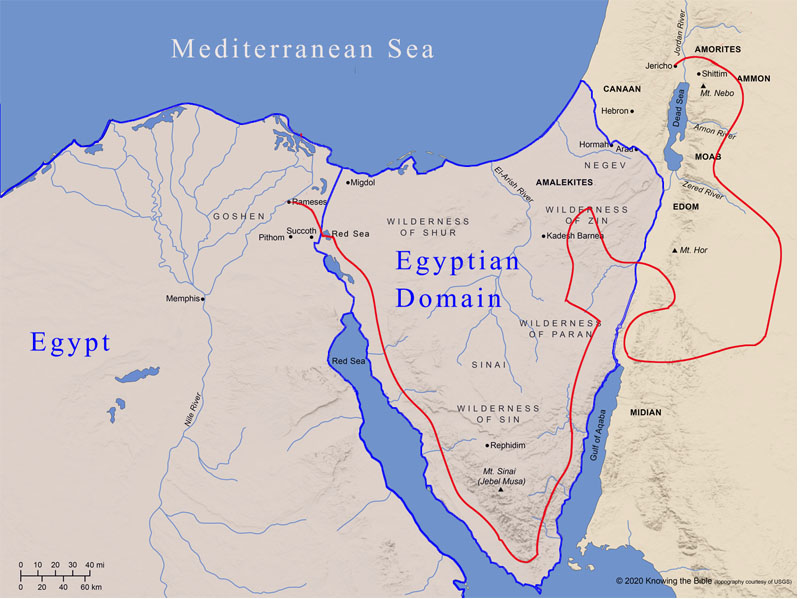
The children of Israel camped 42 times total after they departed from Egypt: two before they crossed the Red Sea and 40 after they crossed the Red Sea. There are many interpretations of the chronology of the wilderness journey. One such interpretation is found here.
Exodus 17:1 Then all the congregation of the children of Israel set out on their journey from the Wilderness of Sin, according to the commandment of the Lord, and camped in Rephidim; but there was no water for the people to drink. Therefore the people contended with Moses, and said, "Give us water, that we may drink." Led by the pillar of God, they camped at Dophkah, which was about twelve miles from the wilderness of Sin. Then they traveled another twelve miles to Alush and set up camp. Rephidim is eight miles from Alush located about a day's march from Mount Sinai. Rephidim means rests, or resting-places. This is the most fertile spot in the whole peninsula, where there is usually abundant water, rich vegetation, and numerous palm-trees. However, at times the brook has been dried up, as it was at this time. The Old Testament contains eight times when the children of Israel complained, three times in Exodus, three times in Numbers, once in Joshua and once in Psalm 59. This time, they were anticipating water to be available but were disappointed when they found the brook dry. As they complained, Moses responded with anger toward the people but God was extremely patient. So Moses said to them, "Why do you contend with me? Why do you tempt the Lord?" And the people thirsted there for water, and the people complained against Moses, and said, "Why is it you have brought us up out of Egypt, to kill us and our children and our livestock with thirst?" For the fourth time, the people complained to Moses. So Moses cried out to the Lord, saying, "What shall I do with this people? They are almost ready to stone me!" The Israelites had been captive in a land of people for over 400 years who believed that the gods were responsible for the good and the bad things that happened. It is hard to change the hearts of people who have been indoctrinated so thoroughly, however, they should have been praying to God instead of complaining to Moses. All their grumbling demonstrated a lack of faith. Exodus 17:5 And the Lord said to Moses, "Go on before the people, and take with you some of the elders of Israel. Also take in your hand your rod with which you struck the river, and go. Behold, I will stand before you there on the rock in Horeb; and you shall strike the rock, and water will come out of it, that the people may drink." Moses brought the elder of Israel to witness the miracle so that the people would know that it came from God. Then he struck the rock as the Lord gave instructions and the water gushing out of the rock.
This is not the incident where Moses was rebuked. In the later chapters we will see that Moses was instructed to speak to the rock but instead struck it. God was furious with him so he was not allowed to go into the Promised Land because of is disobedience. And Moses did so in the sight of the elders of Israel. So he called the name of the place Massah and Meribah, because of the contention of the children of Israel, and because they tempted the Lord, saying, "Is the Lord among us or not?" Moses named the place preserving the remembrance, not of the mercy of their supply. Massah means "temptation" and Meribah means "striving". They put the Lord to the test. Then later, when they were receiving God's commandments, He warned them about their disobedience and unfaithfulness:
Exodus 17:8 Now Amalek came and fought with Israel in Rephidim. And Moses said to Joshua, "Choose us some men and go out, fight with Amalek. Tomorrow I will stand on the top of the hill with the rod of God in my hand." So Joshua did as Moses said to him, and fought with Amalek. And Moses, Aaron, and Hur went up to the top of the hill. And so it was, when Moses held up his hand, that Israel prevailed; and when he let down his hand, Amalek prevailed. But Moses' hands became heavy; so they took a stone and put it under him, and he sat on it. And Aaron and Hur supported his hands, one on one side, and the other on the other side; and his hands were steady until the going down of the sun. So Joshua defeated Amalek and his people with the edge of the sword.
The Amalekites were a tribe of nomads living in the area south of Canaan between Mount Seir and the Egyptian border. Many reasons have been attributed to the brutal attack against the weakest among the children of Israel: While all of these theories could be correct, the fact remains that they attacked the end of the Israelite line, to where the old, weak and feeble and otherwise defenseless had fallen back. It was for that reason that God vowed to blot them out from under the heaven. You don't mess with God's chosen ones. The battle was fought on the day after the first attack. Moses told Joshua to defend the Israelites as he goes with Aaron and Hur to a hill overlooking the battle. Jewish traditions have different ideas who Hur was. He was either married to Moses' sister or her son. Another Jewish tradition says he stood up to the idolaters at Mt. Sinai and was murdered by them—after which Aaron complied with the crowd's demands. These traditions cannot be confirmed in Scripture. Exodus 17:14 Then the Lord said to Moses, "Write this for a memorial in the book and recount it in the hearing of Joshua, that I will utterly blot out the remembrance of Amalek from under heaven." And Moses built an altar and called its name, The-Lord-Is-My-Banner; for he said, "Because the Lord has sworn: the Lord will have war with Amalek from generation to generation." God instructs Moses to record the events but then says He will blot out the remembrance of Amalek. Archeologists have not been able to find evidence of the Amalekites, however, Israel has not forgotten what they did and who they are. Benjamin Netanyahu compared the recent war against Hamas to the war against the Amalek people. Morton Schapiro wrote this in the Jewish Journal: "The Amalekites, eternal enemies of the Jewish people, are said to be the embodiment of pure evil. Just as the Nazis were the 20th century's version of Amalek, Hamas has proven that they are the Amalek of today. " (https://jewishjournal.com/commentary/columnist/364360/hamas-todays-amalek/) Eric Rollon has an interesting video that uses scripture to explain who the Amalekites were: Amalekites – Tribes of the Nephilim Bible Study Questions 1. What happened when the children of Israel camped at Rephidim? a. There was no manna 2. According to the scripture, who did the people complain against? a. Moses 3. What were the people going to do to Moses? a. Thank him 4. What did God tell Moses to use to get water from the rock? a. His rod 5. Why did Moses call the name of the place Massah and Meribah? a. Because they complained too much 6. Who faught with Israel in Rephidim? a. Amalekites 7. What happened when Moses held up his hand? a. God prevailed 8. Who supported Moses hands? a. Aaron and Miriam 9. What did Moses call the alter he built? a. The-Lord-Is-My-Banner 10. What did the Lord swear against Amalek? a. The Lord will have peace with Amalek from generation to generation |