Exodus 16 - Manna from Heaven and Quail
Timeline: 1450 BC
|
Rameses
|
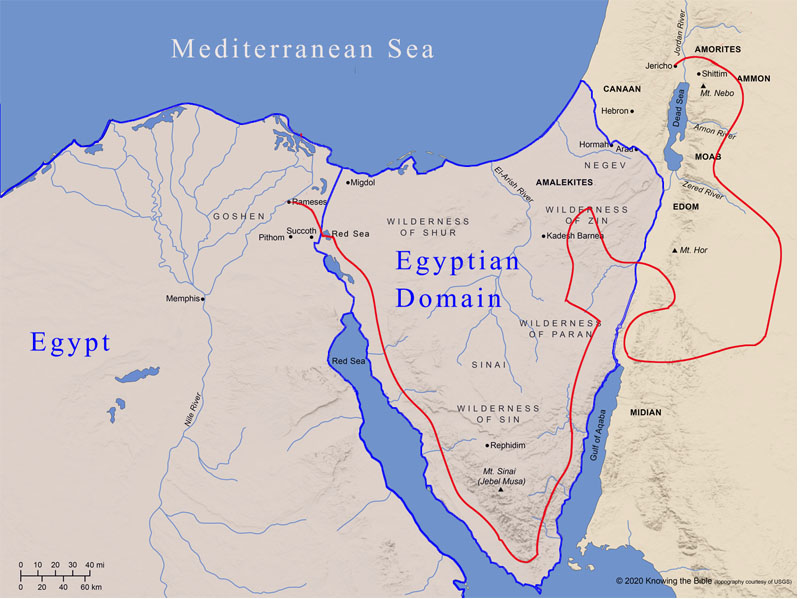
God led the congregation of the children of Israel from Elim to the wilderness of Sin, where they had stayed at least a week. Once again, he tested them. Exodus 16:1 And they journeyed from Elim, and all the congregation of the children of Israel came to the Wilderness of Sin, which is between Elim and Sinai, on the fifteenth day of the second month after they departed from the land of Egypt. Then the whole congregation of the children of Israel complained against Moses and Aaron in the wilderness. And the children of Israel said to them, "Oh, that we had died by the hand of the Lord in the land of Egypt, when we sat by the pots of meat and when we ate bread to the full! For you have brought us out into this wilderness to kill this whole assembly with hunger." One month after their exodus from Egypt which would have been around the middle of April to the middle of May, the nation left Elim and entered the wilderness of Sin, a dry, sandy, wasteland in the southwestern part of the Sinai Peninsula. The area may have derived its name from the ancient moon god Sin who was worshiped by desert. They This version uses the word "complained" against Moses and Aaron. A better translation would be grumbled: to complain or murmur, a form of complaining that is done behind the leader's back. Hunger can cause mood and behavior changes. How quickly the congregation forgot the miracles God preformed over the last few weeks. Did they really think He would let them starve to death? Hunger and food insecurity can cause anxiety and depression. Combine that with the "bandwagon" effect, the tendency of people to adopt the behaviors or opinions of others regardless of their own beliefs. Among the congregation were group of non-Israelites who left Egypt with the children of Israel to escape slavery and/or because they witnessed the awesome plagues of the God of the Hebrews. Their desire for their favorite foods from home expanded to the Israelites. They all became "hangry" which made them lose touch with reality and – fueled by fear and anxiety – their imaginations began to run wild. This is the third time the children of Israel complained about Moses. Exodus 16:4 Then the Lord said to Moses, "Behold, I will rain bread from heaven for you. And the people shall go out and gather a certain quota every day, that I may test them, whether they will walk in My law or not. And it shall be on the sixth day that they shall prepare what they bring in, and it shall be twice as much as they gather daily."
They were told to gather what they could consume in a day and the day before the Sabbath, they were to gather twice as much. Would they follow His orders? God tested them not for His sake, but for theirs. It was so they would humble themselves and to show them what was in their heart, whether they would keep His commandments or not. Exodus 16:6 Then Moses and Aaron said to all the children of Israel, "At evening you shall know that the Lord has brought you out of the land of Egypt. And in the morning you shall see the glory of the Lord; for He hears your complaints against the Lord. But what are we, that you complain against us?" Also Moses said, "This shall be seen when the Lord gives you meat to eat in the evening, and in the morning bread to the full; for the Lord hears your complaints which you make against Him. And what are we? Your complaints are not against us but against the Lord." The people soon forgot God's goodness to them in giving them water, and complained against Him again. While they thought they complained against Moses and Aaron they were really complaining against God. Food for thought: Why do most people need proof to believe but no proof to disbelieve? Furthermore, when confronted with proof, why do they still doubt? Exodus 16:9 Then Moses spoke to Aaron, "Say to all the congregation of the children of Israel, 'Come near before the Lord, for He has heard your complaints.' " Now it came to pass, as Aaron spoke to the whole congregation of the children of Israel, that they looked toward the wilderness, and behold, the glory of the Lord appeared in the cloud. The appearance of the glory of the Lord was in answer to Moses' prayer. With patience and grace, God proved to them once again that he would provide in spite of their disobedience and disbelief. The cloud shrouded the full brilliancy of the glory, which human eye could not behold. Exodus 16:11 And the Lord spoke to Moses, saying, "I have heard the complaints of the children of Israel. Speak to them, saying, 'At twilight you shall eat meat, and in the morning you shall be filled with bread. And you shall know that I am the Lord your God.' " Exodus 16:13 So it was that quail came up at evening and covered the camp, and in the morning the dew lay all around the camp. And when the layer of dew lifted, there, on the surface of the wilderness, was a small round substance, as fine as frost on the ground. So when the children of Israel saw it, they said to one another, "What is it?" For they did not know what it was. The people called it "manna" which is derived from an expression "what's it?" The Lord always speaks of it as "bread". It was described as being white and the size of coriander seed. The KJV calls it "hoar frost", whose root is taken from the old English adjective "hoary" which means, gray or white in appearance. Hoar frost forms on cool, clear nights rising from moisture near the ground. Psalm 78:25 called it "angels' food". According to The Holy Observer, Manna has recently been found in the Sinai desert. Other resources explain that the white drops on shrub's stems are the digestive byproduct of insects that feed on the plant's sap, known as honeydew. The secretion, formed at night, is loaded with sugar. The sweet liquid hardens to the form of white granules and is collected and used in recipes today. While all this may be true, the fact remains that God sent manna six days, about nine million pounds per day so that each person had their fill, but on the seventh day there was none. This went on for 40 years. This was not a natural phenomenon. Quails migrate from Saudi Arabia through the Sinai Peninsula and head toward Europe in the fall and back again in the spring. They travel with the winds so they can cover long distances. They fly slow and low to the ground, often stopping to rest. They fly in dense masses making it easy to be caught by hand. And Moses said to them, "This is the bread which the Lord has given you to eat. This is the thing which the Lord has commanded: 'Let every man gather it according to each one's need, one omer for each person, according to the number of persons; let every man take for those who are in his tent.' " This is the scripture Jesus quoted when Satan tempted Him in the desert, telling Him to turn the stones into bread.
Scripture is consistent in reminding us that we need more than just physical food in order to thrive—we need to be nourished spiritually, as well. All material things will eventually pass away. Instead of being consumed with things like food, we ought to be concerned with eternal rewards.
Exodus 16:17 Then the children of Israel did so and gathered, some more, some less. So when they measured it by omers, he who gathered much had nothing left over, and he who gathered little had no lack. Every man had gathered according to each one's need. And Moses said, "Let no one leave any of it till morning." Notwithstanding they did not heed Moses. But some of them left part of it until morning, and it bred worms and stank. And Moses was angry with them. So they gathered it every morning, every man according to his need. And when the sun became hot, it melted. This was not the first time they were given orders not to leave food till morning:
The Israelites were required to follow God's specific instructions without deviation. This act of disobedience demonstrated their lack of faith in God's protection and deliverance. They had to learn to trust God for their daily bread. Exodus 16:22 And so it was, on the sixth day, that they gathered twice as much bread, two omers for each one. And all the rulers of the congregation came and told Moses. Then he said to them, "This is what the Lord has said: 'Tomorrow is a Sabbath rest, a holy Sabbath to the Lord. Bake what you will bake today, and boil what you will boil; and lay up for yourselves all that remains, to be kept until morning.' " So they laid it up till morning, as Moses commanded; and it did not stink, nor were there any worms in it. Then Moses said, "Eat that today, for today is a Sabbath to the Lord; today you will not find it in the field. Six days you shall gather it, but on the seventh day, the Sabbath, there will be none." Manna was so solid that it could endure the fire and ground in a mill but it melted by the sun. Yet twice the amount fell the day before the Sabbath and lasted twice as long. While they were slaves in Egypt, they worked seven day a week. Now God was re-establishing the ancient Divine laws of setting apart the seventh day that was given when God created man upon the earth. Exodus 16:27 Now it happened that some of the people went out on the seventh day to gather, but they found none. And the Lord said to Moses, "How long do you refuse to keep My commandments and My laws? See! For the Lord has given you the Sabbath; therefore He gives you on the sixth day bread for two days. Let every man remain in his place; let no man go out of his place on the seventh day." So the people rested on the seventh day. Some of them, being of little faith, left it until the morning out of distrust, for fear they should have none the next day. They did not trust God to provide more for the next day. Since the nature of the manna was not to breed worms so soon, this happened supernaturally, not a natural result. God ordered it to happen. Exodus 16:31 And the house of Israel called its name Manna. And it was like white coriander seed, and the taste of it was like wafers made with honey. Exodus 16:32 Then Moses said, "This is the thing which the Lord has commanded: 'Fill an omer with it, to be kept for your generations, that they may see the bread with which I fed you in the wilderness, when I brought you out of the land of Egypt.' " And Moses said to Aaron, "Take a pot and put an omer of manna in it, and lay it up before the Lord, to be kept for your generations." As the Lord commanded Moses, so Aaron laid it up before the Testimony, to be kept. And the children of Israel ate manna forty years, until they came to an inhabited land; they ate manna until they came to the border of the land of Canaan. Now an omer is one-tenth of an ephah. The amount of flour needed to produce bread for one day for one healthy adult is between ¾ and 1 cup. The measurements in ancient times were not standardized to the extent that they are now. Since they were to gather enough for each one's needs, then perhaps each person would gather a hand full, being different amounts depending on how large the hands.
Bible Study Questions 1. Who complained against Moses and Aaron in the wildreness? a. the inhabitants who lived in Elim and Sinai 2. What did Moses promise the people in the morning? a. Meat 3. What came up at evening and covered the camp? a. quail 4. Why did God ration their food? a. there wasn't enough to go around 5. What did the children of Israel see when they looked toward the wilderness? a. the glory of the Lord 6. How much bread was each person supposed to gather? a. one omer for each family 7. What happened to the bread when they saved it for the next day? a. it doubled in size 8. What were they to do on the sixth day? a. gather two omers for each person 9. Why did God command Moses to fill an omer? a. to be sure there will be enough for the next day 10. How long did the children of Israel eat Mana? a. 12 years |
| Joe, Matt, Mary, Sue | |