Exodus 13 - The Firstborn Consecrated
Timeline: 1450 BC
|
Rameses
|
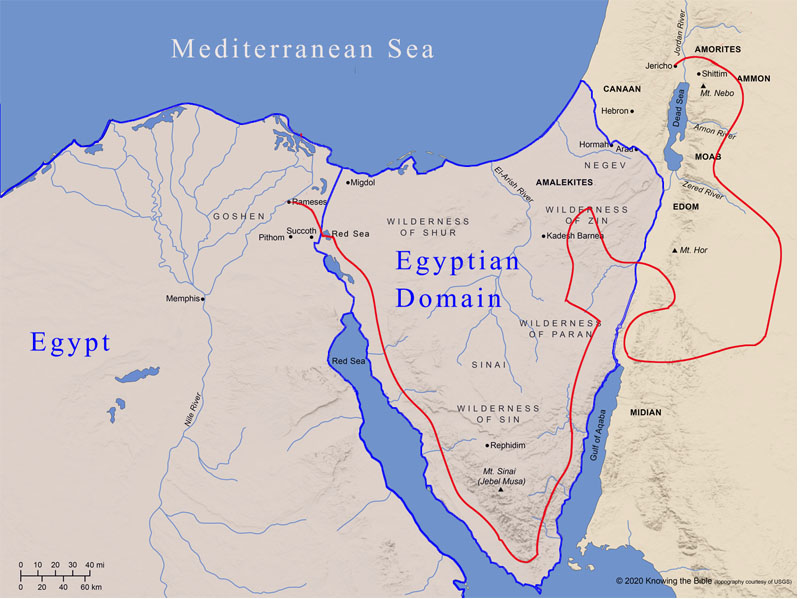
Genesis 12:1-3 Now the Lord had said to Abram: "Get out of your country, From your family And from your father's house, To a land that I will show you. I will make you a great nation; I will bless you And make your name great; And you shall be a blessing. I will bless those who bless you, And I will curse him who curses you; And in you all the families of the earth shall be blessed." Because of the faith of Abraham, God promised his descendants will be a blessing to all nations. After centuries of living as slaves in a foreign land, the Israelites transitioned from a people into a nation. And from this nation will come the Messiah. Galatians 3:16 Now to Abraham and his Seed were the promises made. He does not say, "And to seeds," as of many, but as of one, "And to your Seed," who is Christ. The children of Israel left Egypt as the Lord had commanded them and God did for them as he promised. At this point, they became a nation under the charge of the Lord.1 Then the Lord spoke to Moses, saying, "Consecrate to Me all the firstborn, whatever opens the womb among the children of Israel, both of man and beast; it is Mine." Israel had been spared from the destruction of Egypt's firstborn because they had been chosen as the Nation of God. If the firstborn was male, it was to be consecrated to the Lord. If the first born was female, then subsequent males were exempt. 3 And Moses said to the people: "Remember this day in which you went out of Egypt, out of the house of bondage; for by strength of hand the Lord brought you out of this place. No leavened bread shall be eaten. On this day you are going out, in the month Abib. Abib means spring. This was originally the term in Hebrew referring to the barley grain that was about to spring forth from the stalk. When God delivered His people, He chose to commemorate their new beginning by introducing a new "new year." So the first month of the Jewish calendar became known as the month of Nisan, a Babylonian name, but in Hebrew it was called Abib (pronounced "Aviv"). 5 And it shall be, when the Lord brings you into the land of the Canaanites and the Hittites and the Amorites and the Hivites and the Jebusites, which He swore to your fathers to give you, a land flowing with milk and honey, that you shall keep this service in this month. According to the scriptures, there were seven nations that lived in the land of Canaan prior to the arrival of the Israelites. The seven nations are all descendants of Canaan, son of Ham and grandson of Noah, from whom they derive their collective name Canaanites. When enumerated separately, one of the seven nations is called Canaanites, while the others are called the Amorites, the Girgashites, the Hittites, the Hivites, the Jebusites and the Perizzites. Only five nations are mentioned here. Canaanite is generic and included all the Hamite races of Palestine. The people of Canaan were idolatrous and superstitious so the Israelites were to avoid them. 6 Seven days you shall eat unleavened bread, and on the seventh day there shall be a feast to the Lord. Unleavened bread shall be eaten seven days. And no leavened bread shall be seen among you, nor shall leaven be seen among you in all your quarters. Israel was commanded to celebrate the Feast of Unleavened Bread for seven days after Passover. Leavened bread was made by taking a bit of old fermented dough and working it into new dough. The old yeast would cause the new dough to ferment and rise. The Egyptians urged the Israelites to leave in haste, so they could not add yeast to the dough and carried it on their shoulders in kneading troughs wrapped in clothing. Since they had no time to prepare any other food, they baked loaves of unleavened bread made from the dough without yeast. Every year, at this feast, Jewish families celebrate the Feast of Unleavened Bread, by removing all leaven from their homes and eat unleavened bread for seven days to remember the suffering they went through from when they left Egypt until they crossed the Red Sea. So, unleavened bread is also called the "bread of affliction". 8 And you shall tell your son in that day, saying, 'This is done because of what the Lord did for me when I came up from Egypt.' It shall be as a sign to you on your hand and as a memorial between your eyes that the Lord's law may be in your mouth; for with a strong hand the Lord has brought you out of Egypt. You shall therefore keep this ordinance in its season from year to year. Many Orthodox Jews practice wearing phylacteries on their forehead or hand as signs or remembrances. These small pouches hold parchment with portions of Exodus 13 scriptures on them, and are held on with leather straps. Revelation 14:1 And I looked, and, lo, a Lamb stood on the mount Sion, and with him an hundred forty and four thousand, having his Father's name written in their foreheads. Satan is the great imitator, the master deceiver, the arch counterfeiter, and the great forger. The seal of God is a sign of God's ownership and protection, given to true worshipers of God while the mark is given to worshipers of the beast, and those who refuse to join in this false worship of the beast will be killed. Revelation 13:16-17 He causes all, both small and great, rich and poor, free and slave, to receive a mark on their right hand or on their foreheads, and that no one may buy or sell except one who has the mark or the name of the beast, or the number of his name. 11 "And it shall be, when the Lord brings you into the land of the Canaanites, as He swore to you and your fathers, and gives it to you, that you shall set apart to the Lord all that open the womb, that is, every firstborn that comes from an animal which you have; the males shall be the Lord's. But every firstborn of a donkey you shall redeem with a lamb; and if you will not redeem it, then you shall break its neck. And all the firstborn of man among your sons you shall redeem. The Israelites were to sacrifice every to the Lord the firstborn male of their clean domestic animals: cattle, sheep and goats. An unclean animal, such as a donkey being a beast of burden, could not be sacrificed. The word redeem means "buy back." If a family's firstborn donkey was critical to their livelihood, they could buy it back from God by offering a lamb in its place. The Israelites were required to sacrifice their firstborn males to the Lord, including their firstborn sons. God did not demand that His people offer their firstborn children as literal human sacrifices. The firstborn son was dedicated for holy service, for the sacred ministrations of the priestly office. This was in force until the Levis were selected to be the priests. However If a father wanted to exempt his son from service, he could redeem him by presenting an offering of five silver coins. God only accepts perfect, clean sacrifices. Man is compared to a donkey in the scriptures. We are unclean (sinful) before God. A sacrifice must be made to redeem us just as the donkey had to be redeemed. Jesus became our Sacrificial Lamb for our redemption which ended animal sacrifices for the sins of man. 14 So it shall be, when your son asks you in time to come, saying, 'What is this?' that you shall say to him, 'By strength of hand the Lord brought us out of Egypt, out of the house of bondage. And it came to pass, when Pharaoh was stubborn about letting us go, that the Lord killed all the firstborn in the land of Egypt, both the firstborn of man and the firstborn of beast. Therefore I sacrifice to the Lord all males that open the womb, but all the firstborn of my sons I redeem.' It shall be as a sign on your hand and as frontlets between your eyes, for by strength of hand the Lord brought us out of Egypt." It is the duty of all Jewish parents to instruct their children in the word and works of God. God had spared the firstborn of Israel's people and animals in the Passover judgment. The Israelites were to acknowledge this by dedicating, or setting apart, their firstborn to God in an act of thankful worship. This act also symbolized the dedication of the entire redeemed nation to God, since Israel as a whole was God's firstborn.17 Then it came to pass, when Pharaoh had let the people go, that God did not lead them by way of the land of the Philistines, although that was near; for God said, "Lest perhaps the people change their minds when they see war, and return to Egypt." So God led the people around by way of the wilderness of the Red Sea. And the children of Israel went up in orderly ranks out of the land of Egypt. The most direct route into the Promised land was through the land of the Philistines which ironically is Gaza today. They occupied the coastal plain and were among Israel's avowed enemies. God proportions his people's trials to their strength. The Philistines were a strong and warlike people. After four centuries of slavery, the Israelites would have been an ill match for the Philistines. Engaging the Philistines would have discouraged or dismayed the unwarlike band which Moses led. God chose to lead his people through the wilderness for several reasons: To strengthen their faith, to demonstrate His faith and protect them so they will learn to depend on God, and to increase their military strength. 19 And Moses took the bones of Joseph with him, for he had placed the children of Israel under solemn oath, saying, "God will surely visit you, and you shall carry up my bones from here with you." At the end of his life, Joseph demonstrated his faith that God would fulfill His promise to give the land of Canaan to His people and so he told the nation to take his bones with them when they left Egypt. He did not want his body to be buried in exile but rather to be buried in the Promised Land.20 So they took their journey from Succoth and camped in Etham at the edge of the wilderness. And the Lord went before them by day in a pillar of cloud to lead the way, and by night in a pillar of fire to give them light, so as to go by day and night. He did not take away the pillar of cloud by day or the pillar of fire by night from before the people. Genesis 33:17 And Jacob journeyed to Succoth, built himself a house, and made booths for his livestock. Therefore the name of the place is called Succoth. The word Succoth means "booths" or "tents", indicating a temporary dwelling. Succoth is located west of the Jordan, sometimes used as a boundary word to indicate the outer reaches of the Promised Land. God used the cloud by day and fire by night to lead the people in the way in which they should go. However, it provided much more than just direction. Deserts in Israel are renowned for their extreme temperatures, with the average temperature ranging from 24° to 107° Fahrenheit. During the day, the heat can be intense, and during the night, the temperatures can dip to freezing levels. Having the cloud to cover the harsh heat from the sun and the warming of the fire by night would provide protection for the people. Bible Study Questions 1. What did the Lord tell Moses to consecrate?
2. The Lord was bringing the Israelites into what?
3. How long did God tell the Israelites to eat unleavened bread?
4. What shall be done with a firstborn male donkey? 5. What are Jewish parents to tell their son when he asks, "What is this?"
6. Who did God have the Israelites avoid?
7. Where did God lead the people?
8. What did Moses take on the journey?
9. Where did the Israelites first stop first after they left Egypt?
10. By what method did God lead His people?
|
| Cassie, Matt, Sue | |