Exodus 1 – Jacob's Family Stays in Egypt
Timeline: 1530 BC
|
Resources |
Shem was the oldest son of Noah who received the first-born blessing. He was considered "blameless in his days". The Israelites and the Jewish nation sprang from the line of Shem and are considered Semites. Ham was the youngest son who had sinned against Noah. In turn, Noah cursed Canaan, Ham's son, who became the ancestor of the Canaanites, the group that inhabited the land of Canaan. Jesus quoted from each of the 5 books of Moses and attributed them to Moses proving that Moses is the author. Psalms and Isaiah are the only books that are quoted more than Exodus. 1 Now these are the names of the children of Israel who came to Egypt; each man and his household came with Jacob: Reuben, Simeon, Levi, and Judah; Issachar, Zebulun, and Benjamin; Dan, Naphtali, Gad, and Asher. All those who were descendants of Jacob were seventy persons (for Joseph was in Egypt already). And Joseph died, all his brothers, and all that generation. But the children of Israel were fruitful and increased abundantly, multiplied and grew exceedingly mighty; and the land was filled with them. The twelve tribes of Israel originated from the sons of Jacob, whom God renamed Israel. Together, their descendants multiplied into the nation of Israel, eventually dividing into distinct territories and playing unique roles within the ancient Hebrew kingdom.
The majority of the four hundred years the Hebrews were in Egypt were prosperous and favored. By the forth generation from Abraham, they had grown into thousands. During this time, they maintained distinct separation from the Egyptians, kept their own language and names, and actively avoided Egyptian worship. 8 Now there arose a new king over Egypt, who did not know Joseph. A new Egyptian dynasty arose that did not respect or acknowledge Joseph's previous contributions to Egypt, nor intend to continue the previous regime's benign policies toward the Hebrew settlers. The new Pharaoh felt threatened by their sheer numbers and forced them into severe, brutal labor, using them to build treasure cities.
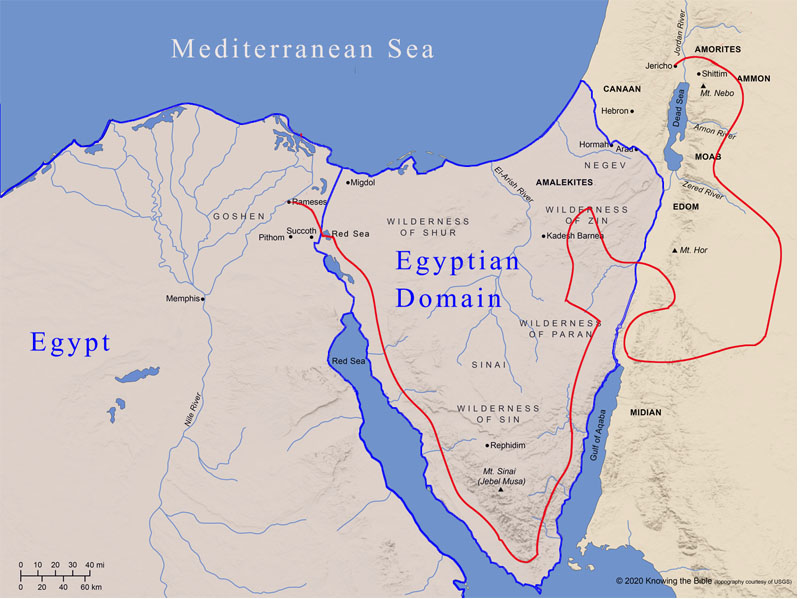
9 And he said to his people, "Look, the people of the children of Israel are more and mightier than we; come, let us deal shrewdly with them, lest they multiply, and it happen, in the event of war, that they also join our enemies and fight against us, and so go up out of the land." In 1275 B.C, the Pharaoh had waged war against the Hittites of the north and had won a resounding victory. The Pharaoh feared retaliation. If the children of Israel, who lived in the northern part of Egypt, joined with the Hittites, they would become a significant threat to their security. 11 Therefore they set taskmasters over them to afflict them with their burdens. And they built for Pharaoh supply cities, Pithom and Raamses. The area near Goshen is referred to as Pithom and Raamses. Pithom was named after the sun-god, one of the "treasure" cities built for the Pharaoh. Archaeologists have discovered of the ruins of Pithom which confirms the Hebrew people's Exodus from Egypt in an undeniable way. The Biblical statement and evidence points to Raamses II as the Pharaoh that oppressed Israel. 12 But the more they afflicted them, the more they multiplied and grew. And they were in dread of the children of Israel. So the Egyptians made the children of Israel serve with rigor. And they made their lives bitter with hard bondage—in mortar, in brick, and in all manner of service in the field. All their service in which they made them serve was with rigor. This Pharaoh implemented a plan to oppress the Hebrews. If the nation lost a generation of boys, then the girls would married native men and would have been assimilated, therefore, the Hebrew nation would be no more. However, God implemented His own plan. The more the children of Israel were oppressed, the more their numbers increased. "The blood of martyrs is the seed of the Church," wrote the second-century Church Father, Tertullian. Whenever God's people are oppressed, they are made stronger. When Jesus' disciples were oppressed and martyred, the Gospel spread even more. Today there are more than 60 million Christians in China in spite of the persecution. Similarly, around a third of South Koreans are Christians. Iranians have also found themselves pressured, coerced, imprisoned, threatened with death, or executed, and yet, Iran has the largest number of believers to have embraced the Christian faith from across the Islamic world. Abraham, Isaac and Jacob lived for more than 200 years, increasing to only seventy persons plus their wives and grandsons, and the husbands of his daughters and granddaughters. The majority of the four hundred years the Hebrews were in Egypt were prosperous and favored. By the forth generation, they had grown into thousands. Now the time had come for them to fulfill the predictions given to Abram by God for them to go out of the land of Egypt and into the Promised land. The only way they would have been willing to leave such a comfortable way of life was if Goshen became less attractive. God determined that the sinful Canaanite people would receive their judgment at the hands of the Jewish people. It was time for them to make their journey home. 15 Then the king of Egypt spoke to the Hebrew midwives, of whom the name of one was Shiphrah and the name of the other Puah; and he said, "When you do the duties of a midwife for the Hebrew women, and see them on the birthstools, if it is a son, then you shall kill him; but if it is a daughter, then she shall live." But the midwives feared God, and did not do as the king of Egypt commanded them, but saved the male children alive. So the king of Egypt called for the midwives and said to them, "Why have you done this thing, and saved the male children alive?" And the midwives said to Pharaoh, "Because the Hebrew women are not like the Egyptian women; for they are lively and give birth before the midwives come to them." Therefore God dealt well with the midwives, and the people multiplied and grew very mighty. And so it was, because the midwives feared God, that He provided households for them. Shiphrah and Puah were probably in charge of all the other midwives. They were faithful to God and when the law of man supersedes the law of God, they chose to obey God. Because of God's blessing, it may be that the women had quick and easy labor and the mothers rarely needed the help of the midwives. Also, perhaps the midwives purposefully took their time getting to the Hebrew women so that the babies were born before they arrived. God blessed the midwives. He gave them husbands and families as rewards for their faithfulness. 22 So Pharaoh commanded all his people, saying, "Every son who is born you shall cast into the river, and every daughter you shall save alive." Pharaoh decreed for the mass genocide of all infant Jewish males. A similar act was done following the birth of Jesus in Bethlehem when King Herod sought to kill the baby Jesus to remove any threat of another king. Inadvertently, this creates the very situation which leads to the rise of Israel's deliverer, Moses. Bible Study Questions 1. How many descendants of Jacob came to Egypt not including their household?
2. What nationality was the Pharoah who did not know Joseph?
3. What did Pharoah fear about the children of Israel?
4. What were the slave drivers called? 5. The Egyptians made the children of Israel serve with what?
6. Who were the midwives?
7. What did Pharoah tell the midwife?
8. Why didn't the midwives obey Pharoah?
9. What happened to the Hebrews when they were oppressed?
10. When the first oppression didn't work, what did Pharaoh do next?
|
| Cassie, Matt, Joe, Noah, Sue, Steve | |